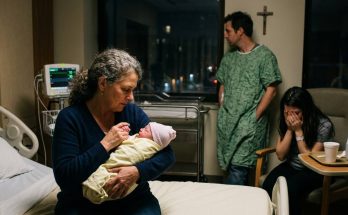
Years later, the house was quieter.
Not empty.
Never empty.
Just quieter.
Elise had finished university and begun working in adaptive design. She traveled often, complained about airports, called her mother when she encountered a problem she couldn't solve, and still arrived home with too much luggage.
Harper's company had continued growing, but she had kept its original promise.
No child was treated as a marketing story.
No family was required to perform gratitude.
No device was presented as a cure for being different.
The research center remained busy.
Harper still visited.
Sometimes she spent hours in meetings.
Sometimes she tightened a screw on a prototype herself.
Sometimes she simply sat with parents who had just received news they had never expected.
She never pretended fear wasn't real.
She only refused to let fear speak for the child.
One afternoon, a young couple came to see her.
Their baby had been born without one hand.
The father looked exhausted.
The mother held the baby against her chest.
Neither knew what to ask.
Harper sat across from them.
“What have the doctors told you?”
They explained.
She listened.
Then she asked, “What do you know about your baby?”
The mother looked confused.
“She is healthy.”
“What else?”
“She likes being held.”
The father gave a small smile.
“She grabs my shirt.”
Harper smiled.
“There you are.”
The mother looked down at the baby.
Harper did not give them a speech.
She showed them equipment.
She gave them names of specialists.
She explained what might be difficult and what might not be.
And before they left, she said one thing.
“You don't have to know who she will become.”
The father looked at her.
“You don't?”
“No.”
“What do we do?”
Harper looked at the baby.
“You get to know her.”
The mother began crying.
Harper understood.
She had heard those tears before.
She had lived inside the uncertainty they represented.
But uncertainty was not tragedy.
Sometimes it was simply the beginning of a life nobody had written yet.
That evening, Harper called the narrator.
They spoke every day now.
Sometimes for an hour.
Sometimes for five minutes.
Today they talked for nearly forty.
“Did you help another family?” the narrator asked.
“Yes.”
“Good.”
“How did you know?”
“I know you.”
Harper smiled.
“I'm coming over tomorrow.”
“Bring dinner.”
“I always bring dinner.”
“You bring salad.”
“Salad is dinner.”
“No.”
Harper laughed.
The next day she arrived with too much food.
David and Sarah came too.
Daniel brought dessert.
Elise arrived late.
The table was crowded.
People talked over one another.
David told a story that Elise had heard six times.
Sarah corrected him.
Daniel laughed.
Harper tried to stop everyone from arguing about the dessert.
The narrator sat at the center of it all.
She looked around the table.
For a moment, she remembered the tiny baby she had once carried home.
She could almost feel the weight of her.
Almost.
But memory was strange.
The baby had been real.
So was the woman sitting across the table.
Both belonged to the same life.
After dinner, Elise helped the narrator wash dishes.
“Grandma,” she said, “Mom told me something when I was little.”
“What?”
“That when she was born, Grandpa wanted another family to take her.”
The narrator nodded.
“I know.”
Elise dried a plate.
“She said you stayed.”
“I did.”
“Why?”
The narrator smiled.
“Because somebody had to.”
Elise looked at her.
“I think that's too simple.”
“Sometimes simple is enough.”
“No.”
Elise placed the plate down.
“I think you saw her.”
The narrator's eyes softened.
“Yes.”
“You saw her before you saw everything else.”
The narrator looked toward the dining room.
Harper was talking to David.
Sarah was listening.
Daniel was teasing Elise.
The room was warm.
Alive.
“Yes,” the narrator said. “I did.”
Later, Harper and the narrator sat together outside.
The night was clear.
Neither spoke for a while.
Then Harper said, “I used to think you saved me.”
The narrator smiled.
“I didn't.”
“I know.”
“You saved yourself.”
Harper shook her head.
“I was a baby.”
“You grew.”
“That isn't the same thing.”
“No.”
Harper looked at her.
“You gave me the chance.”
The narrator considered that.
“Yes.”
“That's what I wanted to say.”
“I know.”
Harper smiled.
“You always do that.”
“Do what?”
“Answer before I finish.”
“Age gives me advantages.”
Harper laughed.
Then she became serious.
“I'm glad you didn't know what I'd become.”
“Why?”
“Because if you had known, maybe you would have chosen me because you believed I'd become extraordinary.”
The narrator shook her head.
“I didn't.”
“I know.”
“You were a baby.”
Harper smiled.
“Exactly.”
The silence returned.
After a while, Harper said, “Do you regret anything?”
The narrator looked toward the house.
“Yes.”
Harper waited.
“I regret that you had to carry things you should never have had to carry.”
Harper nodded.
“I regret that your parents were frightened enough to leave.”
Another nod.
“I regret that the world still makes children explain themselves.”
Harper reached for her hand.
“But you don't regret taking me.”
The narrator looked at her.
“Never.”
Harper squeezed her fingers.
That was enough.
Inside, Elise was showing Daniel a new design.
David was arguing about something.
Sarah was laughing.
The sound reached them through the open door.
Harper stood.
“Come inside.”
“In a minute.”
“You always say that.”
“Because I like sitting here.”
Harper smiled.
“Then I'll wait.”
The narrator looked at her.
“You don't have to.”
“I know.”
Harper sat back down.
They stayed together beneath the old tree.
The narrator thought about the first night.
The hospital.
The bassinet.
David looking away.
Sarah crying.
The tiny hand that had closed around her finger.
She remembered how little she had known.
She had not known whether Harper would walk.
Whether she would ride a bike.
Whether she would have friends.
Whether she would fall in love.
Whether she would have children.
Whether she would become an engineer.
Whether she would build a company.
Whether she would stand in that same hospital decades later and tell a room full of people that a baby was not a forecast.
She had known none of it.
And that had been the beauty of it.
A child's life was not supposed to arrive with a completed map.
It was supposed to unfold.
Harper had unfolded.
Not according to anyone's prediction.
According to herself.
The narrator looked at her granddaughter.
“Do you remember what I told you when you were little?”
Harper smiled.
“You told me a lot of things.”
“The important one.”
Harper thought.
“You said I could become whoever I became.”
“Yes.”
“And you meant it.”
“I did.”
Harper looked toward the house.
“Elise will be okay.”
“She will.”
“Even when she isn't.”
The narrator smiled.
“Especially then.”
Harper leaned her head against her grandmother's shoulder.
For a few minutes they watched the porch light glow against the dark.
Then Elise opened the door.
“Mom! Grandma! Come inside!”
Harper stood first.
The narrator followed more slowly.
At the doorway, Harper turned back once.
The tree.
The chairs.
The quiet yard.
Everything ordinary.
Everything precious.
She understood now that the most important thing her grandmother had ever done was not rescue her from a terrible beginning.
It was refusing to let that beginning become a verdict.
A frightened father had made a terrible choice.
A frightened mother had made another.
A grandmother had made a different one.
And Harper, year after year, had made thousands of choices of her own.
None of them could erase what came before.
None needed to.
She walked inside.
Elise handed her a plate.
Daniel complained that everyone had abandoned him with the dishes.
Sarah laughed.
David reached for another piece of bread.
The narrator took her usual chair.
Harper sat beside her.
The room settled around them.
There were no speeches.
No applause.
No final lesson anyone needed to announce.
Only a family that had once been broken by fear and had, slowly and imperfectly, learned how to stay.
And if there was one thing the narrator knew with absolute certainty, it was this:
Fear is not wisdom.
Pity is not love.
A diagnosis is not a destiny.
A frightened parent can make a terrible choice without that choice becoming the child's future.
And sometimes the most important thing a person can do is simply stay long enough for another person to discover who they are.
The narrator looked at Harper.
Harper smiled.
Then they turned back toward the table, toward the people they had chosen, toward the life that none of them had been able to predict.
And stayed.
The End
Read more original stories on Feel Every Story.
The Room Went Quiet When My Son Looked at His Newborn Daughter and Decided Her Difference Was a Reason to Let Her Go
Part 20 of 20