I wish I could say that by the end of that week, I had discovered the truth.
I hadn't.
I had a series of troubling facts, a stack of documents, and a memory of a voice that I could not forget.
I did not have a complete explanation.
That distinction mattered.
For two years, I had believed that Arthur died in the collision on Interstate 55.
I had accepted the identification process.
I had received his ashes.
I had held a memorial service and tried to build a life around the absence he left behind.
I had done all of that honestly.
I had not pretended to grieve.
I had not hidden some secret knowledge about his fate.
I believed he was dead because that was what I had been told.
Now I knew that belief was no longer enough to settle the matter.
The woman had entered my house with a key.
She had searched Arthur's old documents.
She had spoken to a man about an insurance endorsement.
The voice had sounded like my husband's.
Those facts remained true, even though I could not yet explain them.
I kept the folder.
I kept the notes.
I stopped moving Arthur's papers from one drawer to another in the hope that a hidden answer would suddenly appear.
I had searched what I knew how to search.
I had reached the limit of what I could learn by myself from the same documents.
That was difficult to admit.
I wanted the truth to be sitting in an envelope somewhere, waiting for me to find it.
I wanted a page with a name on it.
I wanted a document that would explain why the woman had come and who she had called.
Instead, I had to face the possibility that the answers depended on people and events I did not yet understand.
I could not make those answers appear simply by staring at the papers.
I also could not return to the way I had lived before.
The house was still my house.
The kitchen was still the place where Arthur used to make coffee.
The bedroom was still the room where I had hidden beneath the bed, holding my phone and listening to a stranger search my dresser.
The details had not changed.
My understanding of them had.
I had once thought the locked front door meant I was safe from strangers.
Now I knew someone had a key.
I had once thought Arthur's belongings were reminders of a life that had ended.
Now I knew someone was still searching among them for something important.
I had once believed the account of his death was settled.
Now I had a reason to question it.
I did not know whether Arthur was alive.
I could not honestly say that I had proved he was.
But I could no longer say that I knew he was dead in the way I had believed for two years.
The difference between those statements was small in words.
It was enormous in my life.
I thought about the memorial service.
I remembered the people who had come to offer their condolences.
I remembered the expressions on their faces.
I remembered standing there and trying to understand how a person could be present in so many memories and yet be gone.
I had accepted the ashes as the final physical reminder of him.
I had never questioned what I had been given.
I had never imagined that I might need to revisit the circumstances surrounding it.
I still did not know whether the identification had been wrong or whether some other explanation existed.
I wasn't going to pretend I knew.
That was one thing the experience had taught me.
Fear could make a person leap toward an answer because uncertainty felt unbearable.
Grief could make a person cling to an answer because the alternative was too painful.
I had done both.
I had tried to dismiss the woman's visit because I didn't want to believe it meant anything.
Then I had begun to imagine what it might mean because I desperately wanted an explanation.
Neither reaction could replace evidence.
I had to be willing to remain uncertain.
That did not mean doing nothing.
It meant treating what had happened seriously without claiming to know more than I did.
The woman had been inside my house.
She had been looking for something.
She had left without finding it.
I had no reason to believe she would never return.
I could not assume that the next visit would be as uneventful as the first.
The locks were secure, but I knew they were not enough if someone already possessed a key.
I kept my phone close.
I paid attention to the doors.
I no longer ignored small changes in the house.
And I stopped telling myself that I was imagining things simply because I could not explain them.
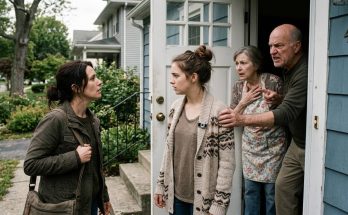
Mrs. Gable's complaint had started all of this.
At first, I had been irritated by her accusation.
I thought she was mistaken.
I thought she had heard something from another house and decided it was mine.
I had wanted the problem to belong to someone else.
Now I understood why she had been so insistent.
She had heard a woman screaming.
She had heard something strike a wall.
She had noticed something wrong and refused to pretend otherwise.
I was grateful she had spoken to me.
I was also ashamed that my first response had been to defend the appearance of my life rather than investigate what might be happening inside it.
I had believed my home was empty because I believed I lived alone.
I had believed Arthur was dead because I had been told he was.
I had treated both beliefs as facts that required no further examination.
The woman with the red handbag had shattered that certainty.
I still saw the bag whenever I looked at the reading chair.
I still heard the heels crossing the bedroom carpet.
And I still remembered the man's question about the insurance endorsement.
Most of all, I remembered the voice.
I could not make myself forget it.
I did not know whether the voice belonged to Arthur.
I did not know who the woman was.
I did not know what document she had hoped to find.
Those were the questions I carried forward.
I would not invent answers to make the story easier to bear.
I would not turn my suspicion into certainty.
And I would not return to the comfort of believing that the past could never change.
For two years, I had thought my greatest task was learning to live without my husband.
Now I understood that I had another task.
I had to find out what had happened to him, and why someone was still searching my home for something connected to his life.
Until I had answers, I could not call the matter settled.
I could not call my fear proof.
And I could not call my grief the end of the story.
I was still Clara Hayes.
I was still thirty-nine years old.
I still lived in the same suburban Chicago house where I had tried to rebuild my life after the accident.
But I no longer believed that the life I remembered was the whole truth.
The Seahawks mug remained on the kitchen counter.
The folder remained where I had placed it.
The front door stayed locked.
And somewhere beyond the walls of my house were answers I did not yet have.
I had spent two years believing the dead stayed dead.
Now I knew only that I had been told my husband was one of them.
I had to find out whether that was the truth.
The End
Read more original stories on Feel Every Story.
My Neighbor Said She Heard Someone Screaming in My Empty House, and I Had No Idea Who Could Be Inside
Part 12 of 12