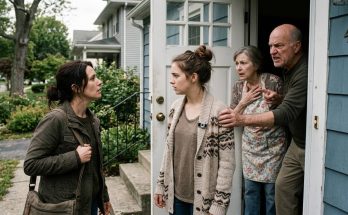
I had imagined many versions of returning to my parents' house.
In some, my father would refuse to speak to me.
In others, my mother would cry.
I had even imagined that one of them might admit that throwing me out had been wrong.
I had never imagined the young woman at the door.
I had not expected to see a face that reminded me so sharply of my own.
I had not expected her to call my father Grandpa.
And I had not expected to discover that she had never heard of me.
Those facts had changed the way I understood the visit, even though they had not answered the question that brought me back.
I still did not know what happened to my daughter after the transfer.
I still did not have a death certificate.
I still did not have a burial record or the name of a funeral home.
I still had only the hospital paperwork and the account my parents had given me when I was seventeen.
I could not honestly say that I knew my parents had lied.
I could not honestly say that the young woman was my daughter.
I had no proof for either conclusion.
That was the hardest thing to accept.
I wanted the details to fit together.
I wanted the dimple, the nervous gesture, and the young woman's age to mean something definite.
I wanted my mother's pale face and my father's anger to explain themselves.
But wanting those things did not make them true.
I had learned that lesson too late once already.
I would not repeat the mistake by deciding what the truth had to be before I found it.
What I knew was enough to change my next step.
I had questions that needed answers.
The hospital document recorded a transfer.
My parents had told me my daughter died afterward.
I had never received the records that would confirm that account.
I had spent twenty years accepting their explanation without knowing whether it was complete.
Now I was no longer willing to do that.
I also knew that my parents might never give me what I wanted.
My father had made that clear.
He had seen me on his doorstep and demanded that I leave.
He had not asked about my life.
He had not asked what I had found.
He had not shown any willingness to discuss the daughter he had sent away.
My mother had looked at me with an expression I could not forget, but she had not explained it.
I could not force either of them to speak honestly.
I could not make them acknowledge the pain they had caused.
And I could not spend another twenty years waiting for them to decide that I deserved an answer.
That was what I had finally understood.
When I was seventeen, I had believed that losing my parents meant losing my place in the world.
I had stood in the rain and waited for the door to open.
I had thought that if I stayed there long enough, they might remember I was their daughter.
They had not opened the door.
For a long time, I had carried that moment as proof that I was somehow unworthy of being kept.
I had been wrong.
Their decision had been theirs.
It had not determined my value.
I had gone on to build a life in Seattle.
I had learned to care for myself.
I had survived the grief of losing a child I believed had died.
I had lived through birthdays, holidays, and ordinary days without the people who were supposed to help me grow up.
I had done all of that without my parents' approval.
I could continue seeking answers without it, too.
The thought did not erase the hurt.
I still wished my mother had come outside that night.
I still wished my father had offered help instead of rejection.
I still wished they had made sure I understood what happened to my daughter.
Those wishes remained.
But I no longer needed to make my future depend on whether they ever fulfilled them.
I thought about the young woman.
I hoped she would ask questions of her own.
She had learned that her grandparents had a daughter she had never known about.
That was a difficult thing to discover without warning.
I could not know how she would respond.
She might accept what I told her.
She might doubt it.
She might decide she needed to hear the story from my parents.
I could not blame her for any of those reactions.
I had been a stranger to her when I arrived.
A woman claiming to be her grandparents' daughter had appeared at the door after twenty years of absence.
I understood why she had been confused.
If our paths crossed again, I would tell her what I knew and be honest about what I did not.
I would not tell her that I had proof of something I could not prove.
I would not demand that she believe me because we shared a dimple or a nervous habit.
And I would not ask her to choose between me and the people she called family.
I wanted the truth.
I did not want to take away her right to discover it for herself.
I also knew that I could not undo the way my parents had treated me.
Whatever they had told the young woman, whatever they had chosen not to say, the night I was thrown out remained part of my life.
The rain had been real.
The backpack had been real.
My father's words had been real.
The porch light going dark had been real.
I had not imagined those things.
I had been seventeen and pregnant, and my parents had sent me away.
Nothing I learned later could make that decision disappear.
If the truth about my daughter turned out to be different from what I had believed, I would have to face that.
If it confirmed the loss I had spent twenty years grieving, I would have to face that, too.
Neither possibility would change the fact that I had deserved care when I was young.
Neither would make my parents' rejection acceptable.
I had spent too many years tying those things together.
I had thought that if I could understand why my parents abandoned me, I might finally understand everything that followed.
But their treatment of me and the truth about my daughter were separate matters.
I could seek answers to both without allowing one to excuse the other.
I could acknowledge that my parents might have had their own fears or regrets without pretending that those feelings justified what they had done.
And I could admit that I still wanted my mother to explain herself without making that explanation a condition of my healing.
That was not forgiveness.
Not yet.
Perhaps not ever.
It was simply a decision to stop waiting for my parents to tell me how to understand my own life.
I picked up the hospital envelope one last time.
The plastic wristband rested inside.
I remembered how young I had been when it was placed on my wrist.
I remembered how little I understood.
For years, I had thought of that envelope as a container for the last pieces of a life that had ended before I could know it.
Now I saw it differently.
It held the information I had.
It also showed me what I was missing.
That was enough to begin.
I would keep the papers.
I would continue seeking the records that might explain what happened after the transfer.
I would not assume that my parents' account was true simply because they had repeated it.
I would not assume it was false simply because the young woman at the door looked familiar.
I would let the evidence determine what I could believe.
And whatever I learned, I would face it as the woman I had become.
Not as the frightened girl who had stood outside in the rain.
I thought about that girl often.
I wished I could tell her that she would survive.
I wished I could tell her that one day she would return to the house, not because she needed her parents to let her in, but because she had questions she deserved to ask.
I wished I could tell her that the answers might be complicated.
I could not promise her that the people who hurt her would ever make things right.
But I could tell her that she did not have to spend the rest of her life waiting for them.
The night they threw me out, my parents had treated their decision as final.
They had closed the door and turned off the light.
For twenty years, I had let that door remain closed in my mind.
Now I had gone back.
I had knocked.
I had faced my father, looked at my mother, and spoken to the young woman who had opened the door.
I had not received the answers I wanted.
But I had stopped pretending that the questions did not matter.
The truth about my daughter remained unresolved.
The young woman's resemblance remained unexplained.
My parents' silence remained their choice.
Those were the facts I had to live with at the end of that visit.
I could not force them into a different shape.
I could only decide what to do next.
For the first time in twenty years, I was ready to keep looking without waiting for my parents to lead me.
I had returned to the house believing I needed them to explain my past.
I left understanding that I could ask for the truth without surrendering my life to their refusal.
And I would not let that door close on my questions again.
The End
Read more original stories on Feel Every Story.
I Thought Losing My Parents Was the Worst Thing That Could Happen to Me, Until I Questioned What They Told Me About My Baby
Part 12 of 12