I kept the hospital envelope beside me the following morning.
I had put it away the night before, but I brought it out again before I had even finished my coffee.
I needed to stop thinking in circles.
The young woman at my parents' house had unsettled me, but I couldn't let her face become the answer to a question I had not yet investigated.
I needed facts.
I looked at the transfer document again.
The information was plain enough to understand.
My premature daughter had been transferred to another medical center across town.
That was the part I could verify from the paper in front of me.
My parents had told me she died shortly afterward.
That was the part I had accepted for twenty years without having the supporting records in my possession.
I had no death certificate.
No burial record.
No name of a local funeral home.
I had the hospital paperwork, my old plastic wristband, and my memory of what my parents had told me when I was seventeen.
I couldn't change the past by wishing I had asked more questions.
But I could stop pretending that I had all the answers.
I began sorting through the papers again, separating what I knew from what I had assumed.
It was a simple exercise.
It was also harder than I expected.
For years, the events had existed in my mind as one continuous story.
The pregnancy.
The rejection.
The birth.
The transfer.
The death.
I had never considered how much of that sequence depended on information supplied by other people.
I knew I had been pregnant.
I knew my parents had thrown me out.
I knew my daughter had been born prematurely and transferred.
I knew I had been told she died.
But I could not produce a record confirming the final event.
That distinction mattered.
It did not prove my parents had deceived me.
It did mean I had to find out more before I could keep calling the matter settled.
I looked at the plastic wristband.
It was still the same small strip I had kept all those years.
I remembered being too young to understand what was happening around me.
I remembered feeling that everyone else knew what to do while I was struggling to understand what was being said.
When my parents gave me the news, I had been in no condition to demand a complete explanation.
I had been grieving.
I had been heavily medicated.
I had believed them because I needed something definite to hold on to, even if that something was terrible.
I had not known how to question them.
Now I wished I could go back and tell that girl that needing an answer was not the same as refusing to accept a loss.
I wished I could tell her that she was allowed to ask what had happened.
But I couldn't return to that hospital room.
I could only do what I should have been able to do then.
I could ask now.
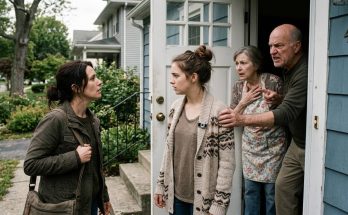
I thought about returning to my parents' house.
The memory of my father's face made me hesitate.
He had not changed much in the ways that mattered.
He had seen me, recognized me, and ordered me away.
My mother had gone pale.
When I mentioned my daughter, both of them had reacted in ways I could not understand.
I could have driven back and knocked again.
But I already knew what my father would probably say.
He would tell me to leave.
If I went back without new information, I risked repeating the same encounter and leaving with nothing.
I did not want to keep giving him the opportunity to end the conversation before it began.
I wanted something concrete to ask about.
Something he could not dismiss merely by saying I had misunderstood.
I also wanted to understand what had happened to the young woman.
She had never known I existed.
That fact remained lodged in my mind.
I kept returning to the way she had looked at my surname.
She had repeated it as if it were unfamiliar in connection with me.
Then she had looked at my parents, waiting for them to explain.
They hadn't.
I wondered what they had said to her after I left.
Had they told her who I was?
Had they explained why I had returned?
Had my father simply insisted that the subject was closed?
I could imagine several possibilities.
None was reliable enough to become a conclusion.
I had to remind myself that the young woman was not responsible for the answers I needed.
She had been polite to me.
She had listened.
She had even apologized for the way my parents treated me.
I didn't want my search for the truth to turn her into someone she wasn't.
At the same time, I could not ignore the details that had struck me.
Her age.
Her dimple.
Her nervous gesture.
The fact that she called my father Grandpa.
Each detail had been ordinary on its own.
Together, they had made the encounter impossible to forget.
I sat back and closed my eyes.
For years, I had wondered what my daughter might have looked like if she had lived.
I had never known whether she would have inherited my eyes, my face, or the little movements I made when I was nervous.
I had imagined those things without expecting to see them.
Now I had seen a young woman whose face brought those questions back with painful force.
I could not turn that resemblance into proof.
But I could no longer pretend it had not affected me.
I needed to know what happened after the transfer.
That was the starting point.
Whatever I learned about the young woman, I could not make sense of it without first understanding the records I had kept for twenty years.
I put the papers back into the envelope.
The decision felt small.
It wasn't.
For the first time, I was choosing to investigate rather than simply endure the uncertainty.
I had spent two decades believing that the truth had been given to me.
Now I was willing to admit that I might have received only part of it.
I did not know how much my parents had known.
I did not know whether they had deliberately withheld information.
I did not even know whether the missing records meant what I feared they might mean.
But I had finally stopped confusing their certainty with proof.
And that was enough to keep me moving.
Click here to continue reading: PART 10: The Young Woman Had Called My Father Grandpa, and I Could No Longer Ignore What Her Age and Familiar Face Meant to Me
I Thought Losing My Parents Was the Worst Thing That Could Happen to Me, Until I Questioned What They Told Me About My Baby
Part 9 of 12