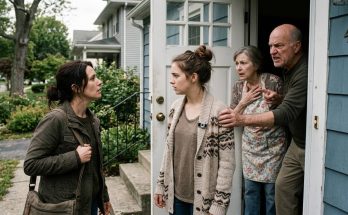
I woke the next morning thinking about the doorway.
I could see my mother standing behind the young woman.
I could see my father farther down the hall.
And I could see the young woman looking at me with a confusion that seemed entirely genuine.
She had not known I existed.
That fact was still difficult to accept.
I had spent twenty years believing that my parents had rejected me and moved on with their lives.
I had assumed they might have told relatives what happened.
I had assumed my name had remained somewhere in their memories, even if they never wanted to speak to me.
But the young woman had looked at me as though I had appeared from nowhere.
She had asked whether I was really their daughter.
I could still hear the disbelief in her voice.
I tried to imagine what it would feel like to discover that my grandparents had another child they had never mentioned.
I couldn't make the pieces fit.
There was too much I didn't know.
I didn't know what my parents had told her about the family.
I didn't know whether she had ever heard a story about a daughter who had left home.
I didn't know whether they had explained why there were twenty years of silence between them and me.
I only knew that she had not expected me.
That was enough to make me question how thoroughly my parents had kept the past out of their household.
I had always thought the night I left was the end of my relationship with them.
Now I wondered whether it had also been the beginning of a secret.
I didn't want to jump to that conclusion.
I knew how easily fear could make a person connect things that had not been connected.
I had done that before, when I was seventeen and trying to understand what was happening to my daughter.
I had accepted the explanation I was given because I had no strength left to challenge it.
I wasn't going to replace that explanation with a theory simply because the new one frightened me.
I needed to know what had happened.
The young woman was part of the questions now, but I couldn't assume she was the answer.
I took the hospital envelope out again.
I placed the discharge papers on the table.
Then I set the plastic wristband beside them.
It looked so ordinary.
There was nothing about it that suggested it could hold a memory this painful.
I turned the transfer document over, even though I had already checked the other side.
I read the information again.
The transfer was recorded.
The death my parents had described was not confirmed by anything I had in my possession.
I had no certificate.
I had no burial record.
I had no funeral home information.
I had spent twenty years believing that my daughter's death was an established fact, yet I could not find a single record that confirmed it.
That didn't prove she had survived.
I knew that.
But it did mean I had no reason to keep treating my parents' statement as the only possible source of truth.
I had relied on them because I had been young.
I had relied on them because I had been grieving.
I had relied on them because the thought of asking for proof had seemed unbearable.
Now I was an adult.
I could admit what I did not know.
I could look for answers without deciding in advance what they had to be.
And I could do that without asking my parents for permission.
The realization brought a strange kind of relief.
Not happiness.
Nothing about the situation made me happy.
But I felt less trapped than I had the day before.
For twenty years, the story had been closed in my mind.
My daughter had died, and there was nothing more to say.
Now the story was open again.
I could ask questions.
I could search for records.
I could find out what the transfer meant and whether there had been any later documentation.
I could stop treating uncertainty as something I had to endure silently.
I looked at the envelope and thought about the young woman.
I had not asked her name.
The realization surprised me.
I had been so focused on the resemblance and the way she reacted to my surname that I had forgotten the simplest question a person could ask.
I had introduced myself.
She had not given me her name.
Perhaps she had been too startled.
Perhaps I had not given her the chance.
I didn't know.
I only knew that she had been kind enough to step outside and speak to me after my father told me to leave.
She had listened while I explained what I knew.
She had apologized for the way my parents treated me.
I had no reason to make her responsible for anything that had happened before she was old enough to understand it.
If I ever spoke to her again, I wanted to remember that.
She had not thrown me out.
She had not told me my daughter was dead.
She had not kept the hospital records from me.
She had simply opened a door.
I could not ask her to carry the weight of the whole family history because she happened to resemble me.
But I could acknowledge that meeting her had changed the way I understood my situation.
Before I saw her, I had gone back to confront my parents.
Afterward, I was no longer certain that confronting them would be enough.
I needed information they might refuse to provide.
I needed to find out what had happened after my daughter was transferred.
And I needed to be prepared for the possibility that the answer would be painful, whatever it was.
I sat with that thought for a long time.
Then I considered my father.
He had looked at me and told me to leave before I could explain myself.
He had not asked why I had returned.
He had not asked whether I had been safe over the years.
He had not asked about my life in Seattle.
He had not asked whether I had ever recovered from what happened when I was seventeen.
His first concern had been getting me away from the house.
I could not know why.
Perhaps he was angry that I had returned.
Perhaps he was ashamed.
Perhaps he was afraid of a conversation he had spent twenty years avoiding.
I could not decide which explanation was true.
I could only look at what he had done.
He had tried to end the conversation before I could ask about my daughter.
That was a fact.
My mother had looked at him before answering me.
That was another.
The young woman had never heard of me.
That was a third.
And I had no record of my daughter's death.
Those were the pieces I had.
I wasn't going to pretend they formed a complete picture.
But I wasn't going to ignore them, either.
I had spent too much of my life accepting silence as the end of a conversation.
The rain had stopped twenty years ago.
The backpack had dried.
The girl who stood on the lawn had grown into a woman who could make her own decisions.
I did not need my father to welcome me back before I could ask what happened.
I did not need my mother to approve of my questions.
And I did not need either of them to tell me whether I was entitled to know the truth.
I already knew that I was.
I gathered the papers and put them back in the envelope.
The plastic wristband slid against the edge of the document.
I tucked it inside carefully.
I didn't want to lose any of it.
For the first time since I had found the envelope, I felt certain about what I needed to do next.
I would no longer depend on my parents' willingness to speak.
I would seek an answer that could be supported by something more than their words.
I still did not know whether my daughter had survived.
I still did not know who the young woman at the door really was in relation to the questions I carried.
I still did not know why my parents had reacted as they did.
But I knew I could not return to the life I had been living and pretend those questions no longer mattered.
I had gone back to the house because I wanted to confront the people who had abandoned me.
I had expected anger.
I had expected denial.
I had even expected the old feeling of being unwanted to return.
What I had not expected was to discover how much of my own history I still did not understand.
I looked at the envelope one final time before putting it away.
Then I made myself a promise.
I would find out what happened after the transfer.
I would not assume the answer was the one I feared.
I would not assume it was the one I secretly wanted.
And I would not let my parents' silence decide what I was allowed to know.
The questions were still there.
For once, I was willing to follow them.
Click here to continue reading: PART 9: I Could No Longer Treat My Parents’ Explanation as the Truth When the Only Evidence I Had Raised More Questions
I Thought Losing My Parents Was the Worst Thing That Could Happen to Me, Until I Questioned What They Told Me About My Baby
Part 8 of 12