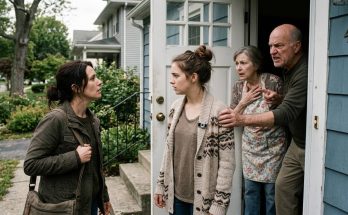
I had nearly reached the driveway when I heard the door move behind me.
I turned.
The young woman had stepped outside.
She pulled the door mostly closed, leaving it open just enough that I could see the narrow strip of hallway behind her.
For a moment, neither of us spoke.
Then she came down one step.
"Wait."
I stopped.
She looked back toward the house before facing me again.
"Can you tell me what you meant about your baby?"
I studied her face.
Up close, the resemblance was even harder to ignore.
Her left cheek had the same small indentation as mine.
When she pressed her lips together, it became less noticeable.
When she looked uncertain, it returned.
I had spent the last few minutes trying not to stare.
Now I had to remind myself again.
"Your grandparents told me my daughter died when I was seventeen," I said.
She frowned.
"Your daughter?"
I nodded.
"I was pregnant when they made me leave home. The baby was born prematurely, and I was told she died after being transferred to another hospital."
The young woman lowered her eyes.
I could see her trying to understand what I was saying.
"How long ago was that?"
"Twenty years."
She looked up quickly.
I saw the number settle in her expression.
She was around twenty herself.
I did not need to say that aloud.
Neither of us mentioned it.
Instead, she asked why I had come back now.
I showed her the envelope.
"I found this while cleaning out a closet. One of the papers recorded the transfer, but I couldn't find anything confirming what happened afterward."
"Couldn't you ask the hospital?"
"I haven't yet. I only found the papers recently."
I didn't tell her that I had been afraid to investigate.
I had already spent enough years accepting what my parents told me.
It was difficult to admit that I had never questioned them before.
She looked at the envelope again.
"Did you tell them you found it?"
"I just did."
She nodded slowly.
Then she glanced at the house.
"My grandparents never told me they had a daughter named Sarah."
The words hurt, though I tried not to show it.
I had expected my parents to deny me.
I had expected my father to tell me I didn't belong.
But hearing that the young woman had never even known I existed made the rejection feel larger than I had understood.
They had not merely shut me out of their lives.
They had apparently left no place for me in the family story she knew.
I wondered what they had told her about their own past.
I wondered whether she had ever asked why there were no photographs of me, or why nobody mentioned a daughter who had grown up in that house.
I couldn't know.
I had only her words.
"How long have you lived here?" I asked.
"Most of my life."
She paused.
"At least, as far back as I can remember."
I held still.
The information was ordinary enough.
It didn't explain anything.
Yet I felt the need to be careful with every word I said next.
"Do you know why they never mentioned me?"
She shook her head.
"No."
Her answer came quickly.
She seemed as confused as I was.
I believed that she genuinely did not understand what had happened at the door.
That did not tell me whether my parents had explained anything to her afterward.
It only told me that, at that moment, she had no explanation to offer.
She rubbed her thumb against her index finger.
I watched the movement again.
I had done the same thing before important conversations, during uncomfortable silences, and whenever I was trying to stop myself from saying something I might regret.
I had never thought of it as something another person might share.
Now it seemed to be following me.
I looked away.
I did not want to make a stranger feel as though I was examining her for evidence of something she had not agreed to discuss.
"I don't want to frighten you," I said. "I know this is a lot to hear from someone you just met."
She gave a small nod.
"But you look like me."
The words came out before I could decide whether I should say them.
She touched her left cheek.
I watched her realize what I meant.
"The dimple?"
"Yes."
She looked at me carefully.
"I noticed it, too."
That was the first moment when I felt that I wasn't the only person who had seen the resemblance.
It did not prove anything.
I reminded myself of that.
A shared physical feature could mean many things.
A nervous habit could be a coincidence.
The fact that she was about twenty did not establish a connection between us.
Still, I could not pretend the similarities were meaningless to me.
I had spent years wondering what my daughter might have looked like if she had survived.
I had wondered whether she would have my eyes or my face.
I had imagined a young woman growing older without knowing what she might become.
Now one was standing in front of me.
And I had no idea whether I was looking at someone who was connected to that loss or simply a stranger who happened to resemble me.
The uncertainty was almost unbearable.
The young woman glanced toward the house again.
"My grandfather doesn't want us talking."
"I noticed."
She looked embarrassed.
"I'm sorry."
"You don't have to apologize for him."
She nodded, but I could tell she wasn't sure what to say.
I had been that age once.
I remembered how difficult it could be to understand that adults you loved might behave in ways that were unfair.
I also knew that a family could teach you to avoid certain subjects without ever telling you directly that they were forbidden.
Sometimes all it took was a look.
My mother had given me that look many times.
My father had perfected it.
I wondered whether the young woman had learned to read their expressions the same way I had.
I decided not to ask.
Instead, I told her I had not come to blame her for anything.
"I came because I need to understand what happened to my daughter."
She studied me.
"What do you think happened?"
I looked down at the envelope.
"I don't know anymore."
It was the most honest answer I could give her.
For twenty years, I had believed I knew.
Now I could no longer separate what I had experienced from what I had been told.
I remembered the pregnancy.
I remembered the hospital.
I remembered the transfer.
I remembered my parents saying my daughter had died.
But I had no record in my possession that confirmed the last part.
I had no right to turn that absence into certainty in the other direction.
I couldn't tell this young woman that my daughter had survived.
I couldn't tell her that my parents had lied.
I could only tell her what I knew and what I didn't.
She seemed to appreciate that.
Perhaps she was relieved I wasn't demanding that she choose sides.
Perhaps she simply needed someone to speak plainly.
After a moment, she asked whether I had any other family in Illinois.
I shook my head.
"Not anyone I've stayed close to."
"Have you talked to them at all?"
"Very little."
I didn't explain the years of silence.
She had already heard enough to understand that the family had not been close.
I told her I had built my life in Seattle.
I had work, a home, and people who knew me as an adult rather than as the girl who had been thrown out.
I didn't say that I had sometimes wished I could return to the house and ask my parents why they had done it.
That wish had been too painful to entertain for long.
Now I had finally acted on it.
And I was standing in the driveway talking to a young woman whose existence seemed to complicate every assumption I had brought with me.
She looked at the envelope once more.
"Are you going to find out what happened?"
"Yes."
The answer surprised me with how quickly it came.
I had been uncertain when I first found the papers.
I had been uncertain during the journey.
I had been uncertain at the door.
But now I knew that I could not go back to Seattle and pretend the questions had disappeared.
"I need to know," I added.
She nodded.
Then she looked toward the house again.
I could see that she was torn between wanting to hear more and being afraid of what the conversation might mean for her family.
I understood that feeling.
I had spent my childhood trying to preserve my place in that same family.
I had once believed that if I stayed quiet enough, I might avoid making my father angry.
It had not saved me.
I didn't want her to feel that she had to defend anyone or give me information she didn't have.
"If you don't know anything, that's all right," I told her.
"I really don't."
"I believe you."
She looked at me for a long moment.
Then she asked for my name again, though I had already given it to her.
"Sarah Miller," I repeated.
She said it quietly, as though she were trying to make it fit into the history she knew.
I wondered whether she would tell my parents we had spoken.
I wondered what they would say to her.
I wondered whether they would insist that she forget the conversation.
There was no way for me to know.
The young woman moved back toward the door.
"I should go inside."
"Of course."
She hesitated.
"I'm sorry they treated you that way."
I had not expected those words.
For a moment, I couldn't answer.
It was such a simple thing to say.
Yet nobody in that house had said anything like it to me in twenty years.
I swallowed.
"Thank you."
She went inside.
The door closed softly behind her.
I remained in the driveway for a little while.
I had come to the house expecting rejection, and I had received it.
But I had also met someone who had looked at me and recognized that something was wrong.
She hadn't given me answers.
She hadn't promised to help.
She had simply listened.
That was more than I had received from my parents.
I got into my car and placed the envelope on the passenger seat.
The old plastic wristband was still inside.
I looked at it before starting the engine.
For years, I had treated it as a reminder of a loss I could not change.
Now it was a reminder of a question I could no longer ignore.
I was going to find out what had happened after my daughter was transferred.
I did not know what the answer would be.
But I was done accepting that there was nothing left to learn.
Click here to continue reading: PART 7: The More I Thought About Her Face, the Harder It Became to Accept That My Parents Had Told Me Everything
I Thought Losing My Parents Was the Worst Thing That Could Happen to Me, Until I Questioned What They Told Me About My Baby
Part 6 of 12