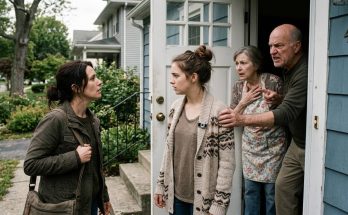
I thought about the young woman more than I wanted to admit.
It wasn't only her face.
It was the way she had looked at me when I told her my name.
She had been genuinely confused.
There had been no recognition in her expression, no sign that she had been waiting for me to return.
She had simply not known who I was.
I understood that I couldn't draw a complete conclusion from that.
My parents might have avoided discussing me for reasons I could not yet understand.
The young woman might have grown up without ever asking about the years before her own memories began.
There were explanations that did not require anything more sinister.
But the age difference between the girl I had lost and the young woman I had met was difficult to ignore.
My daughter would have been about twenty.
The young woman looked about twenty.
I kept returning to those two facts.
I tried to tell myself that the resemblance was not enough.
It wasn't.
A dimple was not a birth certificate.
A nervous habit was not a hospital record.
And a grandfather's presence in a young woman's life did not explain how she had come to be part of the family.
Still, I could not make myself stop wondering.
I remembered how she had rubbed her thumb against her index finger while she waited for an answer.
I had done that since childhood.
I had never considered it special.
I did it when I was uncomfortable, when I was thinking, and when I wanted to keep my hands busy so nobody would notice how nervous I felt.
Watching her do it had startled me.
I had felt as if I were seeing a small part of myself carried by someone I had never met.
That feeling had stayed with me long after I left the driveway.
I wanted to know her name.
I wanted to know what she had been told about her own history.
I wanted to know whether my parents had ever spoken about the daughter they sent away.
But I did not want to turn my questions into accusations before I had something to support them.
I had already lived through one terrible misunderstanding of what my parents had done.
I wasn't going to create another by assuming I knew what the young woman's resemblance meant.
I needed to be patient.
That was not easy for me.
For twenty years, I had lived with an answer that had never been fully explained.
Now I had a reason to question it, and I wanted to know everything immediately.
I wanted the missing records.
I wanted an explanation for my mother's reaction.
I wanted to understand why my father had seemed so determined to end the conversation.
I wanted to know why the young woman had never heard of me.
And I wanted to know why she looked at me as though we shared something neither of us could name.
I had to accept that those were separate questions.
They might be connected.
They might not.
I could not decide that simply because the possibilities frightened me.
I thought about the way my mother had said my name.
"Sarah."
She had not sounded angry.
She had sounded shocked.
For a brief moment, I had seen something in her expression that looked almost like fear.
Then my father appeared, and whatever had been there disappeared behind the familiar hostility.
I wondered whether she had been afraid of seeing me or afraid of what I might ask.
I wondered whether she had expected me never to return.
Perhaps she had believed the past would remain buried if neither of us spoke about it.
I had done my share of avoiding it.
For years, I had stayed away because I could not bear the thought of standing in front of them and being rejected again.
I had convinced myself that distance was the only way to protect my life.
Now I understood that distance had protected me from some things while leaving other questions unanswered.
I could not change the years I had lost.
I could not make my parents behave differently.
But I could stop treating the questions as forbidden.
The young woman's confusion had made that clearer than anything else.
She had looked at me and asked whether I was really her grandparents' daughter.
She had not seemed to know what to do with the information.
I could not blame her.
If someone had appeared at my door and told me that my grandparents had hidden an entire daughter from me, I would have wanted an explanation, too.
I wondered whether she would ask my parents about me after I left.
I hoped she would.
Then I worried about what they might tell her.
I did not want her to feel responsible for choosing between the people who had raised her and a stranger who claimed to be their daughter.
I did not want to make her feel that she owed me trust.
I had not earned that from her simply by sharing a surname.
I wanted her to have the freedom to ask questions without feeling that she had to protect me.
I wanted the same freedom for myself.
That was the part I had missed when I was seventeen.
I had believed that asking questions would make my parents angrier.
I had believed that if I wanted to remain part of the family, I needed to accept their decisions.
I had been wrong about what I owed them.
I did not owe them silence.
I did not owe them unquestioning acceptance.
And I did not owe them another twenty years of pretending I had no right to know what happened to my child.
I looked at the hospital envelope again.
The transfer document was still the only specific record I had found that related to what happened after the birth.
It did not answer my questions.
But it gave me a reason to keep asking.
I thought about the missing death certificate.
I had spent years assuming it was unnecessary because my parents had told me what happened.
Now I understood how much I had depended on their words.
If they had been mistaken, I wanted to know.
If they had been right, I wanted to understand why I had been left without the records I expected.
And if there was another explanation, I wanted the chance to hear it.
I wasn't asking for a miracle.
I was asking for the truth.
That distinction mattered to me.
I had to keep reminding myself that wanting an answer did not mean deciding what the answer should be.
The young woman might have been connected to my daughter's story.
She might have been connected in a way I could not yet imagine.
Or I might have been letting grief make too much of a resemblance.
I could not know.
I had to leave room for the truth to be different from what I feared and different from what I hoped.
For the first time in twenty years, I was prepared to do that.
I would not turn away from the question simply because I was afraid of the answer.
And I would not accept an answer merely because it came from my parents.
Click here to continue reading: PART 11: I Had Returned to Ask Why They Let Me Grieve Without Proof, and I Finally Understood That Their Silence Could Not Be My Answer
I Thought Losing My Parents Was the Worst Thing That Could Happen to Me, Until I Questioned What They Told Me About My Baby
Part 10 of 12