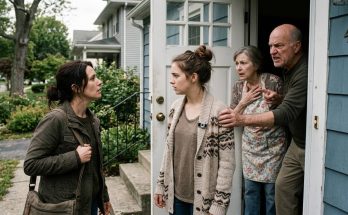
Nobody moved for several seconds.
I stood on the doorstep, looking at the young woman who had just learned that I was her grandparents' daughter.
My mother remained behind her.
My father stood farther down the hallway, watching me with the same expression I remembered from the night he had thrown me out.
The young woman looked between us again.
I could tell she was waiting for someone to explain.
Nobody did.
My father broke the silence first.
"You heard me. Leave."
His voice was firm, almost impatient.
I looked at him.
"I haven't even told you why I'm here."
"I don't care why you're here."
That answer hurt more than I wanted it to.
I had driven all the way back to Illinois after twenty years of silence.
I hadn't come expecting him to hug me.
I hadn't even expected him to apologize.
But I had thought he might at least let me speak.
Apparently, that had been too much to expect.
The young woman stepped slightly away from the doorframe.
"Grandpa, why are you talking to her like that?"
He ignored her.
I noticed her thumb moving against her index finger again.
She was nervous.
So was I.
The difference was that I knew why.
She had been living inside a family history she apparently didn't understand, while I had spent two decades believing I knew mine.
Now we were standing in the same doorway, and neither of us had enough information to make sense of what was happening.
I wanted to ask her name.
I wanted to know how long she had lived there.
I wanted to know why she looked so much like me.
But my father was still staring at me as if he could force me to disappear by refusing to acknowledge me.
I turned toward my mother.
"Mom, I need to talk to you."
Her lips parted slightly.
For one brief moment, I thought she might answer.
Then she glanced at my father.
That small movement told me more than a speech would have.
Even after twenty years, she was still looking to him before deciding what she was allowed to say.
I felt something inside me settle.
I had come here hoping for answers.
I was beginning to understand that I would have to ask the questions myself.
"I'm not here to cause trouble," I said.
My father gave a short, humorless laugh.
"You should have thought about that twenty years ago."
The words landed exactly where he intended.
For an instant, I was seventeen again.
I could almost feel the wet fabric of my hoodie against my arms.
I could see my backpack lying on the lawn.
I could hear the door closing.
Then I looked at the man standing in front of me, and the memory became what it really was.
Something he had done.
Not something I had deserved.
"I've spent twenty years living with what happened," I told him. "I'm not going to argue with you about my right to ask a question."
He stared at me.
The young woman looked from him to me.
"What happened twenty years ago?"
My father turned toward her.
"Go inside."
She didn't move.
"Why?"
"Because I told you to."
She folded her arms.
It was a small act of resistance, but I noticed it.
My mother noticed it, too.
The young woman was not a little child who would automatically obey every command.
She was an adult, standing in her own home, asking a reasonable question.
And my father was treating her the way he had treated me.
I wondered how often that had happened.
Then I stopped myself.
I didn't know her well enough to draw conclusions about her life.
I had only just met her.
Whatever I thought I recognized in her face or her gestures, I couldn't assume I understood her.
I took a breath.
"My name is Sarah," I said to her. "I grew up here."
She studied me.
"Then why have I never seen you?"
I looked toward my parents.
Neither answered.
"Because I haven't been back in a very long time."
"Why?"
I could have given her the short version.
I could have told her that I had gotten pregnant at seventeen and my parents had thrown me out.
I could have explained that my daughter had been born prematurely and that I had been told she died.
I could have told her about the hospital envelope in my possession.
But I didn't know who this young woman was beyond the fact that she called my father Grandpa.
I wasn't going to place twenty years of pain in her hands before I understood what she had been told.
"My parents and I have a difficult history," I said.
She looked unconvinced.
"That doesn't explain why Grandpa told you to leave."
"No," I admitted. "It doesn't."
My father stepped forward.
"Sarah, this conversation is over."
I turned toward him.
"You don't get to decide that before I've said what I came to say."
His jaw tightened.
I remembered that expression.
When I was a child, it had been enough to make me stop talking.
I had learned to measure my words around him, to watch his face, and to decide whether a question was worth the anger it might bring.
That habit had followed me into adulthood.
Even now, part of me wanted to lower my eyes and apologize for making things uncomfortable.
I refused.
"I need to know what happened to my baby."
My mother went completely still.
The young woman stopped rubbing her fingers.
My father looked at me without blinking.
For the first time since I had arrived, nobody told me to leave.
That silence was different from the others.
I could feel it.
My mother looked down at the floor.
I had seen her do that when she didn't want to meet my eyes.
I had seen it when I was younger, though I could never remember what I had been asking at the time.
Now I wondered how many times I had mistaken her silence for uncertainty.
Perhaps she had been afraid.
Perhaps she had been ashamed.
Perhaps there had been something she did not want to say.
I didn't know.
I only knew that the mention of my daughter had changed the room.
The young woman turned toward my mother.
"What baby?"
My mother didn't answer.
I felt the old hurt rise again.
I had come here carrying a question that had taken me twenty years to ask.
Now I was standing in front of the people who had given me the original explanation, and their silence was beginning to feel like an answer of its own.
I took the envelope from my bag.
My hands were not entirely steady.
I held it against my palm and looked at my mother.
"I found my hospital records," I said. "They say she was transferred. I never found a death certificate or any record of a burial."
My mother looked at the envelope.
She did not reach for it.
My father glanced at the papers, then back at me.
"You have no idea what you're talking about."
"Then explain it to me."
He said nothing.
I waited.
I had spent twenty years waiting for people to tell me what had happened.
I wasn't going to fill the silence for him.
The young woman looked at the envelope.
Then she looked at me.
I could see that she was trying to connect pieces of information she had never expected to hear.
I wished I could make things easier for her.
I also wished someone had tried to make things easier for me when I was seventeen.
But I could not protect her from the truth simply because the truth might be painful.
Not when I still didn't know what it was.
My mother finally spoke.
"Sarah, you shouldn't have come here."
I looked at her.
"Why?"
She pressed her lips together.
For a moment, I thought she might cry.
Instead, she glanced at my father again.
He shook his head once.
It was a tiny gesture.
My mother fell silent.
I understood then that whatever had happened in the years since I left, the old arrangement between them remained.
My father spoke.
"Get off my property."
I folded the papers back into the envelope.
I wasn't ready to leave.
But I wasn't going to force my way into the house, either.
I looked at the young woman.
"I'm sorry you were put in the middle of this."
She shook her head.
"I don't even know what's happening."
"I know."
I meant it.
She had opened the door expecting an ordinary visitor.
Instead, she had discovered that her grandparents had a daughter they apparently never discussed.
I could not explain that to her without understanding why.
My father repeated his demand.
This time, I stepped back from the threshold.
Not because he had convinced me I was wrong to come.
Because I could see that standing there and arguing would get me nowhere.
I had learned that lesson twenty years earlier.
I wasn't going to spend another hour trying to make him hear what he did not want to hear.
I looked at my mother one last time.
"All I want is the truth."
She stared at me.
Then her eyes moved to the envelope in my hand.
I turned away before I could start hoping for an answer she had not offered.
I walked down the steps toward the driveway.
The young woman remained at the door.
I could feel her watching me.
I had come back to confront my parents about the darkest year of my life.
Instead, I had met a stranger with my face.
And I was leaving without knowing whether my daughter had ever died.
Click here to continue reading: PART 6: I Had Almost Reached My Car When I Realized the Young Woman’s Questions Were the First Honest Ones Anyone Had Asked
I Thought Losing My Parents Was the Worst Thing That Could Happen to Me, Until I Questioned What They Told Me About My Baby
Part 5 of 12