The longer I sat with the envelope, the more I understood how little I had known at seventeen.
I had been a child in the eyes of the law in some ways, but I had been expected to face an adult crisis without the support of the people who were supposed to care for me.
My parents had thrown me out.
I had given birth prematurely.
My daughter had been transferred.
Then I had been told she was dead.
I had accepted that explanation because I had no reason to think otherwise.
I had not understood that I could ask to see records.
I had not known how to insist that someone explain what had happened in words I could understand.
I had been grieving, and I had been heavily medicated.
I had trusted the people who were supposed to know more than I did.
Looking back, I could see how easily that trust had become the foundation for twenty years of uncertainty.
I had never seen a death certificate.
I had never received a burial record.
I had never been given the name of a funeral home.
Those absences had not seemed important when I was seventeen.
They mattered now.
I had spent years telling myself that the past could not be changed.
That was true.
But the facts of the past could still be discovered, if there were records and people willing to explain them.
I could not go back and hold my daughter.
I could not recover the years I had spent believing she was gone.
But I could find out whether the story I had been given was complete.
That was the reason I had returned to Illinois.
It was also the reason I could not let my father's anger decide what happened next.
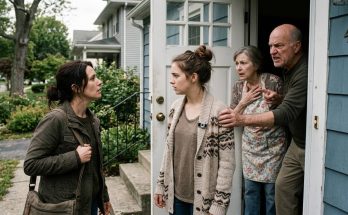
I thought about the way he had stood in the hallway.
He had not asked why I was there.
He had not asked what I had found.
He had not even let me finish explaining myself before ordering me to leave.
When I mentioned my daughter, his response had not become gentler.
He had remained hostile.
I did not know what that meant.
I could not honestly say that his reaction proved he was hiding something.
But it did mean I could not rely on him to answer my questions voluntarily.
My mother had been no more helpful.
She had looked at me as though the sight of me had brought something back that she had tried not to remember.
When I asked her to speak with me, she had looked toward my father.
When I mentioned the hospital records, she had gone quiet.
I had spent much of my childhood interpreting her silences.
I had often assumed that if I waited long enough, she would eventually explain herself.
That night in the rain, I had waited for her to come outside.
Twenty years later, I had waited for her to speak.
Both times, I had been left standing alone.
I could not keep doing that.
I could not continue making my life depend on whether my mother was ready to face what had happened.
I had given her twenty years without demanding anything.
I had stayed away.
I had built my own life.
I had not called to accuse her or ask for help.
I had not shown up at holidays expecting to be welcomed back.
I had accepted the distance she and my father created.
But I could not accept that distance as a reason to stop asking about my daughter.
I had a right to know what had happened.
I had a right to understand why I had been left without the records that would confirm the story I had been told.
And I had a right to question the explanation when the evidence I possessed did not settle the matter.
I didn't know whether my parents would ever admit that they had made a mistake.
I didn't know whether they would tell me anything more.
I didn't even know whether they would speak to me again.
But I no longer needed their permission to acknowledge what I did not know.
That was a change I could feel.
For twenty years, the story had been closed.
Now it was open, and I could not pretend otherwise.
I thought about the young woman again.
She had not asked me to return.
She had not caused the years of silence.
She had not chosen to be standing in the doorway when I arrived.
She had simply been there.
Yet her presence had forced me to confront how little I understood about the family I had left behind.
I wondered whether she had seen the same resemblance I had.
She had touched her cheek when I mentioned the dimple.
She had admitted that she had noticed it, too.
I remembered the way her fingers moved when she was nervous.
I remembered her calling my father Grandpa.
I remembered the confusion in her voice when she learned my name.
Those details remained with me, but I refused to make them into a conclusion.
I could not tell her who she was.
I could not tell myself who she was.
I had to let the facts speak when I finally found them.
I also had to accept that the answer might not be the one I wanted.
I had imagined my daughter growing up in the years after I was told she had died.
I had wondered what she would look like, how she would sound, and what kind of person she might become.
Seeing the young woman had made those thoughts painfully vivid.
For a brief moment, I had felt as though I were looking at the life I had lost.
But a resemblance could not bring back twenty years.
It could not tell me what had happened at the hospital.
And it could not explain why my parents had never given me the records I expected.
I needed to be careful with my heart.
I had spent too long grieving without answers to let myself believe something simply because I desperately wanted it to be true.
I could hope.
But I could not call hope evidence.
I put the envelope away.
Then I sat quietly, thinking about the girl I had been.
I wished someone had told her that she deserved to ask questions.
I wished someone had explained that being pregnant did not mean she deserved to be abandoned.
I wished someone had made sure she understood what happened to her baby.
I could not change what had been done to that girl.
But I could stop treating her questions as if they were unreasonable.
I could stop telling myself that I had no right to revisit the past.
I could stop accepting silence as the only answer available.
I had returned to the house because I wanted my parents to face what they had done.
I had thought that if I stood in front of them and spoke plainly, I might finally hear something that made the last twenty years easier to understand.
Instead, my father had ordered me away.
My mother had said almost nothing.
And a young woman I had never met had looked at me with my own dimple in her cheek.
I still did not know what that meant.
But I knew what I needed to do.
I would keep seeking the truth about the transfer.
I would not allow my father's refusal to end the search.
I would not let my mother's silence convince me that the questions were unimportant.
And I would not ask the young woman to solve a mystery she had not created.
If I ever spoke to her again, I would treat her as a person, not as a possibility.
She deserved that much.
So did I.
I had lost twenty years to a story I had accepted because I was too young and too hurt to challenge it.
I was not going to lose the rest of my life to the same uncertainty.
The envelope had brought me back to Illinois.
The encounter at the door had made the questions harder.
Neither had given me the answer.
But I finally understood that the absence of an answer did not mean I had to stop looking.
Click here to continue reading: PART 12: I Returned to the House Believing I Needed My Parents to Explain My Past, but I Left Knowing I Could No Longer Let Them Define It
I Thought Losing My Parents Was the Worst Thing That Could Happen to Me, Until I Questioned What They Told Me About My Baby
Part 11 of 12