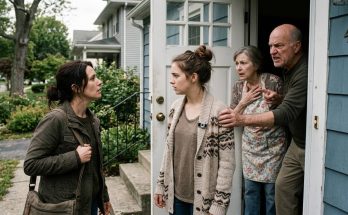
I drove away from the house without knowing what to do next.
The envelope sat beside me.
Every few minutes, I glanced at it as though the papers might somehow look different after what had happened at the door.
They didn't.
The transfer record remained the same.
The missing death certificate remained missing.
And the young woman with my dimple was still a person I knew almost nothing about.
I tried to concentrate on the road.
But I kept seeing her standing in the doorway.
Dark hair.
Hazel-green eyes.
That small indentation in her left cheek.
The way she rubbed her thumb against her index finger when she was unsure what to say.
I had noticed each detail separately.
Together, they had made an impression I could not shake.
I knew better than to treat resemblance as proof.
I had lived long enough to understand that people could look alike without sharing the connection we imagined.
But I had never met someone who reminded me so sharply of the daughter I believed I had lost.
The fact that she called my father Grandpa only made the encounter harder to dismiss.
I could not stop thinking about her age.
She looked about twenty.
My daughter would have been twenty.
That did not mean they were the same person.
I repeated that to myself because I was afraid of what would happen if I let hope take over before I had facts.
Hope had not been part of my life for a long time when it came to my daughter.
I had learned to think of her as someone I had loved briefly and lost before I could know her.
I had carried that loss quietly.
I had not built my life around expecting a miracle.
Now I had to face the possibility that I had been wrong about something I thought was settled.
I pulled over for a moment and took the envelope from the passenger seat.
I opened it again.
The papers were still there.
I read the transfer information.
I checked the other documents.
Nothing had changed.
I had no death certificate.
No burial record.
No name of a funeral home.
I had the original hospital paperwork and the account my parents had given me.
That was all.
I put the papers away.
I didn't want to convince myself that the young woman's face had supplied the missing proof.
It hadn't.
But I could no longer dismiss the possibility that my parents knew something they had never told me.
Their reaction at the door had bothered me almost as much as the resemblance.
My mother had gone pale the instant she saw me.
My father had ordered me to leave before I could explain why I had returned.
When I mentioned my daughter, my mother had looked down.
My father had become even more hostile.
None of those reactions proved that they had concealed the truth about my baby.
People could react badly for many reasons.
But I had spent twenty years accepting their words without asking for evidence.
I was no longer willing to do that.
I thought about my mother.
I had spent much of my life trying to understand her silence.
When I was seventeen, she had packed my clothes and carried my backpack outside.
I had never been able to forget that she was the one who physically put my belongings on the lawn.
My father had stood behind her, but she had taken the bag.
For years, I had wondered whether she regretted it.
I had wondered whether she had cried after the door closed.
I had wondered whether she had wanted to come outside and bring me back in.
Those thoughts had kept a small part of me attached to her, even when I refused to return.
But I had never received an answer.
Now, seeing her turn pale at the sight of me, I wondered whether the past was something she feared for reasons beyond the night I had left.
I couldn't know.
I had to be careful not to turn every expression into a confession.
Still, I remembered how quickly she had looked at my father before speaking.
That was familiar.
It was the same glance she had given him in the hallway when I asked to talk.
She seemed to be waiting for permission.
I had spent twenty years believing that the two of them had made the same decision together.
Now I wondered whether their silence had always meant the same thing to each of them.
I didn't have enough information to answer that question, either.
I drove until I could think clearly again.
The young woman had asked why I had never been there.
She had not known I existed.
That fact kept returning to me.
I could understand my parents wanting to avoid talking about the daughter they had thrown out.
They might have been ashamed.
They might have wanted to forget the conflict.
They might have told themselves that silence was easier for everyone.
But I could not understand why a daughter who had grown up in that house had apparently never been mentioned to their granddaughter.
Perhaps there was an explanation.
Perhaps the young woman had never asked.
Perhaps my parents had simply never spoken about the years before her memory began.
I did not know.
I had to resist the urge to build a complete story from a handful of facts.
That was how I had ended up accepting the first story without questioning it.
I had been told my baby died, and I had filled in the gaps with what I assumed must have happened.
I would not make the same mistake again.
I needed records.
I needed a clear account of the events after the transfer.
I needed to understand whether there was any evidence that my daughter had died when my parents said she had.
Only then could I begin to make sense of the young woman at the door.
I returned to the memory of my daughter's birth.
The details were not all clear after twenty years.
Some moments remained sharp, while others had blurred.
I remembered being young and frightened.
I remembered the hospital environment and the feeling that the adults around me understood things I did not.
I remembered the transfer.
Then I remembered being told that my daughter had died.
The memory of that statement was clear.
But I could not remember receiving the kind of documentation I would expect to accompany such news.
I had never been shown a death certificate.
I had never been told where she was buried.
I had never received a funeral home's name.
I had been too devastated to question those omissions.
At the time, I had believed that asking for more details would not change the outcome.
If my daughter was dead, no document could bring her back.
I had tried to protect myself from the pain of asking questions that might only deepen the loss.
Now I understood that the questions themselves had never been the problem.
The problem was that I had been left without enough information to understand what happened.
I had mistaken my inability to bear the grief for proof that there was nothing more to learn.
By the time I returned to my life in Seattle, the years had taught me how to function around the absence.
I could go to work.
I could make plans.
I could laugh at something a friend said without feeling that I was betraying the daughter I had lost.
But every year, when her birthday came around, I was reminded of the life I had never seen.
I wondered what she might have liked.
I wondered whether she would have been quiet or outspoken.
I wondered whether she would have inherited my nervous habit.
I had never expected to see those possibilities standing in a doorway.
Now I couldn't stop thinking about the young woman touching her fingers together.
I had to remind myself that she had her own life.
She was not a collection of clues placed there for me to interpret.
She was a person who had answered a door and discovered that her family history was not what she thought it was.
If I wanted to know who she was, I would have to respect that.
I couldn't demand that she provide answers simply because I had questions.
My parents had already tried to control the conversation.
I did not want to become another person telling her what she was supposed to believe.
I wanted facts.
I wanted the truth.
And I wanted the young woman to have the freedom to understand it for herself.
When I finally returned to where I was staying, I placed the envelope on a table.
I sat beside it for a long time.
I thought about calling my mother.
I thought about trying to speak to my father when he was alone.
But I had already seen how they reacted when I stood in front of them.
My father had made it clear that he would rather send me away than answer a question.
My mother had not spoken when I asked her why.
I could not rely on either of them to explain what had happened.
If there was an answer, I needed to find it somewhere other than in their willingness to talk.
I looked at the hospital papers again.
They had been waiting in that closet for twenty years.
I had nearly put them away without examining them.
If I had done that, I might never have questioned the story I had been given.
I would have continued living with the same certainty.
I would never have returned to the house.
I would never have met the young woman.
I would never have seen that dimple or watched her make the same nervous movement I had made since childhood.
I could not say what any of it meant.
But I could no longer pretend it meant nothing.
I had gone back to Illinois to confront my parents about the year they had abandoned me.
I had left the house with more questions than I had brought.
That was not the answer I had wanted.
But it was the first time in twenty years that I had allowed myself to look directly at what I did not know.
And I was not going to turn away again.
Click here to continue reading: PART 8: I Had Gone Back for an Explanation, but the Silence in That House Made Me Realize I Could No Longer Depend on My Parents’ Word
I Thought Losing My Parents Was the Worst Thing That Could Happen to Me, Until I Questioned What They Told Me About My Baby
Part 7 of 12