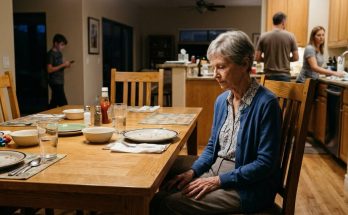
I used to believe that when your own child offered you a place in his home, you could trust the offer.
At seventy-one, I knew better.
It took me a long time to admit that.
Two years after my husband died, I was still making decisions as if he might come home and help me make them.
I kept his old tea mug in the kitchen cabinet.
I sometimes caught myself buying the brand of biscuits he liked, even though nobody else in the house ate them.
Then I would stand in the grocery store aisle, holding the package, and remember.
Harold was gone.
There would be no more mornings with him sitting at the kitchen table, reading the paper and asking me whether I'd slept well.
There would be no more arguments about the thermostat.
No more hearing his keys drop into the little wooden bowl beside the front door.
Thirty-eight years together had left traces of him everywhere.
The house was full of them.
I knew which floorboards creaked and which window needed a little pressure before it would close properly.
I knew how much water to give the rose bushes and when the yellow kitchen walls caught the afternoon sun.
That house had never been grand.
It was simply ours.
After Harold died in Tucson, people kept telling me how strong I was.
I thanked them because it seemed easier than explaining that strength had very little to do with it.
Most mornings, I got out of bed because the day had arrived.
I made coffee because I always made coffee.
I watered the roses because they needed water whether I felt like giving it or not.
Then evening came, and I ate something small in the kitchen where Harold used to sit.
The silence was the worst part.
Not because the house was quiet.
Because it was familiar.
Every room reminded me of the person who should have been there.
I could walk into the living room and remember an ordinary Tuesday from fifteen years earlier.
I could open a drawer and find a receipt Harold had tucked away because he thought he might need it later.
Sometimes I laughed at those things.
Sometimes I cried.
Usually, I did both at different times of the same day.
My son Daniel worried about me.
At least, that was what I believed.
He called more often during those first months.
He asked whether I was eating properly and whether I had been sleeping.
He wanted to know if I was managing the bills.
I told him I was.
He would pause before ending the calls, as though there were something else he wanted to say.
Eventually, he said it.
“You shouldn't have to handle everything by yourself, Mom.”
I was sitting at my kitchen table when he called.
There was a cup of tea beside me and a grocery list I had started that morning.
I remember looking at the list while he talked.
Eggs.
Bread.
Milk.
The ordinary things of a life that had suddenly become much harder to manage.
“I've been doing all right,” I told him.
“I know you have.”
He said it gently.
That made it easier to believe him.
“But you don't have to keep living alone. Come stay with us for a while.”
I didn't answer immediately.
Daniel lived in Scottsdale with his wife, Renee, and their two children.
I loved my grandchildren.
They were old enough to have their own opinions and young enough to still want me around when something went wrong.
I pictured their faces when I visited.
I imagined having breakfast with them, hearing about school, and being part of a household again.
Daniel continued before I could find an answer.
“Just come for a bit. You can take your time figuring out what you want to do.”
For a while.
Those words mattered.
He wasn't asking me to give up the rest of my life.
He was offering me somewhere to land while I learned how to live without Harold.
At least, that's how I understood it.
I wish I had asked more questions.
I wish I had thought about what it meant to leave the home I had shared with my husband for nearly four decades.
But grief makes even simple decisions feel larger than they are.
I was tired of being the only person in the house.
I was tired of pretending I didn't mind.
And I wanted to believe that my son needed me as much as I needed him.
So I agreed.
The decision to sell the house came later.
Daniel and Renee said it would make things easier.
They reminded me that the property needed maintenance and that I would have to arrange repairs by myself.
They mentioned insurance, taxes, and all the little responsibilities that had once been divided between Harold and me.
None of their arguments were unreasonable.
That was what made the decision so difficult.
There was no single moment when I could point to someone and say they had forced me.
I listened.
I considered everything.
Then I told myself that the house was only a building.
I could keep the memories without keeping the rooms.
I could take the things that mattered and let someone else have the rest.
I repeated those thoughts until I believed them enough to sign the papers.
The sale went through.
Thirty-eight years of marriage became a set of boxes, a collection of photographs, and a new address in Scottsdale.
I gave away furniture I had expected to keep for the rest of my life.
I packed Harold's clothes carefully, though I knew I could not wear them or make use of them.
I stood in the kitchen one last time before leaving.
The yellow walls looked brighter than I remembered.
The counter was bare.
There was a pale rectangle where the clock had hung.
I put my hand on the counter and stayed there for a moment.
Then I picked up my bag.
I did not take the roses.
I could not imagine digging them up and asking Daniel where I might plant them.
That decision seemed small at the time.
Later, I would think about those roses more than once.
The drive to Scottsdale was uneventful.
I had my clothes, my personal papers, a few keepsakes, and the framed photograph of Harold that I had wrapped in a towel.
Daniel had cleared space for me.
Renee had prepared the room.
They had made an effort, and I was grateful.
I told myself that gratitude was the right response.
The first few days felt almost like a holiday.
My grandchildren came into my room to show me things.
Daniel asked what I wanted from the grocery store.
Renee checked whether I needed another blanket.
At dinner, everyone sat together.
I heard about school, work, errands, and the small problems that made up their lives.
For the first time in months, I wasn't eating alone.
I could hear people moving through the house.
I could smell food cooking in the kitchen.
I could sit in the living room without being confronted by every memory of Harold.
It helped.
I won't pretend it didn't.
There were evenings when I went to bed feeling that I had made the right choice.
I had a family around me.
I had somewhere to live.
And I had a reason to get up in the morning.
I didn't know then that a person could be surrounded by family and still begin to disappear.
At first, the changes were small enough to seem natural.
One morning, Renee asked if I could make the children's lunches because she had an early meeting.
Of course I could.
The next week, Daniel asked if I could take one of them to soccer practice.
I was happy to help.
Then Renee had a late afternoon appointment, and I stayed with the children.
Another day, I folded a basket of laundry while waiting for the kettle to boil.
Nobody had to ask me.
I saw the clothes sitting there and thought it would be useful to get them done.
That was how it began.
Not with a demand.
With a dozen little things that each seemed too ordinary to refuse.
And because I was grateful to have a place in my son's home, I did them.
I had no idea how much of myself I would give away before I understood what was happening.
Click here to continue reading: PART 2: I Became the Person Everyone Relied On, and the One Person Who Never Seemed to Notice Was My Own Son
I Thought Moving In With My Son Would Help Me Survive Losing My Husband, but I Never Asked What It Would Cost Me
Part 1 of 12