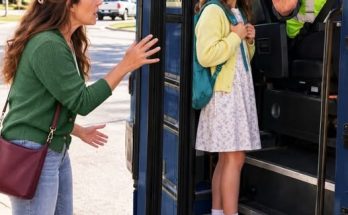
I kept returning to the moment the doors closed.
Even after Ellie had told us about the stranger, I couldn't stop seeing it.
Frank standing in the aisle.
His arm stretched across the steps.
His face turned toward something beyond the doorway.
Then the doors shutting while I stood outside.
For hours, I had replayed those seconds as proof that he had done something terrible.
Now I replayed them because I wanted to understand what I had missed.
The difference mattered.
Before, I had been certain that Frank's behavior had no reasonable explanation.
Now I knew there had been an incident before the bus reached me.
An unfamiliar man had approached the bus at Oak Street.
He had asked for Ellie by name.
He had claimed to be her uncle.
He had said he knew her teacher.
And he had wanted her to go with him.
Frank had refused to let him board.
Those were the details Ellie had given us.
They were not guesses.
They were the things she remembered.
I couldn't tell myself that none of it mattered simply because I hadn't witnessed it.
I hadn't been there at Oak Street.
I hadn't heard the conversation.
I hadn't seen the man in the brown jacket.
I hadn't watched Frank refuse him entry.
My knowledge began at Briar Street, and I had treated that small piece of the afternoon as though it were the whole thing.
That was my mistake.
I was still angry about how frightening the situation had been.
I was angry that Ellie had been crying.
I was angry that I had stood outside a bus, calling for my daughter, without understanding why the driver wouldn't let her come to me.
Those feelings hadn't disappeared.
But they no longer pointed in only one direction.
I could feel my anger shifting into something less certain.
Fear, mostly.
And embarrassment.
I thought about the complaint I had filed with the school district.
I had written it while Ellie sat beside me, still upset.
I had described Frank's behavior as though I knew his intentions.
I had said he had refused to release my daughter and driven away while she cried.
Those things had happened.
But I had not known why.
I had left that part out because, at the time, I believed there was no reason to ask.
The driver was wrong.
I was right.
That was how I had arranged the afternoon in my mind.
It had been easier than admitting I was frightened and didn't know what to do.
I looked at Ellie.
She was still holding my hand.
Her fingers had become warm against mine, and the bottle on the table was nearly empty.
“Are you feeling a little better?” I asked.
She nodded.
“Do you want some more water?”
“No, thanks.”
I smoothed the hair away from her face.
She looked tired.
Not just from crying, but from trying to understand why the adults around her had suddenly become so serious.
I wished I could explain it to her.
I wished I had an answer that would make the afternoon feel ordinary again.
Instead, I told her the truth.
“You didn't do anything wrong.”
She looked at me for a moment.
Then she nodded.
I didn't know whether she believed me completely.
I hoped she would remember the words, even if the rest of the afternoon stayed confusing.
I had asked her so many questions that I could see her becoming careful with every answer.
She paused before speaking.
She looked at me to see how I would react.
That hurt more than I expected.
My daughter should not have had to worry about whether I would be angry because she couldn't remember something.
She should not have had to wonder whether telling me about a frightening stranger would get her into trouble.
I had never wanted her to feel that way.
But intentions were not enough.
I had to show her that she could tell me the truth, even when the truth frightened me.
I squeezed her hand.
“Whenever something feels wrong, you can tell me.”
She leaned closer.
I let the room stay quiet.
There was no need to fill every second with another question.
After a while, I looked toward the door through which Deputy Reed had left.
I thought about the silver pickup truck he had mentioned.
I had barely registered it.
I remembered the sound of an engine somewhere behind me, but I couldn't say for certain whether it belonged to that truck.
I remembered the vacant property across the intersection.
I remembered turning toward the bus when I saw Ellie in the window.
After that, my attention had narrowed.
Everything I saw was filtered through the panic of watching my daughter cry.
I hadn't looked carefully at the street.
I hadn't paid attention to what might have been behind me.
I had assumed the only person I needed to understand was Frank.
The deputy's questions had shown me how incomplete that assumption was.
He had asked about the truck.
He had asked whether someone had approached from behind me.
He had asked whether I had seen anyone get out.
At the time, those questions had seemed like distractions.
Now I understood why they mattered.
If someone had been nearby, I might not have noticed.
I had been focused on Ellie.
That was understandable.
But it meant I couldn't honestly say that nobody else had been there.
I could only say that I hadn't seen anyone.
Those were not the same thing.
I sat back in my chair.
For the first time since the bus had pulled away, I felt the urge to be quiet rather than to demand an answer.
I needed to let the details settle.
A man had appeared at a bus stop on Oak Street and asked for my daughter.
He had used her full name.
He had claimed to be family.
He had referred to her classroom teacher.
Then he had wanted her to leave with him.
Frank had stopped him.
And when Frank saw me at Briar Street, he had reacted as though he still believed Ellie was in danger.
I couldn't say exactly what he had seen.
I couldn't say why he hadn't explained himself.
I could only recognize that his behavior might have come from fear rather than malice.
That possibility was enough to make me reconsider everything I had said.
I had demanded his arrest.
I had complained to the district.
I had spoken as though I knew he had acted without reason.
I had not asked myself whether he might have had information I didn't possess.
Now I wished I had.
I wished I had stopped long enough to ask what he was trying to prevent.
But the bus had already gone.
The moment had passed.
All I could do was deal with what I knew now.
I turned toward Ellie.
“I'm glad you told us about the man.”
She looked down at her hands.
“I didn't know who he was.”
“I know.”
“He said he was my uncle.”
“I heard you, sweetheart.”
She was quiet for a moment.
“Was he really my uncle?”
I felt my throat tighten.
“No. Not one of the uncles we know.”
She absorbed that answer without speaking.
I didn't want to frighten her further by speculating about the stranger or telling her things I couldn't prove.
So I stayed with what we knew.
She had not recognized him.
She had told Frank the truth.
Frank had not allowed the man to board.
And she was sitting beside me now.
I placed my arm around her shoulders.
She leaned against me, and I held her without asking anything else.
The room felt different from the one I had entered earlier.
When I arrived at the school, I had been looking for someone to blame.
I had wanted the driver brought to account for what I believed he had done.
I had thought the facts were simple.
Now the facts were still incomplete, but the shape of the incident had changed.
There had been a stranger.
There had been a false claim of family.
There had been a child who didn't recognize the person asking for her.
And there had been a driver who refused to let that person take her.
I couldn't undo my first reaction.
I couldn't pretend I hadn't been furious.
But I could stop insisting that my anger was proof of what had happened.
That was the part I had needed to understand.
A frightened person could be certain and still be mistaken.
A mother could love her child completely and still fail to see something important.
I had believed that being there meant I had witnessed everything.
I now understood that I had witnessed only what happened in front of me.
The rest had been happening before I arrived.
I looked at the purple schoolbag beside Ellie's chair.
She carried it every afternoon without thinking.
It was just part of her routine, like the bus ride and the familiar corner where I waited.
That day, those ordinary things had become tangled with a fear neither of us had expected.
I wanted her to feel safe again.
I wanted to feel safe again, too.
But I knew that would take more than a quick explanation.
For now, I could stay beside her and listen.
I could admit what I didn't know.
And I could stop treating Frank Lawson as the villain simply because, from where I stood, his actions had looked unforgivable.
I was not ready to forgive him for frightening my daughter.
I was not ready to decide whether every choice he had made was right.
But I could finally see that he might have been trying to keep her safe.
And that meant I had to reconsider the moment I thought I understood best.
The bus pulling away.
My daughter crying behind the glass.
My own voice shouting after them.
I had remembered it as the moment someone took Ellie from me.
Now I knew it was also the moment I failed to see the danger that might have been standing behind me.
Click here to continue reading: PART 5: I Wanted to Believe the Worst Was Behind Us, but the Questions About That Afternoon Would Not Leave Me Alone
I Thought the Driver Had Taken My Daughter Until I Realized There Was Something I Had Failed to See
Part 4 of 8