Two days later, Detective Ramirez contacted me again.
She told me the investigation had progressed and that the authorities were pursuing the necessary steps to examine the device and the property.
She didn't give me every detail.
I didn't ask her to.
My role was to provide what I knew, preserve the messages I had received, and stay available if investigators needed clarification.
That was harder than it sounds.
I wanted to know what was happening every hour.
I wanted to know whether Marcus had admitted anything.
I wanted to know whether Elisa had finally told the truth.
Most of all, I wanted to know what had been hidden beneath Sophia's chair.
Instead, I had to wait.
The waiting gave me time to think about the way the family had behaved at dinner.
Elisa's laugh came back to me.
Marcus's voice.
The way Sophia had lowered herself onto the seat, trying not to cry.
I kept returning to the same question.
How many times had she tried to tell them?
The doctor had found injuries that appeared to have occurred at different times.
That meant the warning signs hadn't all appeared in one evening.
There had been other days.
Other opportunities for an adult to notice.
Other chances for someone to ask why a child was afraid.
And yet, when Sophia finally showed me her bruises, her first question had been whether I would believe her.
I couldn't stop thinking about what that said about the people around her.
A few days later, Ramirez called to ask about the dinner table and the chair's location.
I described the dining room as accurately as I could remember it.
The chair had been positioned near the center of the table.
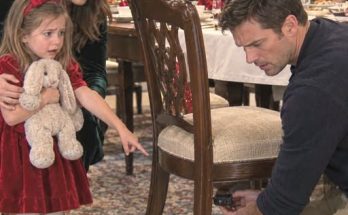
Sophia had been seated where she could reach her rabbit, and the object was attached beneath the wooden seat.
I explained that I hadn't removed it.
She thanked me for the clarification.
Then she asked whether Marcus had ever discussed using physical devices to store sensitive information at home.
I told her what I knew about his professional work.
Marcus had built his business around cybersecurity consulting.
He had clients who depended on him to protect confidential systems and data.
He was proud of his technical knowledge and often talked about the importance of limiting access to sensitive material.
But I had never seen the object under the chair before that night.
I had no way of knowing what it was designed to do.
Ramirez said the investigators would examine it.
I left the conversation there.
I didn't want to speculate my way into believing I understood the evidence before it had been assessed.
Meanwhile, Sophia continued to have visits with me under the arrangements made by the caseworker.
The first time she came over, she spent nearly twenty minutes looking through the books on my shelf.
She chose one with pictures of animals.
We sat on the sofa, and she asked me to read it twice.
Then she asked me to read it a third time, slower.
I did.
When we finished, she put the book down and studied the window.
“Can we leave the lights on tonight?”
I looked at her.
“Of course.”
She nodded as if she were filing away the answer.
I wondered how many small things she had learned to fear.
I didn't ask.
I made sure the lamp beside the sofa stayed on until the visit ended.
That evening, Ramirez called again.
The device had been secured as part of the investigation.
She explained that its contents were being examined by people qualified to handle digital evidence.
I asked whether it had been connected to Sophia's injuries.
She said she couldn't draw that conclusion yet.
The device and the abuse allegations were both being investigated, but each would have to be assessed on the evidence available.
I appreciated her answer.
It was careful.
It was also a reminder that I couldn't force the truth to arrive simply because I needed it.
Over the next several days, I continued to cooperate.
I provided the messages from Marcus.
I answered follow-up questions about the dinner.
I described the moment Sophia had led me to the chair and shown me the hidden object.
I repeated what she had said about her father and the secret game.
I never tried to fill in details I hadn't witnessed.
I had spent years watching people weaken their own credibility by claiming too much.
I wasn't going to make that mistake now.
Then, one afternoon, Ramirez asked me to come in for a longer interview.
I brought my notes.
We went through the evening from the beginning.
The drive to Lake Forest.
The Christmas dinner.
Sophia refusing to sit.
Her parents dismissing her complaint.
The bruises.
Her disclosure.
The call to the doctor.
The hospital.
Marcus's arrival and his threats.
The device beneath the chair.
When we reached that last point, Ramirez asked me to describe the object again.
I explained that it was a small black case fixed tightly against the underside of the wooden seat.
I had seen electronic components attached to it, but I hadn't examined them closely enough to identify every part.
I told her that Sophia had referred to it as a black box.
She asked whether Marcus had ever warned me about it.
“No.”
“Did you know it was there before that night?”
“No.”
“Did you remove it?”
“No.”
She wrote something down.
Then she asked me about Marcus's business.
I told her what I knew from conversations over the years.
He handled confidential information for clients.
He was proud of his security arrangements.
He kept a close watch on who had access to his work and his property.
I didn't know whether any of that was relevant to the device.
Ramirez thanked me.
Before I left, she reminded me that I might receive more questions as the investigation developed.
I said I understood.
When I stepped outside, the sky was grey, and the wind had turned cold.
I stood on the pavement for a moment, looking at the cars passing through the intersection.
I had expected the truth, once found, to make me feel stronger.
Instead, I felt tired.
There was no satisfaction in knowing that my niece had been hurt.
There was no relief in understanding that the situation was serious.
The only thing I could do was keep showing up.
That night, Sophia called me with help from the caseworker.
She wanted to know whether I had repaired Clover's loose ear.
I had sewn it back into place as carefully as I could.
I held the rabbit up to the camera.
She smiled.
It was small, but it was real.
“Is it strong now?”
“Strong enough for a lot of adventures.”
She considered that.
“Not too many.”
I laughed softly.
“Not too many.”
When the call ended, I put the rabbit's spare thread away in a drawer.
I thought about how little it had taken to make her happy.
A repaired seam.
A light left on.
An adult who answered when she called.
Those things should have been ordinary.
For Sophia, they had become reasons to ask whether she could trust someone.
I hated that.
But I also knew trust couldn't be demanded from her.
It would have to grow from what we did next.
Click here to continue reading: PART 7: The Records on the Hidden Drive Forced Investigators to Ask New Questions, and My Brother Could No Longer Treat the Case as a Family Dispute
I Had Driven Four Hours for Christmas Dinner, but My Niece Wouldn’t Sit Down and Nobody Else Wanted to Know Why
Part 6 of 9

One Comment on “PART 6 – The Search of Marcus’s House Began With the Chair, but the Evidence Would Reach Far Beyond the Christmas Dinner We Had Shared”