I used to believe that people who did terrible things eventually gave themselves away.
I made documentaries about fraud, corruption, and powerful men who thought they were too smart to get caught.
Then my five-year-old niece asked me for help, and I learned how much damage a person could do while everyone else sat quietly at the dinner table.
It happened on Christmas night at my brother Marcus’s house in Lake Forest, Illinois.
I had driven nearly four hours from Chicago.
We hadn’t spent time together in eight months, and I had almost canceled the visit twice before leaving.
Marcus and I had never been especially close as adults.
He was successful, confident, and comfortable around people who mattered.
I made investigative documentaries, which meant I spent much of my life asking questions that other people preferred not to answer.
He liked telling people about his business.
I liked asking what his business actually did.
That difference had created a distance between us over the years.
Still, he was my brother.
And his daughter, Sophia, was the closest thing I had to a child of my own.
She was five, small for her age, and rarely went anywhere without a stuffed rabbit with one floppy ear.
I called her Little Bird.
I had started using that nickname when she was a baby, back when she could barely hold her head up and used to curl her fingers around mine.
She still remembered it.
At least, she did before that Christmas.
Marcus’s house looked exactly the way I expected it to look.
Every window had holiday lights.
A tall Christmas tree stood in the living room, its ornaments arranged so carefully that I wondered whether anyone was allowed to touch them.
The dining table was dark mahogany, polished until the overhead lights reflected off its surface.
There were crystal glasses, silver serving dishes, and a large platter of prime rib in the center.
Everything was expensive.
Everything was in its place.
Except Sophia.
She stood beside her dining chair, clutching her rabbit against her chest.
Her red velvet dress was slightly twisted at the waist.
She kept looking at the seat.
Then she looked toward her father.
Then she looked at me.
I noticed because she had never been shy around me before.
“Come on, sweetheart,” Elisa said. “Everyone is waiting.”
Elisa was my sister-in-law.
She had a way of speaking that sounded pleasant until you paid attention to the words.
Sophia didn't move.
Marcus continued cutting his meat.
“Sit down, Sophia.”
His voice carried the same impatience he used when an employee interrupted him during a phone call.
Sophia swallowed.
“I don't want to.”
Elisa gave a small, embarrassed laugh.
“She's been difficult all afternoon.”
I glanced at Marcus.
He didn't look concerned.
He looked annoyed that the meal wasn't proceeding as planned.
Sophia's fingers tightened around the rabbit.
“The chair hurts.”
For a moment, nobody said anything.
Then Marcus shook his head.
“Here we go again.”
He put down his knife, looked directly at his daughter, and pointed toward the seat.
“Sit down.”
I set my fork on the edge of my plate.
“What's wrong with the chair?”
Marcus turned to me.
“Nothing is wrong with it.”
“She says it hurts.”
“She also says a dozen things when she doesn't get her way.”
Elisa took a sip of wine.
“She knows people pay attention when she cries. She's learned that.”
I looked back at Sophia.
Her eyes were fixed on the floor.
She wasn't throwing a tantrum.
She wasn't stamping her feet or demanding a different seat.
She was standing perfectly still, as if any movement might make the situation worse.
I had interviewed people who lied for a living.
I had watched executives smile while explaining missing millions.
I had listened to witnesses describe terrible things with steady voices because they had spent years convincing themselves that nothing had happened.
I knew I could be wrong about people.
But I also knew what fear looked like.
“Maybe we should let her sit somewhere else,” I said.
Marcus's expression hardened.
“Michael, don't start.”
“I asked a question.”
“And I answered it.”
He picked up his knife again.
“She needs to learn that she can't control every situation by crying.”
Sophia finally climbed onto the chair.
She lowered herself slowly, gripping the edges of the seat with both hands.
The moment she settled onto it, her face changed.
Her mouth tightened.
Her shoulders rose.
Tears gathered in her eyes, but she made no sound.
I watched her try to hold herself still.
Then I saw her lift her weight slightly, as though she were trying to find a position that didn't hurt.
Something cold settled in my stomach.
“What happened to her?” I asked.
Marcus sighed.
“Nothing happened to her.”
Elisa looked at me as though I had embarrassed her in front of company.
“She probably bumped herself playing. Children get bruises.”
“I haven't asked about bruises.”
That made her pause.
It was only for a second, but I noticed.
Marcus noticed me noticing.
“Don't turn dinner into one of your investigations.”
I looked down at my plate.
I should have pushed harder right then.
I should have stopped caring whether my brother thought I was interfering.
Instead, I let him change the subject.
Looking back, that decision still bothers me.
Not because it stopped me from helping Sophia.
It didn't.
But because I was already measuring my words against Marcus's temper when I should have been thinking only about what the child in front of me needed.
He began talking about a new lease for his company.
He described the office space, the security arrangements, and the clients he expected to bring in during the coming year.
I answered when he looked at me.
Elisa passed the vegetables.
Sophia remained quiet.
Every few minutes, she shifted on the chair.
Every time she did, her face tightened again.
I stopped eating.
I watched her instead.
At one point, she looked up and caught me looking.
She immediately lowered her eyes.
That frightened me more than the crying had.
A child who expects help usually looks at the person she trusts.
A child who expects trouble learns to look away.
I waited until Marcus was explaining some expensive piece of equipment his company had installed in its new office.
Sophia slipped off her chair.
She carried her rabbit to the kitchen doorway and glanced back at me.
I thought she might want something to drink.
Then she curled two fingers toward herself.
Come here.
I excused myself and followed her.
She took my hand.
Her palm was damp, and she held me so tightly that her fingernails pressed into my skin.
“What's going on, Little Bird?”
She didn't answer.
Instead, she led me back toward the dining room.
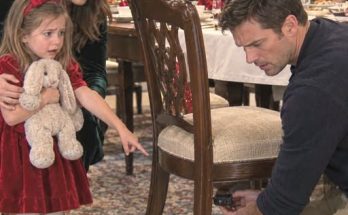
She stopped beside her chair and crouched.
Then she pointed underneath the seat.
I bent down.
At first, I couldn't see what she meant.
The chair was heavy, with a broad wooden seat and thick legs.
I shifted to one side and looked beneath it from a different angle.
Something dark was attached to the underside.
It didn't belong there.
I leaned closer but didn't touch it.
Sophia stood behind me, holding her rabbit against her stomach.
“Does that make the chair hurt?” I whispered.
She nodded.
I turned toward her.
“Can I see where you're hurting?”
She hesitated.
Then she pushed the sleeve of her dress upward.
There were bruises on her arm.
Not one.
Several.
Some were dark enough to stand out against her skin. Others had faded toward yellow and brown.
My mouth went dry.
She lifted the hem of her dress just enough to show me marks near her knee.
I looked away for a second because I needed to steady myself.
When I looked back, she was watching my face.
“Are you going to believe me?”
The question was so quiet that I almost wished I hadn't heard it.
I crouched until we were looking directly at each other.
“I'm listening, Sophia.”
She began to cry.
There was no loud sobbing.
Her face simply crumpled, and tears ran down her cheeks while she tried to keep herself quiet.
She told me that her father came into her room at night.
She described something he called a secret game.
She said she had told him to stop because it hurt.
She said he became angry when she tried to refuse.
Then she told me she had gone to her mother.
Elisa had called her a liar.
She had warned Sophia that if she kept making accusations, the police might take her away from her parents.
I felt as though the floor had tilted beneath me.
I wanted to ask a hundred questions.
I wanted to march back into the dining room and demand that Marcus explain himself.
I wanted to take Sophia out of that house and never let her see either of them again.
But I understood one thing clearly.
She had finally told someone because she believed I might help.
If I frightened her, if I made her think she had caused another fight, I could make it harder for her to speak again.
So I kept my voice low.
“You didn't do anything wrong.”
She wiped her face with the back of her hand.
“Daddy says I have to keep secrets.”
“You don't have to keep a secret that makes you scared.”
She looked toward the dining room.
“Elisa will be mad.”
I didn't correct her about calling her mother by her name.
I only held her hand.
“I'm here.”
“Will you help me?”
“Yes.”
“Promise?”
I looked at the bruises on her arm.
Then I looked at the rabbit she was squeezing against her chest.
“I promise.”
From the dining room, Elisa called her daughter's name.
Sophia flinched.
“Come back here,” Elisa shouted.
Sophia hurried away before her mother came to find her.
I followed a moment later.
Marcus was still talking about his business.
Elisa had started clearing plates.
Neither of them looked as though anything unusual had happened.
I sat down.
I didn't accuse my brother.
I didn't tell Elisa what Sophia had said.
I didn't even ask them to explain the object beneath the chair.
I took out my phone under the table and contacted a doctor.
I described the injuries I had seen and the disclosure Sophia had made.
I didn't try to diagnose anything.
I asked what I needed to do to get her help safely.
The doctor's voice changed as I spoke.
He told me Sophia needed an urgent evaluation by professionals trained to assess possible abuse in children.
He also explained that her immediate safety had to come first.
I looked across the table.
Marcus was laughing at something Elisa had said.
For years, I had thought the worst thing about my brother was his arrogance.
I was beginning to understand how little I knew about him.
I waited until I could get Sophia away from the dining room.
Then I took her to receive medical care.
By the time we reached the hospital, I had stopped pretending that this might be an innocent misunderstanding.
Sophia held my hand all the way inside.
She never asked for her father.
She never asked to go home.
She only kept checking that I was still beside her.
And I kept thinking about the chair.
Whatever had been attached beneath it, Sophia had been frightened enough to show it to me.
I didn't yet understand why.
But I knew I wasn't going to leave her alone with the question.
Click here to continue reading: PART 2: The Doctor Found a Pattern in Her Injuries, but My Niece Was More Frightened of What Her Father Might Discover Than of the Hospital
I Had Driven Four Hours for Christmas Dinner, but My Niece Wouldn’t Sit Down and Nobody Else Wanted to Know Why
Part 1 of 9