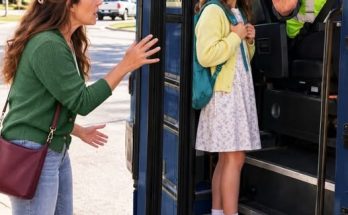
The next afternoon, I left work at the usual time.
I had arranged my schedule so I could collect Ellie myself.
The decision was partly practical.
It was also because I wanted her to know that our ordinary routine was still there for her.
I drove to Maple Ridge Elementary and waited until the school day ended.
When Ellie came outside, her purple schoolbag was hanging from one shoulder.
She saw my car and smiled.
The smile was smaller than the one she had given me before the incident, but it was real.
I felt some of the tightness in my chest ease.
She climbed into the passenger seat and fastened her belt.
“How was school?”
“Okay.”
I glanced at her.
“Anything interesting happen?”
She told me about a classroom assignment and something a classmate had said.
I listened without turning the conversation back toward the bus.
She deserved an afternoon when she could talk about ordinary things without wondering whether I was waiting to ask another question.
When we reached home, she took her bag inside and placed it beside the kitchen table.
I watched her settle into her routine.
She washed her hands.
She got something to eat.
She brought out her schoolwork.
Nothing about those small actions could change what had happened.
But seeing her move through them made me realize how much I wanted to protect the ordinary parts of her life.
I wanted her to be able to stand at a bus stop without worrying about strangers.
I wanted her to trust the adults who were responsible for her safety.
And I wanted her to know that she could come to me when something frightened her.
Those things were more important than proving that I had been right.
That evening, I returned to the message I had drafted for the school district.
I read it again.
The words still seemed honest.
I explained that my initial complaint had been made before I knew about the stranger who had approached the bus.
I acknowledged that Frank had reportedly prevented the man from boarding.
I also made clear that I still wanted to understand the circumstances surrounding the incident.
I did not withdraw my concern for Ellie.
I did not accuse Frank of anything I could not support.
I simply corrected my own account.
Then I sent the message.
I set the phone down.
There was no immediate feeling of relief.
No sudden sense that the problem had been solved.
I still had questions, and I still wished the afternoon had unfolded differently.
But I no longer felt that I needed to defend every word I had said in the first few minutes after the bus left.
I could admit that I had been wrong about part of the situation without pretending that my fear had been unreasonable.
Both things were true.
I had been terrified when I saw my daughter crying behind the window.
And I had made assumptions before I understood what had happened.
One fact did not cancel the other.
Later, I sat with Ellie while she finished her schoolwork.
She asked me to check one of her answers.
I leaned over the paper and read the question.
She had made a small mistake, so I showed her where to look again.
She corrected it herself.
Then she smiled when she got the answer right.
I smiled back.
It was such a small moment.
But I found myself holding on to it.
The afternoon of the bus incident had made everything feel urgent and unfamiliar.
Now I was watching my daughter work through a simple problem, erase an incorrect answer, and try again.
There was something reassuring about that.
Getting something wrong did not have to be the end of the story.
It meant you had to look again.
I thought about Frank.
I still couldn't say that I agreed with every decision he had made.
I still wanted to understand why he had closed the doors without explaining what was happening.
But I could no longer treat that question as proof that he had intended to harm my daughter.
I had to leave room for the possibility that he had been responding to a danger I couldn't see.
That was what I had failed to do at Briar Street.
I had believed that the person who frightened me must be the person responsible for the danger.
I had not considered that someone else's actions might have caused the situation in the first place.
The stranger's brown jacket had become a detail I couldn't forget.
So had the silver pickup mentioned by Deputy Reed.
I didn't know whether the truck belonged to the man.
I didn't know whether he had been waiting near the vacant property.
I couldn't honestly connect those details beyond what had been reported to me.
I had to resist the temptation to build a story around them.
It was easy to do.
A few unanswered questions could quickly become a chain of assumptions, each one making the next seem more certain.
I had already done that once.
I wasn't going to do it again.
Instead, I held on to what I knew.
An unfamiliar man had approached the bus and asked for Ellie.
He had claimed to be her uncle, although she did not recognize him.
Frank had refused to let him board.
And at Briar Street, Frank had acted as though he still needed to keep Ellie on the bus.
I didn't know everything that connected those moments.
But I knew enough to understand why my first judgment had been incomplete.
When Ellie finished her schoolwork, she carried the papers to the counter.
Then she picked up her purple schoolbag and put it beside the door for the next morning.
I watched her do it.
The bag had been with her when she saw the stranger.
It had been with her when she cried behind the bus window.
It had been beside her chair in the conference room while Deputy Reed asked his questions.
Now it was back where she usually kept it.
I wanted that ordinary sight to mean that everything was settled.
It didn't.
There was still more to understand about what had happened that Tuesday.
But the most important change had already begun.
I had stopped treating my first reaction as the final truth.
I had stopped assuming that every unanswered question pointed toward wrongdoing.
And I had started listening to my daughter without expecting her to make the world understandable for me.
That night, before bed, Ellie came to say goodnight.
She hugged me and then stepped back.
“Love you, Mom.”
“Love you, too.”
She went to her room.
I stood in the hallway, listening to her footsteps fade.
I could not guarantee that I would never be frightened again.
I could not promise that I would always understand a situation immediately.
But I could choose what to do when I didn't understand.
I could ask questions before making accusations.
I could accept that someone might know something I didn't.
And I could admit when I had been wrong.
The bus had carried Ellie away from me that afternoon.
For a few terrible minutes, I thought that meant I had lost control of everything that mattered.
Now I understood that control was not the same as certainty.
I could not control every person my daughter might encounter.
I could not see everything happening around her.
But I could make sure she knew she could tell me when something frightened her.
I could take her concerns seriously without deciding in advance who was guilty.
And I could remember that protecting her sometimes meant admitting how much I still had to learn.
I turned off the kitchen light.
Ellie's purple schoolbag waited beside the door.
Tomorrow, there would be breakfast, schoolwork, and another ordinary afternoon.
I hoped it would stay ordinary.
But whatever came next, I knew I had to meet it with open eyes.
The End
Read more original stories on Feel Every Story.
I Thought the Driver Had Taken My Daughter Until I Realized There Was Something I Had Failed to See
Part 8 of 8