I slept badly that night.
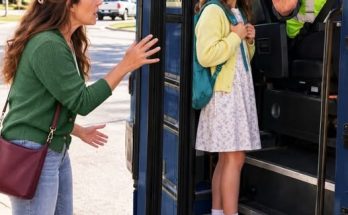
Every time I closed my eyes, I saw Ellie behind the bus window.
Her hand against the glass.
Her face wet with tears.
The bus moving away while I stood on the street.
Then the memory changed.
I saw Frank turning toward something beyond the doorway.
I saw him rise from his seat.
I saw his arm block the aisle.
The same moments kept returning, but I could no longer interpret them as easily as I had before.
I didn't know what he had seen.
I didn't know what he had been thinking.
I knew only that the stranger at Oak Street had changed the meaning of the scene I had witnessed.
In the morning, Ellie came into the kitchen wearing her school clothes.
She placed her purple schoolbag beside her chair and sat down for breakfast.
I watched her carefully.
She looked tired, but she was moving through her routine.
I didn't want to make the morning harder by asking her to revisit everything again.
So I poured her something to drink and asked whether she wanted more breakfast.
She shook her head.
“I'm okay.”
I nodded.
We ate quietly.
Before she left for school, I checked that she had everything in her bag.
The habit felt almost painfully ordinary.
A folder.
Her lunch.
A pencil case.
I closed the zipper and handed the bag to her.
She took it without saying anything.
I drove her to Maple Ridge Elementary that morning rather than asking her to think about the bus.
I didn't make a speech about safety.
I didn't ask whether she was afraid.
I simply stayed with her until she was ready to go inside.
She hugged me before leaving the car.
Then she walked toward the school entrance.
I watched until she disappeared through the doors.
I remained in the parking lot for another moment.
I had work to do.
My schedule at the dental clinic was waiting, and patients would arrive whether I had slept well or not.
But before I started the car, I took out my phone and looked at the complaint confirmation again.
I read the words I had submitted.
I remembered the anger in my hands as I typed them.
I remembered how relieved I had felt when the confirmation number appeared.
At the time, filing the complaint had made me feel as though I had regained some control.
Now I could see that I had acted before I understood the whole situation.
I hadn't lied about what I saw.
But I had treated my interpretation as fact.
That was something I needed to acknowledge.
At the clinic, I tried to concentrate on the day's appointments.
I confirmed times, moved a patient to a different slot, and answered a question about an insurance form.
The work was familiar.
The rhythm helped.
Still, my thoughts kept returning to the bus.
At one point, I caught myself staring at a blank section of the schedule.
I had entered the wrong appointment time.
I corrected it before anyone noticed.
Then I took a breath and continued.
I couldn't afford to let my fear take over every part of the day.
But I couldn't simply push the incident out of my mind, either.
During a quiet moment, I thought about the silver pickup.
I tried to reconstruct the street.
The vacant property.
The driveway.
The sound I remembered behind me.
I could almost see a vehicle in the corner of my memory, but the picture would not settle.
I didn't know whether that was because I had truly seen one or because Deputy Reed's question had planted the image in my thoughts.
I refused to turn uncertainty into another claim.
If I didn't remember, I didn't remember.
That should have been easy to admit.
It wasn't.
I had built my reaction around the belief that I had seen everything important.
Now I had to live with the possibility that I had missed something crucial.
By the time I finished work, I knew what I wanted to say to the school.
I didn't want to withdraw my concerns about how frightening the incident had been for Ellie.
I wanted to correct the part I could no longer stand behind.
I had accused Frank of acting without a reason.
I no longer believed I could say that.
I also wanted to understand what information the school had received about the stranger and how it had handled the situation.
I couldn't assume the answers.
I could only ask.
That evening, after Ellie had settled into her usual routine, I sat at the kitchen table and opened the district complaint confirmation.
The number was still visible.
I read it once more.
Then I put the phone down.
I wasn't ready to write another message while I was still trying to sort through my feelings.
I wanted to be careful with my words.
Not because I wanted to protect Frank from accountability.
Because I wanted my account to be accurate.
I thought about the way I had spoken to the school secretary.
The way I had interrupted the assistant principal.
The way I had told Deputy Reed that the pickup truck was irrelevant.
I had treated every question that didn't fit my version of events as though it were an obstacle.
Now I understood why that had been unfair.
The deputy wasn't asking about the truck to distract me from my daughter.
He was trying to understand whether another person had been involved.
The assistant principal wasn't necessarily refusing to help me.
She had been trying to explain that an incident involving an unfamiliar adult had occurred.
And Frank had not simply driven away for no reason, at least according to the information I had learned.
I had been so certain that everyone else was failing to understand my fear that I hadn't considered how little I understood about theirs.
That realization stayed with me.
The following morning, I woke with the same questions, but they no longer felt like accusations waiting to be spoken.
They felt like things I needed to learn.
I wanted to know what Frank had reported.
I wanted to know what had happened at Oak Street.
I wanted to know whether the school had information I hadn't received.
And I wanted to make sure Ellie didn't feel responsible for any of it.
I didn't have the answers yet.
I did have a better understanding of what I should not do.
I would not claim that I knew the stranger's intentions.
I would not claim that I knew exactly what Frank had seen.
And I would not tell myself that my fear made every conclusion I had drawn correct.
Those limits were uncomfortable.
They were also necessary.
Click here to continue reading: PART 7: I Had Mistaken an Unanswered Question for Proof, and I Could No Longer Pretend My First Explanation Was the Only One
I Thought the Driver Had Taken My Daughter Until I Realized There Was Something I Had Failed to See
Part 6 of 8