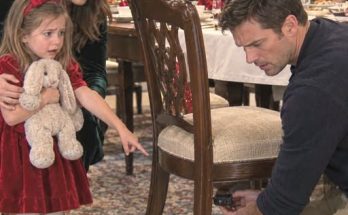
The months after Christmas were difficult in ways I hadn't anticipated.
I had expected anger.
I had expected legal arguments and calls from people who wanted to know why I had become involved.
I hadn't expected how often I would remember ordinary moments from the dinner.
The silver knife in Marcus's hand.
The crystal glasses.
The way Elisa had laughed when Sophia said the chair hurt.
Those details returned without warning.
Sometimes I remembered them while working.
Sometimes I remembered them while driving.
Sometimes I woke in the middle of the night and saw Sophia's face as clearly as if she were standing beside my bed.
I kept telling myself that I had helped her.
That I had listened.
That I had brought her to a doctor instead of allowing the evening to continue.
It was true.
But I also knew how close I had come to doing nothing more than asking Marcus to be nicer.
The investigation moved forward.
The medical findings and Sophia's disclosure were examined alongside the other evidence.
The authorities continued reviewing the digital material recovered from the device.
As more records were verified, the investigation into Marcus's business expanded.
There were financial records that raised questions about his company's practices.
There was material investigators believed was connected to blackmail.
There were files that required careful comparison with information obtained from other sources.
I wasn't given every detail, and I didn't ask to see everything.
I wanted the truth established properly.
I didn't want to become another person who decided what the evidence meant before the work was finished.
Marcus's lawyers challenged the allegations.
He continued to deny that he had done anything wrong.
When he contacted me, he often spoke as if the only problem was my involvement.
He accused me of betraying him.
He said I had taken a private family matter and turned it into a public disaster.
I listened once without interrupting.
Then I told him I had not created the injuries or made Sophia afraid to speak.
He said I was choosing a child over my own brother.
I sat with that sentence after the call ended.
For a long time, I had believed that being a good brother meant giving Marcus the benefit of the doubt.
I had treated family loyalty as an obligation to stand beside him, even when I disagreed with him.
But he was asking me to make a different choice now.
He wanted me to ignore what Sophia had told me.
He wanted me to question the doctor instead of questioning his own behavior.
He wanted me to treat the discovery beneath the chair as a threat to his reputation rather than something the authorities had a right to examine.
I couldn't do that.
I had spent too much time around people who confused loyalty with silence.
I wasn't going to repeat that mistake.
Elisa's role became clearer as the investigation continued.
She had been told about Sophia's complaints.
Instead of seeking help, she had dismissed them and threatened the child with the possibility of being taken away.
The authorities examined those decisions as part of the case.
Elisa had her own legal representation.
I didn't contact her.
I didn't know what she might say, and I didn't want my anger to interfere with the process.
I thought about the evening when she had poured herself another glass of wine while Sophia struggled to sit down.
I wondered whether Elisa had been afraid of Marcus.
I wondered whether she had convinced herself that denying the problem was the only way to keep her life intact.
Those questions did not excuse what she had done.
A child had asked her mother for help.
Her mother had made the child afraid to ask again.
Whatever Elisa had feared, Sophia had paid for it.
The months passed.
I continued visiting Sophia under the arrangements made for her care.
She grew more comfortable asking for things.
Sometimes she wanted a snack.
Sometimes she wanted to draw.
Sometimes she wanted to sit beside me without talking.
I learned not to mistake silence for a problem that needed fixing.
One afternoon, she asked whether I could help her write her name on a piece of paper.
She printed the letters slowly.
The S was large.
The final A leaned sideways.
When she finished, she held the paper up to me.
“Is it right?”
“It's your name.”
She smiled.
Then she folded the paper and tucked it into the bag where she kept Clover.
I watched her do it.
I thought about the way she had once held her rabbit against her chest as if it were the only thing she could trust.
Now she carried it because she loved it.
That difference mattered.
The legal process took time.
There were interviews, records to review, and evidence that had to be presented in a form the court could consider.
I answered questions when I was asked.
I described the dinner.
I explained what I had seen beneath the chair.
I repeated the words Sophia had used when she disclosed the abuse.
I did not embellish her account.
I did not claim to know what had happened in rooms where I had never been.
I told the truth about what I had witnessed and let the evidence speak for itself.
The digital investigation became a separate source of pressure for Marcus.
The records recovered from the device pointed investigators toward financial wrongdoing and a blackmail operation.
The material was examined, authenticated, and compared with other evidence.
It was not simply a matter of finding files and declaring the case solved.
The investigators had to establish what the records showed and how they related to the allegations.
As that work progressed, Marcus's confident public image began to crack.
The same man who had threatened to ruin my career now had to answer questions from people who were not impressed by his money or his reputation.
He could hire lawyers.
He could challenge evidence.
He could deny accusations.
But he could no longer control every person who knew what had happened.
That was the part I had once believed would never happen.
I had watched him move through life as if consequences were something that happened to other people.
Now he was facing them.
I did not celebrate.
There was no satisfaction in seeing my brother's life collapse when the reason for it was the suffering of a child.
I wanted the facts established.
I wanted Sophia protected.
I wanted the adults who had failed her to be held accountable.
Nothing about that felt like victory.
One evening, after a long visit, Sophia sat beside me while the light faded outside the window.
She was quiet for a while.
Then she asked whether her father would come to see her.
I took a breath.
“I don't know what the court will decide about the future.”
She looked at her hands.
“Will he be angry?”
“He might be.”
She seemed to consider that answer.
Then she asked whether she had to make him feel better.
“No.”
I waited until she looked at me.
“You don't have to take care of the feelings of the adults who hurt you.”
She nodded slowly.
I knew she might need to hear that many more times.
I was willing to say it.
Before she left, she handed me a drawing.
It showed a little house with a wide window and a bright yellow door.
There were two figures in front of it.
One was small.
The other was tall.
Above them, she had drawn a yellow circle with lines coming out of it.
“That's the sun,” she explained.
I asked where she wanted me to put the picture.
“Somewhere you can see it.”
I placed it on the refrigerator beside the drawing she had made earlier.
She watched me attach it with the same magnet.
Then she smiled.
On the drive home, I thought about the house in Lake Forest.
The polished table.
The expensive glasses.
The chair that looked like every other chair in the dining room.
I had once mistaken that house for proof that my brother had built a good life.
Now I understood that appearances could tell you very little about what happened inside a family.
The house had not looked frightening.
The dinner had not looked dangerous.
Marcus had not looked like a man who would hurt his own child.
That was what made the warning signs so easy for everyone to dismiss.
The truth had not been hidden because nobody could see it.
It had been hidden because the people who saw pieces of it had chosen not to look closely.
I couldn't change what had happened before Christmas.
I couldn't give Sophia back the years when she had been afraid to tell someone.
But I could keep showing up.
I could make sure she knew she was believed.
I could let the law take its course without allowing Marcus's threats to decide what I said.
And I could stop pretending that protecting a family meant protecting its secrets.
Click here to continue reading: PART 9: Six Months After the Evidence Was Recovered, I Finally Understood What It Meant to Give My Niece a Future She Could Trust
I Had Driven Four Hours for Christmas Dinner, but My Niece Wouldn’t Sit Down and Nobody Else Wanted to Know Why
Part 8 of 9