I used to think the worst thing a frightened child could do was cry.
Then I met Leo.
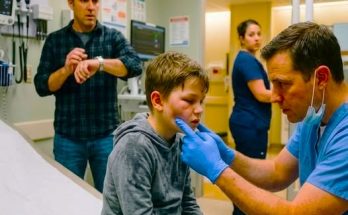
It was 3:14 a.m. when his stepfather brought him into our emergency department on the Oregon coast. By the time they reached my attention, I had already heard the man complain twice about the wait.
He wasn't worried about the boy.
He was worried about being late for work.
Rain had been falling for hours. Water collected beneath the ambulance bay lights, and every time the automatic doors opened, a cold draft swept through the waiting room.
I was finishing a chart when a nurse called me over.
A man stood near triage with one hand wrapped around a small boy's wrist.
The boy had a gray hoodie pulled up around his head. His shoes were wet, and one lace had come undone.
The man kept tugging him forward whenever he slowed down.
"Spider bite," he told the nurse. "He needs antibiotics."
The nurse asked how long the swelling had been there.
The man glanced at his watch.
"I don't know. Since yesterday, maybe. Can we hurry this up? I've got a shift in three hours."
I put down my pen.
There were plenty of reasons someone might be impatient in an emergency department. People were tired. People were frightened. Sometimes they were both, and it came out sounding like anger.
I had learned not to judge a person from one bad sentence.
But the boy's face made me stop thinking about the man.
The right side was swollen beneath the hood. Even from several feet away, I could see the difference between his cheeks.
He wasn't crying.
He wasn't asking for help.
He was watching the floor.
"My name is Dr. Thomas," I said. "What's yours?"
The man answered before the boy could.
"Leo."
I looked at the child.
"Is that right, Leo?"
He nodded.
His stepfather's grip tightened as though the simple question had somehow taken too long.
I asked the man for Leo's date of birth.
He stared at the registration form.
For a few seconds, he appeared genuinely puzzled.
"My wife keeps track of all that stuff."
He said it with the irritation of someone asked to remember a meaningless password.
I looked back at Leo.
Nine years old.
That was what the registration information eventually established.
Nine, and standing beside an adult who could not readily provide his birthday.
I told them I would examine him in Room 4.
The man pulled Leo toward the corridor.
The boy stumbled once.
He recovered without making a sound.
That bothered me more than it should have, though at the time I couldn't have explained why.
Children fell. Children tripped over their own feet. Children arrived at the hospital tired and miserable.
Still, I noticed that Leo never looked up to see whether the man had noticed his stumble.
He simply corrected himself and kept moving.
Inside the examination room, he climbed onto the bed and sat near the edge.
The paper beneath him crackled.
He tucked both hands into the front pocket of his hoodie and kept his knees close together.
Water dripped from his shoes onto the floor.
His stepfather remained standing.
"Sit properly," the man told him.
Leo straightened at once.
There was no pause between the command and the movement.
His back stiffened. His shoulders drew themselves into place. His chin lifted a fraction.
It looked less like obedience than practice.
I glanced toward Sarah, the nurse assigned to my room.
She had the chart open against her chest. When the man turned away, she touched the chart twice with one finger.
She had noticed the same things I had.
The story at triage was already full of gaps.
The man claimed a spider had bitten Leo, but he couldn't tell us exactly when the swelling began. He didn't know whether the boy had developed a fever.
He couldn't say when Leo had last eaten.
Every time Sarah tried to ask the child something, his stepfather answered instead.
I had seen adults do that before. Some were anxious and believed they were helping. Others were simply accustomed to speaking for their children.
The distinction mattered.
I wasn't ready to decide which kind of man stood in my examination room.
Sarah moved closer while he looked toward the counter.
"Could be a dental infection," she murmured.
She was right to consider it.
A damaged tooth could cause serious swelling across a child's cheek and jaw. If an infection spread into the surrounding tissues, the situation could become dangerous quickly.
But the circular opening near the center of Leo's swollen cheek didn't look like anything I wanted to dismiss.
I pulled my stool toward the bed.
Then I stopped.
Leo's eyes had moved to my hands.
I placed them in my lap so he could see them clearly.
"Would it be all right if I moved your hood back?"
He looked at his stepfather.
The man gave an impatient sigh.
"Just let him do it."
Leo nodded.
I reached slowly for the fabric and eased it away from the right side of his face.
The swelling extended from the cheekbone toward the jaw. His skin was tight and discolored, with purple marks visible beneath the surface.
Near the middle was a small, round opening.
At first glance, it might have passed for a puncture from an insect.
But the edges looked unusually distinct, and the opening appeared deeper than I expected.
I leaned closer without touching it.
There was an unpleasant smell.
Something like wet soil, mixed with a faint sweetness that didn't belong in an ordinary examination room.
His stepfather noticed my expression.
"Looks disgusting, doesn't it?"
He almost sounded amused.
Leo kept his gaze on the pens in my scrub pocket.
I asked whether the area hurt.
"No."
"Does it sting?"
He shook his head.
"Tell me what you feel."
The boy considered that question carefully.
"It feels heavy."
I looked at him again.
He didn't sound confused. He didn't sound as though he were trying to find a word that would satisfy me.
He seemed to be describing a sensation he had already spent time trying to understand.
His stepfather checked his watch.
The metal caught the fluorescent light.
I asked Leo to open his mouth so I could examine his teeth. He did as he was told, although his eyes kept shifting toward the man standing behind me.
I checked what I could without forcing him to hold his mouth open longer than necessary.
A dental problem remained possible, but it didn't explain everything I was seeing.
I needed to examine the rest of the affected area and determine whether the swelling concealed an abscess, an injury, or something else entirely.
More importantly, I needed to see how Leo responded when he wasn't being watched by the man who had brought him in.
"Sir, could you stand over by that wall for a moment?" I asked.
The man frowned.
"Why?"
"I need room to complete the examination."
It was an ordinary request, but I knew it wasn't the real reason I had made it.
There was no special hospital rule requiring him to stand against a wall.
I wanted distance between him and the boy.
I wanted to know whether Leo could answer a question without first checking his stepfather's face.
The man looked at Sarah.
She met his eyes without changing her expression.
After a moment, he moved.
I waited until he had crossed the room before turning back to Leo.
"Have you eaten anything today?"
Leo's hands remained inside his hoodie.
He looked toward the wall.
Then he answered in a voice so quiet I almost asked him to repeat it.
"Yesterday afternoon."
I felt my stomach tighten.
Before I could ask another question, his stepfather spoke from across the room.
"He eats when he's hungry. He's just difficult."
I didn't turn around.
I had learned that a child sometimes needed to see that an adult's interruption would not automatically end the conversation.
"Leo, did you have breakfast this morning?"
The boy shook his head.
"Anything last night?"
Another shake.
His stepfather made a noise of annoyance.
"He's always been like this."
I wrote down the information.
I didn't argue. I didn't accuse him of anything. At that point, I had observations and unanswered questions, not a complete explanation.
The swelling still needed treatment.
Whatever had happened before Leo entered the hospital, I couldn't let my suspicion distract me from the immediate medical problem.
I opened a sterile packet and put on fresh gloves.
"Leo, I'm going to check the swollen area now. I'll be gentle."
He nodded.
I brought two fingers toward his cheek and pressed lightly along the tissue surrounding the opening.
The skin felt hot.
Then something beneath it shifted.
I stopped moving.
For an instant, I thought my fingers had slipped against a pocket of fluid.
That would have been a familiar finding. An abscess could feel soft or fluctuant beneath inflamed skin.
But what I had felt wasn't soft.
It had moved away from the pressure.
I lifted my hand and stared at the boy's face.
The swelling remained still.
I told myself to be careful about what I thought I had felt. A long night could make a person uncertain. Strange sensations sometimes had ordinary explanations.
I repositioned my fingers.
Before I could touch Leo again, something under the skin moved toward my hand.
Not the same direction as before.
Toward me.
I froze.
Across the room, the man lowered his wrist.
His watch no longer seemed to interest him.
For the first time since entering the hospital, Leo's stepfather was watching the examination closely.
And I realized that whatever had brought the boy through our doors, the spider bite story was not going to be enough.
Source: camdope.site
Click here to continue reading: PART 2: The Second Time I Felt Something Move Beneath His Cheek, His Stepfather Suddenly Remembered He Had Somewhere Else to Be
The Man Who Wanted Antibiotics Before Anyone Had Properly Looked at the Boy He Brought Into My Emergency Room
Part 1 of 9