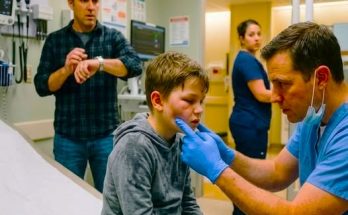
I returned to Room 4 with the chart tucked beneath my arm.
Leo was still on the bed.
The blanket had slipped toward his knees, and his hands rested together near the front pocket of his hoodie.
He looked tired.
Not just sleepy.
There was a guardedness in his face that seemed to take effort, as though even resting required him to keep watch.
I pulled my stool closer.
"How are you doing?"
"My face still feels heavy."
I nodded and checked the affected area again.
The swelling remained prominent.
The opening was still visible, and the surrounding skin was discolored.
I kept my examination gentle.
I had no reason to repeat the pressure that had produced the strange sensation earlier, especially when we were already arranging a more thorough evaluation.
I told Leo what I was doing as I went.
He stayed still.
When I finished, I stepped back and removed my gloves.
I could not explain what I had felt.
That remained the most unsettling part of the case.
If I had found an ordinary abscess, I could have explained the swelling in familiar terms. If I had found a clear injury, I could have focused on its treatment while we learned how it happened.
Instead, I had felt something move beneath the tissue.
I had lifted my hand.
Then it had seemed to move back toward the place I had touched.
The sensation had been unmistakable enough to make me stop in the middle of the examination.
Yet I had no confirmed finding to name.
I could not tell Leo what was there because I did not know.
I could not tell myself that I had imagined it simply because I lacked an explanation.
So I kept the observation in its proper place: something unusual had occurred during the examination, and it needed further investigation.
Sarah came in to check on the arrangements.
I asked whether the next steps were still moving forward.
She confirmed what she could and continued coordinating the care.
We had to keep the medical work moving while the other concerns were addressed.
I looked at Leo.
"Do you remember what you told me about the shed?"
He became still.
I regretted the question almost immediately.
I had not meant to make him feel as though he needed to repeat himself. I had wanted to know whether he was ready to say more.
He looked toward the door.
I softened my voice.
"You don't have to talk about it right now."
His shoulders lowered slightly.
"Okay."
I left the subject alone.
There was no need to make the room feel like another place where he had to answer questions on demand.
Instead, I asked whether he wanted the blanket adjusted.
He nodded.
I pulled it back over his knees.
He watched my hands, then settled against the raised portion of the bed.
The ordinary gesture seemed to help more than my attempts to reassure him.
I sat nearby.
Outside the room, the department continued its work. A phone rang. A cart rolled past. Someone spoke briefly to a nurse and moved on.
Leo listened to the sounds.
When footsteps approached the door, he stiffened.
They continued down the corridor.
He waited until they were gone before looking back at me.
I wished I could tell him that he would never have to be afraid of those footsteps again.
I couldn't.
What I could do was keep the room predictable.
I told him when Sarah would return. I explained that we were still working to understand his injury and that we would let him know before anything changed.
He listened carefully.
Then he asked, "Will the swelling go away?"
"I hope so, but first we need to understand what's causing it."
He accepted that answer with a small nod.
I reviewed the chart once more.
The record contained the details that mattered: the swelling, the opening, the bruises, the mark around his wrist, and his statement about the shed.
It also contained the uncertainty.
I had not decided what caused the injury.
I had not identified what moved beneath the skin.
And I had not heard a complete account of what happened before Leo arrived.
Those were not failures of documentation.
They were the facts of the case at that moment.
My job was not to make uncertainty disappear by writing a more confident sentence.
My job was to preserve what we knew and keep looking for answers.
I checked the time.
The night was moving toward morning, though the rain still blurred the windows.
Leo shifted beneath the blanket.
I noticed that he had begun rubbing the edge of his sleeve between his fingers again.
"Would you like something to eat when we know it's okay?" I asked.
He looked up.
"Yes."
I told him we would work that out.
He seemed surprised that I had asked.
That small reaction stayed with me.
A child should not have to wonder whether requesting food would irritate the adult responsible for him.
I thought about the stepfather's answer when we asked when Leo had last eaten.
He had treated the question as an annoyance.
Leo had answered it quietly, without complaint.
The difference between them had been there from the beginning.
I had simply needed time to understand how much it mattered.
Sarah returned and checked on him.
She spoke to him directly, explaining what she needed to do before touching the equipment near the bed.
Leo listened and cooperated.
After she finished, she gave me a brief update.
We continued following the plan for further examination.
I did not let the strange movement become the only thing I thought about. The swelling and the opening were visible problems that required attention, and Leo's account raised concerns that could not be put aside.
Each part needed its own careful response.
The medical evaluation would help us understand the injury.
The information he had given us needed to be shared with the people responsible for his safety.
And the stepfather's attempt to take him away had to be considered when deciding how to proceed.
I sat beside Leo again.
He was looking at the pens in my pocket.
The blue one remained clipped securely in place.
"That one didn't fall," he said.
"No, it didn't."
He nodded as though that settled something important.
I found myself almost smiling.
Then I noticed his eyes move toward the door again.
The brief moment passed.
I didn't try to force it to stay.
I had spent much of the night wanting a clear answer: a diagnosis, a cause, an explanation for the movement beneath his skin.
But Leo's case was teaching me that not every answer arrived at the same time.
Some things could be documented immediately.
Some needed tests.
Some required a child to feel safe enough to speak.
And some remained unknown until more evidence became available.
I looked at the swelling one last time before stepping away.
The opening remained small against the larger area of bruised skin.
I remembered how ordinary it had seemed from a distance.
A possible bite.
A child who needed antibiotics.
A tired man who wanted to return to work.
If I had accepted that version without looking more closely, I might have missed the details that changed the entire encounter.
I could not yet explain what had happened beneath Leo's cheek.
But I knew I had been right to stop when I felt it.
I knew I had been right to question the explanation.
And I knew that when Leo finally told me about the shed, the room had become a different place for him.
He was still frightened.
He was still injured.
He still had no clear answer about the strange sensation in his face.
But he had spoken, and no one had interrupted him.
For that moment, it was enough to keep listening.
Source: camdope.site
Click here to continue reading: PART 9: What the Shed Had Been Hiding
The Man Who Wanted Antibiotics Before Anyone Had Properly Looked at the Boy He Brought Into My Emergency Room
Part 8 of 9