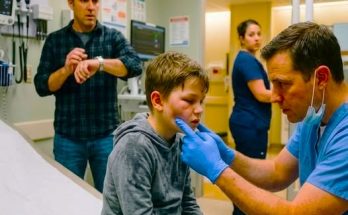
For a moment, neither Sarah nor I moved.
Leo sat on the edge of the examination bed, his small hands twisted together in his lap.
The word shed seemed to hang in the room long after he had spoken it.
I kept my voice steady.
“Leo, when you say Greg put you in the shed, can you tell me what you mean?”
He looked toward the door.
“He said I had to stay there.”
“Was the door locked?”
Leo nodded.
I felt my stomach tighten, but I kept my face calm.
“How long were you inside?”
“I don't know.”
He rubbed his wrists with his thumbs.
“It was dark.”
Sarah moved closer, stopping where he could see her without having to turn his head.
“You're safe in here,” she told him.
Leo glanced at her, then back at me.
“Is he coming back?”
“Not into this room,” I said. “Security is with him, and we're going to make sure you stay safe.”
He didn't look convinced.
I couldn't blame him.
Adults had probably made promises to him before. Promises that had meant very little once a door closed behind him.
I pulled a stool toward the bed and sat down so we were at his eye level.
“Leo, you haven't done anything wrong.”
His expression barely changed.
That frightened me more than tears would have.
He had learned to listen to adults as if every sentence might contain a condition.
I asked Sarah to bring the pediatric assessment supplies and contact the hospital's safeguarding team.
She understood what I meant without asking me to explain it in front of him.
Before she left, she placed a cup of water within Leo's reach.
He stared at it.
“You can drink if you want,” she said.
He picked it up with both hands and took a cautious sip.
Then he put it down carefully, as though even the sound of the cup touching the counter might get him into trouble.
I returned to the injury on his cheek.
The swelling had not gone away. The skin around the small opening remained tight and inflamed.
I had examined hundreds of wounds in my career, including insect bites that looked far worse than they felt.
This didn't fit comfortably into any category I could name.
When I had first touched the area through my glove, I had felt something shift beneath the skin.
I had moved my fingers away, then returned with lighter pressure.
The sensation had seemed to move again.
I would not tell Leo that I suspected anything strange without evidence. I would not frighten him with my uncertainty.
But I also would not pretend the wound was ordinary simply because Greg wanted it to be.
“Does your cheek hurt right now?” I asked.
“A little.”
“Has it hurt since yesterday?”
He hesitated.
“Since before.”
“How long before?”
He looked down.
“I don't know.”
“That's okay. You don't have to guess.”
He swallowed.
“Greg said it was a spider.”
“What did you think happened?”
Leo's shoulders rose toward his ears.
“I don't know.”
I let the silence sit.
Eventually, he whispered, “I wasn't supposed to tell.”
I kept my hands still on my knees.
“You can tell us what happened, Leo. You don't have to protect anyone from the truth.”
He shook his head quickly.
“I didn't do anything.”
“I believe you.”
The answer came out before I had time to make it more careful.
His eyes lifted to mine.
For the first time since he had arrived, he looked directly at me for more than a second.
Sarah returned with another nurse and a member of the hospital's safeguarding team.
We introduced ourselves one at a time, without crowding him.
The safeguarding specialist explained that her job was to help keep children safe when something at home might be hurting them.
Leo listened without speaking.
When she asked whether he would be comfortable talking with her, he glanced at me.
“You can take your time,” I told him.
He nodded once.
We did not ask him to repeat every detail of the shed.
We did not press him to describe anything he could not explain.
We recorded the words he had already given us, including his statement that Greg had put him inside and that the door had been locked.
His wrist marks were documented, too.
So were the bruises on his fingers, the swelling on his cheek, and the fact that he had not eaten since the previous afternoon.
None of those findings, taken alone, could tell us the entire story.
Together, they gave us more than enough reason to take his disclosure seriously.
A nurse brought a small packet of crackers and a sealed carton of juice.
Leo looked at the food before reaching for it.
“Are these mine?”
“Yes,” Sarah said. “They're for you.”
He opened the crackers slowly.
He ate one, then another, chewing as if he expected someone to take the packet away.
I looked toward the sink while he ate, giving him the privacy of not being watched.
A few minutes later, security called to say Greg wanted to speak with me.
I left Sarah with Leo and stepped into the corridor.
Greg was standing near the nurses' station, his jacket half unzipped.
He had the impatient look of someone whose night had been inconvenienced by a problem he believed should have been simple.
“How much longer is this going to take?” he asked.
“We're continuing Leo's evaluation.”
“I told you it's a spider bite.”
“We're assessing the injury and the other marks we've found.”
His jaw tightened.
“What other marks?”
I did not disclose details of Leo's private conversation.
“I'm not discussing his confidential medical assessment in the corridor.”
Greg gave a short, disbelieving laugh.
“I'm his stepfather. I brought him here.”
“And we appreciate that he received medical attention.”
“Then give him antibiotics and let us go.”
“We can't make that decision without completing the evaluation.”
He looked past me toward the treatment area.
“Where is he?”
“Being cared for.”
“I want to see him.”
“Not right now.”
The change in his face was quick.
The impatience disappeared, replaced by something harder.
“You can't keep me away from a child who lives in my house.”
“I can ask you to remain here while we address a safety concern.”
He took a step closer.
“I have work in three hours.”
“I understand.”
“No, you don't. I can't lose another night because of this.”
He glanced toward the exit and then back at me.
For a second, I wondered whether he would try to walk out again.
Security remained nearby.
I did not raise my voice.
“Greg, I need you to stay here and cooperate with the process.”
He stared at me, breathing through his nose.
Then he looked toward the treatment room again.
“Leo knows what happens when he makes trouble,” he muttered.
The words were quiet, but they were clear.
I held his gaze.
“What did you mean by that?”
“Nothing.”
“You just said he knows what happens when he makes trouble.”
“He gets disciplined. That's what children need.”
“Discipline does not explain every injury.”
He looked away.
I returned to the treatment room without giving him another argument to use.
Leo had finished half the crackers.
He was holding the juice carton against his chest, both hands wrapped around it.
When I entered, he watched my face.
“Is Greg mad?” he asked.
“He's upset that we're taking time to check on you.”
Leo's fingers tightened around the carton.
“I'm sorry.”
“You have nothing to apologize for.”
He looked down again.
I wished I could make those words settle inside him with the same certainty they had in my mind.
Instead, I asked Sarah to continue the examination while I arranged for the appropriate medical assessment of the cheek wound.
We needed a clearer understanding of what lay beneath the skin.
The strange movement I had felt was not a diagnosis.
It was a reason to investigate carefully.
We discussed imaging with the clinical team and prepared Leo for the next steps in language he could understand.
I told him we might need pictures of his cheek from the inside.
“They won't hurt?” he asked.
“The scan itself shouldn't hurt. We'll explain everything before we do it.”
“Will I have to go back to the shed?”
The question stopped me.
“No,” I said. “We're not sending you anywhere unsafe.”
He searched my face.
I knew that assurance alone could not decide where he would go after the hospital. That required the people responsible for his protection, not a promise I could make without them.
So I added, “The safeguarding team is working on what happens next. You won't be left to figure it out by yourself.”
He nodded, though his eyes stayed fixed on me.
We continued with the examination.
The opening in his cheek was small, but the tissue around it was unusually swollen. The wound required more investigation than an uncomplicated bite would normally demand.
We did not squeeze it or probe it blindly.
We protected the area and followed the clinical plan for determining what was happening beneath the surface.
As we prepared to move him, Leo reached for Sarah's sleeve.
“Can she come?”
Sarah glanced at me.
“Of course,” I said.
She walked beside the bed as we moved him through the corridor.
He watched the ceiling lights pass overhead, one after another.
At the imaging area, he asked whether he could keep his small blanket.
Sarah told him he could.
He held it against his chest while the staff explained the procedure.
I stayed nearby, listening as the team reviewed the available findings.
The unusual sensation beneath the skin had worried me, but I reminded myself not to turn a strange observation into a story before we had evidence.
A child with an unexplained wound needed careful medicine, not guesses.
When the assessment was complete, we returned him to the treatment area.
Leo looked exhausted.
The adrenaline that had kept him alert through the earlier questions seemed to be leaving him, and his eyelids drooped whenever the room became quiet.
Sarah brought him another cup of water.
He drank more this time.
Then he asked, “Can I sleep here?”
“You can rest while we take care of you,” she said.
He lay down on his side, protecting the injured cheek from the pillow.
I checked the chart and reviewed the documented findings with the clinical team.
The concern was no longer limited to the wound.
The bruising, the marks around his wrist, the lack of food, and his account of being locked in a shed all demanded attention.
We had to keep the medical and safeguarding work connected without confusing their purposes.
The examination would help us understand his injury.
The safeguarding team would help determine what arrangements were necessary to protect him.
Neither could replace the other.
A little after four, a hospital social worker arrived and spoke with the safeguarding specialist.
They reviewed what Leo had said and what we had observed.
I gave them the medical details that were relevant to his immediate care.
I did not embellish them.
I did not claim to know what had happened in the shed beyond Leo's own words.
When they asked about his stepfather's behavior in the emergency department, I described it as accurately as I could: his insistence that the injury was a spider bite, his repeated demands to leave, his attempts to answer questions for Leo, and his reaction when we explained that the evaluation was not finished.
The social worker took notes.
Then she asked whether Leo was awake.
“He's resting,” Sarah said. “We can ask him whether he's comfortable speaking again when he wakes.”
They agreed.
No one needed to make him relive the same moment simply to satisfy our curiosity.
By then, the rain outside had weakened to a steady drizzle.
Water streaked the windows of the treatment room, catching the pale light from the parking lot.
I checked on Leo once more.
He was awake, watching a small patch of light on the wall.
“Do you know what time it is?” he asked.
“It's a little after four.”
“Is it morning?”
“Almost.”
He thought about that.
“Will I have breakfast?”
The simplicity of the question hurt.
“Yes,” I told him. “We'll make sure you have something to eat.”
He looked toward the door.
“Will Greg get breakfast?”
I pulled the stool closer.
“I don't know what Greg will do. Right now, I'm concerned about you.”
Leo rubbed his wrist again.
“Sometimes he says I'm expensive.”
I waited.
“He says food costs money. And clothes cost money. And he has to work because of me.”
His voice stayed flat, as though he were reciting a list he had been forced to memorize.
“Children need food and clothes,” I said. “Those aren't things you have to earn by being perfect.”
He looked at me as if the sentence did not make sense.
I did not try to force him to accept it.
Some ideas take time to reach a child who has been taught the opposite.
The social worker returned after speaking with the safeguarding team.
She told us that the next steps were being coordinated and that Leo would not simply be released into the same situation without the safety concerns being addressed.
She did not promise an easy resolution.
Neither did I.
When Leo asked what would happen to him, she sat beside the bed and explained that the adults responsible for his care were working together to find a safe plan.
He asked whether he would have to talk to Greg.
“Not right now,” she said. “We'll tell you what you need to know before anything changes.”
He accepted that answer more readily than he had accepted mine.
Perhaps because she did not ask him to trust a promise about the whole future.
She told him what would happen next, and only what she could reasonably tell him.
As dawn began to lighten the windows, the emergency department shifted into its morning rhythm.
Phones rang.
A cart rattled down the hall.
Someone laughed briefly at the nurses' station, then lowered their voice when they passed Leo's room.
The world was continuing as it always did, unaware of the small boy lying beneath a hospital blanket.
I looked at the chart again.
The unusual movement beneath his cheek remained unexplained in my own mind. I would not turn that uncertainty into a claim that it had caused Greg to collapse, or that it proved a particular creature or object was hidden inside Leo's wound.
We had not established that.
What we had established was enough to change the night.
Leo had arrived with an injury his stepfather insisted was ordinary.
During the examination, we had found other marks that required attention.
When he was finally given the chance to speak without Greg answering for him, he told us he had been locked in a shed.
Those facts did not need a dramatic explanation to matter.
They needed to be documented, investigated, and acted upon.
Before the end of my shift, I checked on Leo one last time.
He was eating breakfast from a tray, slowly working through a piece of toast.
Sarah sat nearby, helping him open a small container of fruit.
His shoulders were still tense, but he no longer flinched every time footsteps approached the door.
When I entered, he glanced up.
“Doctor?”
“Yes, Leo?”
“Did I do the right thing by telling you?”
I pulled the stool beside his bed.
“Yes,” I said. “You did the right thing.”
He studied my face, searching for the condition that never came.
Then he took another bite of toast.
I left him with Sarah and the safeguarding team, knowing the work ahead would continue after I walked out of the emergency department.
The rain had stopped.
Outside, the wet pavement reflected the first gray light of morning.
I had come to work expecting another long night of injuries, fevers, and frightened families.
I had not expected a nine-year-old boy to arrive carrying a story he was afraid to tell.
I could not undo the hours he had spent in the shed.
I could not make the bruises disappear or tell him that every adult would always protect him.
What I could do was take his words seriously, record what we had seen, and refuse to send him away as though nothing had happened.
That morning, Leo had finally been heard.
And that was where our responsibility began.
Source: camdope.site
The End
Read more original stories on Feel Every Story.
The Man Who Wanted Antibiotics Before Anyone Had Properly Looked at the Boy He Brought Into My Emergency Room
Part 9 of 9