Leo climbed back onto the examination bed without being asked.
The paper beneath him was torn where his shoe had caught it. One loose strip hung over the side, brushing the floor whenever he moved.
He sat near the edge again.
His hands disappeared into the front pocket of his gray hoodie.
I had expected him to relax once his stepfather was out of the room.
He didn't.
His shoulders stayed raised. His knees remained close together, and his eyes kept drifting toward the door.
It was as though he was waiting for someone to come back and tell him he had done something wrong.
Sarah stood beside the supply counter.
She didn't approach him immediately.
Neither did I.
I had worked with children long enough to understand that an adult's departure did not necessarily make a child feel safe. Sometimes the fear remained after the person who caused it was gone.
Sometimes it became worse because the child had no idea what would happen next.
I pulled my stool closer but stopped well short of the bed.
"Leo, you're not in trouble."
He didn't respond.
I let the words sit between us.
I didn't tell him that everything would be fine. I couldn't promise that. We still didn't know what was happening inside his cheek, and we had not established why he had those injuries.
I could promise him something smaller.
"We're going to explain what we do before we do it."
His eyes moved briefly toward mine.
Then he looked at the pens in my pocket.
I followed his gaze and realized he had been watching them since I first lowered his hood.
There were three pens clipped to my scrub top. One blue, one black, and one with a cracked plastic cap.
Ordinary things.
Things he could look at without having to look directly at me.
I left them where they were.
Sarah moved to the bedside and explained that we needed to continue checking his face. She told him we would arrange further examination and treatment because the swelling concerned us.
Leo listened quietly.
When she finished, he nodded.
We returned to the immediate medical problem.
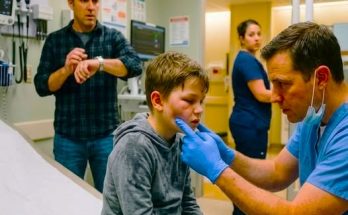
The right side of his face remained badly swollen, and the opening near the center still looked wrong. I could see the bruising extending beneath the stretched skin.
I wanted the surgical team to assess it as soon as possible.
I also needed to make sure Leo understood that the examination wasn't punishment.
"Your face is hurt," I told him. "We need to find out why."
He lowered his eyes.
"Okay."
"Did you notice the swelling before you came here?"
He rubbed the inside of his pocket with his thumb.
A long pause followed.
Then he gave a small nod.
"Was it hurting at home?"
"No."
"Did anyone try to help you?"
His fingers stopped moving.
He didn't answer.
I didn't repeat the question.
Sarah checked the equipment we would need and stepped back to give him space.
The boy looked at the torn paper on the bed.
He followed the hanging strip with his eyes until it stopped moving.
I could see him gathering himself for something, although I didn't know what.
I had the uncomfortable sense that he was measuring the risk of telling us the truth.
I had seen that hesitation before.
A child could be surrounded by adults and still feel that every answer carried a cost.
"Leo," I said, "you can tell me what happened in your own time."
His lips pressed together.
I waited.
The rain tapped against the hospital windows somewhere beyond the corridor. A trolley passed outside, its wheels rattling briefly over a seam in the floor.
Leo glanced toward the door again.
"Is he coming back?"
The question was so quiet that I almost missed it.
I answered honestly.
"The security officers are speaking with him right now."
Leo swallowed.
"Can he come in?"
I looked toward Sarah.
We would have to follow the hospital's procedures and respond to the situation as it developed. I wasn't going to make a promise I couldn't guarantee.
"We're going to keep working to make sure you're safe while we take care of you."
He looked down again.
That answer did not seem to comfort him, but he accepted it.
I asked whether he remembered what had happened before the swelling appeared.
He didn't speak.
I asked if he had been playing outside.
Another pause.
Then a slight shake of the head.
His stepfather's explanation had been simple: a spider had bitten him.
But Leo had already told me that the mark around his wrist was not caused by an insect.
That distinction mattered.
It meant the story given to triage was incomplete, at the very least.
It also meant I needed to avoid letting the adult's explanation become the only version of events we considered.
I turned slightly so Leo wouldn't feel surrounded by my attention.
"Can I ask you about your wrist again?"
He drew his left hand out of the pocket.
The bruises across his fingers were still visible. The red mark around the wrist looked especially sharp against his skin.
I didn't touch it.
I wanted him to have control over the distance between us.
"Does that mark hurt now?"
"No."
"Do you know how it got there?"
He looked at the mark.
His thumb moved over the skin beside it without touching the red line itself.
For a moment, I thought he would answer.
Then his eyes lifted toward the doorway.
He withdrew his hand.
I felt the familiar urge to ask another question quickly, before he changed his mind.
I resisted it.
There was no point in making him feel that he had to perform an explanation for us.
Instead, I told him we would continue caring for his face and that he could speak whenever he felt ready.
He gave another small nod.
The boy's silence was difficult to sit with.
Not because it inconvenienced me, but because I could see how much effort it took him to remain in the room without knowing what would happen next.
I wondered what he had learned about adults.
I wondered whether he had learned that answering honestly led to trouble, or whether the trouble came even when he said nothing.
I wondered how many times he had been told that nobody would believe him.
I didn't know the answers.
I had to be careful not to replace one uncertain story with another of my own making.
But I could no longer treat the situation as a simple insect bite.
The physical findings demanded attention. The bruises demanded attention. The child's behavior demanded attention.
And the stepfather's sudden attempt to leave had given me another reason to be cautious.
I returned to the examination.
"Leo, I'm going to check the skin around your cheek again. I'll tell you before I touch you."
He nodded.
I put on fresh gloves.
Sarah stayed close enough to help but did not crowd the bed.
I examined the area around the opening without applying the same pressure as before. I could not ignore what I had felt earlier, but I also couldn't make a diagnosis from one strange sensation.
The swelling was severe enough to warrant imaging and surgical review regardless.
I stepped away and gave Sarah the information she needed to continue preparing for the next stage of care.
Leo watched my hands.
When I removed the gloves, he followed the movement all the way to the waste bin.
Then he looked at the pens again.
I sat down.
"You're doing fine."
He didn't say thank you.
He didn't smile.
He simply sat there, holding his hands inside his hoodie as if the fabric were the only thing in the room that belonged entirely to him.
For a while, I let the silence remain.
Then I returned to the question I had asked at the beginning.
"Leo, can you tell me what happened to your face?"
His thumb found the loose thread near the pocket seam.
He pinched it between two fingers and pulled it gently.
The thread came free a little farther.
He wrapped it around his index finger.
Once.
Then again.
He unwound it carefully and began the same movement over.
I watched without interrupting.
The room remained quiet except for the rain and the faint sounds of activity outside.
At last, Leo released the thread.
He lifted his head.
For the first time since I had met him, he looked directly into my eyes and held the gaze.
I felt the moment before he spoke, although I couldn't have explained how I knew.
His expression did not change much.
His voice barely rose above a whisper.
"He put me in the shed."
I stayed still.
I did not ask him to repeat it.
I did not ask why.
For a moment, I could hear only the rain.
Then the words settled into place beside everything else I had seen that morning.
The mark around his wrist.
The bruises on his fingers.
The missed meals.
The way he had moved away from his stepfather when the man reached for him.
And the swelling in his face that the man had tried to reduce to a spider bite.
The explanation we had been given at triage no longer seemed merely incomplete.
It had become something we needed to question from the beginning.
Source: camdope.site
Click here to continue reading: PART 4: The Word Shed Changed the Questions I Needed to Ask, but the Strange Movement Beneath His Skin Still Had No Explanation
The Man Who Wanted Antibiotics Before Anyone Had Properly Looked at the Boy He Brought Into My Emergency Room
Part 3 of 9

One Comment on “PART 3 – After the Door Closed, the Boy Stopped Watching the Hallway Long Enough to Tell Me One Thing About His Wrist”