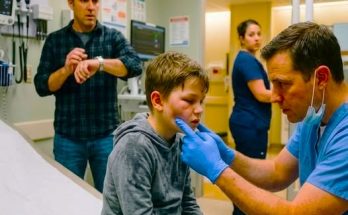
The next time I examined Leo's face, I made sure he could see both my hands before I moved closer.
He watched me carefully.
I told him what I planned to do, then waited for his nod.
The swelling had not disappeared.
The right side of his face remained visibly enlarged, and the bruising still showed through the stretched skin.
I examined the surrounding tissue as gently as I could.
The small opening remained the detail I found hardest to reconcile with the explanation we had been given.
I had treated insect bites before.
I had treated abscesses and injuries caused by accidents.
This did not fit neatly into any category I could confidently choose from the bedside examination alone.
I stepped back.
"We're still going to have a closer look," I told him.
Leo nodded.
He seemed to accept uncertainty more easily when I spoke plainly instead of pretending to know something I didn't.
I asked Sarah to confirm that the arrangements for imaging and surgical evaluation were continuing.
She checked the information and returned with an update.
We kept moving through the necessary steps.
I did not want my concern about the unusual movement to distract me from the ordinary responsibilities of his care. Leo needed a proper examination, appropriate treatment, and careful observation.
Those needs were clear even when the cause was not.
I returned to the bedside.
"Does the heavy feeling come and go?" I asked.
"Sometimes."
"Can you tell when it starts?"
He shook his head.
I recorded his answer.
Then I asked whether he had noticed anything else unusual about his cheek.
He looked at the opening.
For a long moment, he said nothing.
I waited.
Finally, he whispered, "It feels strange."
"Strange how?"
He pressed his lips together.
I could see him trying to decide whether he wanted to explain.
"Like something's there."
I felt a chill move through me, though I kept my expression neutral.
I did not want to place my own fear into his answer.
"Can you tell me when you first noticed that feeling?"
He looked down.
"I don't know."
I accepted that.
Children do not always remember the beginning of an injury clearly, especially when they have been frightened or confused.
I didn't ask him to guess.
Instead, I explained that the tests would help us understand what was happening.
He nodded again.
I looked at Sarah.
We needed to continue with the plan rather than let the conversation become a substitute for the medical work.
She remained with Leo while I checked the chart and confirmed the next steps.
The notes about his wrist and fingers were there.
So were his words about the shed.
I had recorded them carefully, without embellishment.
I wanted the people who became involved in his care to understand the significance of what he had told us without mistaking my concern for proof of details we had not established.
When I returned, Leo was holding the paper cup between his hands.
He had not taken another drink.
"Are you cold?" I asked.
He shook his head.
"Do you want a blanket?"
He considered it, then nodded.
Sarah brought one.
Leo draped it across his lap without letting go of his hoodie.
I sat beside the bed and watched him settle the blanket around his knees.
The movement was careful and quiet.
He looked like a child who had learned not to take up more space than necessary.
I thought about the way he had stood beside his stepfather at triage, allowing himself to be pulled along without protest.
I thought about the man's impatience and the way he had tried to leave when the examination became more serious.
I thought about Leo's immediate fear when the man reached for his jacket.
I could not say exactly what had happened between them.
I did not need to know every detail to understand that Leo needed protection while we investigated.
I made sure the staff involved in his care knew the situation had changed.
The stepfather's presence was not a reason to stop examining Leo, and his insistence that the boy had been bitten was not a reason to dismiss the other findings.
I returned to the chart.
There were times in medicine when a clear diagnosis arrived quickly.
A test showed the problem. The treatment followed. Everyone understood what had happened.
This was not one of those times.
The injury had a visible shape, but its cause remained uncertain.
The movement I had felt was difficult to explain.
The child's account had opened another set of questions that needed to be handled with care.
And the adult who had brought him in had tried to end the examination before we could answer any of them.
I found myself returning to the first few minutes of the encounter.
The wet shoes.
The gray hoodie.
The metal watch on the man's wrist.
The way he had answered the questions before Leo could speak.
At the time, I had thought the man's impatience was the main obstacle to a straightforward examination.
Now I understood that his impatience had also kept us from hearing the child.
That was the part I found hardest to forgive in myself.
I had recognized the behavior, but I had initially treated it as background noise.
It was not background noise.
It was part of the situation I needed to understand.
I returned to Leo.
He was watching the doorway again.
"Has anyone told you what will happen next?" I asked.
He shook his head.
I explained what we knew and what we still needed to find out.
I told him the team would continue assessing his face and that we would explain any procedures before they happened.
He listened without interrupting.
When I finished, he asked, "Can I go to sleep?"
The question made me pause.
He was exhausted.
His body had been tense since the moment he arrived, and he had been awake long enough to miss meals and spend hours dealing with an injury he could not explain to us fully.
"We'll help you get comfortable," I said. "We'll also keep checking on you."
He pulled the blanket higher over his legs.
I told Sarah to make sure he remained attended while we continued the evaluation.
Then I sat for another moment.
I wanted him to see that we were not going to disappear simply because he had stopped talking.
He looked at me.
"You're not mad?"
"No."
"Even though I told you?"
I understood what he meant.
"No, Leo. I'm glad you told me."
He looked down at his hands.
His shoulders eased slightly.
It was not a dramatic change.
He did not suddenly become cheerful or begin telling me everything that had happened.
He simply stopped holding himself quite so rigidly for a few seconds.
I let that be enough.
Then I stood and returned to the work.
The tests still needed to be completed.
The swelling still needed a medical explanation.
And the staff responsible for his safety still needed the information we had gathered.
I could not solve every part of his situation in one conversation.
I could make sure the next person who examined him knew what I had seen.
I could make sure his account was taken seriously.
And I could refuse to let the words spider bite become an excuse to stop asking questions.
When I looked back through the glass in the door, Leo was sitting quietly beneath the blanket.
His gray hoodie remained pulled close around his face.
The loose thread was still visible near the pocket seam.
He had stopped twisting it.
For the moment, he was simply waiting.
I knew that waiting was difficult for him.
So I made sure he knew what we were waiting for, and why.
Source: camdope.site
Click here to continue reading: PART 8: The Room Had Grown Quiet, but I Still Remembered the Exact Moment Something Beneath Leo’s Skin Moved Against My Hand
The Man Who Wanted Antibiotics Before Anyone Had Properly Looked at the Boy He Brought Into My Emergency Room
Part 7 of 9