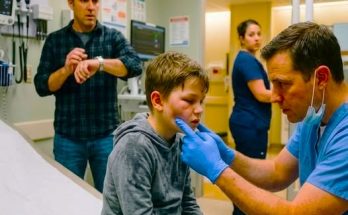
I had asked Leo what happened to his face.
He had answered with three words that changed the way I understood the room.
He put me in the shed.
I kept my expression steady.
The last thing I wanted was to make Leo regret telling me.
I had seen children withdraw after an adult reacted too strongly to a disclosure. A shocked expression, an angry question, even an attempt to comfort them could make them believe they had said something wrong.
So I didn't rush to fill the silence.
I let him sit with what he had told me.
Sarah had heard him, too.
She remained beside the counter, her hands resting on the edge of the work surface.
Neither of us needed to exchange a look to understand that the situation had become more serious.
I moved my stool a little closer.
"Thank you for telling me, Leo."
He lowered his eyes to the thread he had pulled from his hoodie.
I wanted to ask when he had been put in the shed, how long he had been there, and what had happened to his face.
I wanted to know whether the red mark around his wrist came from that same incident.
But I needed to keep my questions simple.
I also needed to continue the medical assessment.
His cheek was still swollen. The opening remained visible, and I had not forgotten the strange movement beneath the skin.
The medical problem had not disappeared simply because we had learned something about the circumstances surrounding it.
I explained that we would keep examining his face and arrange the care he needed.
He nodded.
I asked if he could tell me when he had been in the shed.
His fingers tightened around the loose thread.
He looked toward the door.
I stopped there.
He had already given us information that could not be ignored. I didn't need to force him to provide every detail in the same conversation.
"We can talk more when you're ready," I said.
Leo looked down.
Sarah quietly checked the supplies we had prepared earlier. The room felt different now, though nothing physical had changed.
The torn examination paper still hung over the edge of the bed.
The pens were still clipped to my pocket.
Rain still marked the window beyond the corridor.
Yet I could no longer see the boy as someone who had simply arrived with a swollen cheek and an uncertain bite.
I had to consider the possibility that his injuries were connected to something that had happened while he was under his stepfather's control.
I also had to be careful about the limits of what we knew.
Leo had said he was put in a shed. He had not yet explained what happened there or how his face became injured.
Those details mattered.
So did the medical evidence.
I returned to the examination and explained each movement before making it.
Leo cooperated, though he remained tense.
I checked the surrounding skin again, avoiding unnecessary pressure. The swelling was extensive enough that I wanted the surgical team involved as soon as possible.
Sarah stayed nearby while we continued preparing for further evaluation.
I asked Leo whether he felt dizzy or nauseated.
He shook his head.
I asked whether he had trouble swallowing.
Another small shake.
I didn't interpret his short answers as proof that he was comfortable. He had already shown me how carefully he measured what he said.
Instead, I recorded what he told me and kept watching for changes in his condition.
His face remained the most immediate concern.
The round opening drew my attention every time I looked at it. Its shape was too distinct, and the depth too concerning, for me to feel satisfied with the explanation we had been given.
I thought again about the sensation under my glove.
At first, I had wondered whether I had encountered an unusual pocket of fluid.
Then I had felt something shift away from my fingers.
When I lifted my hand, the movement had seemed to return toward the same place.
I had no clear explanation for it.
I didn't want to tell Leo that something beneath his skin had moved. He was already frightened, and I had no diagnosis to offer him.
I also didn't want my uncertainty to become a reason to delay care.
I told Sarah that the imaging and surgical evaluation remained urgent.
She acknowledged me and continued with the arrangements.
Leo watched us quietly.
"Am I going to have to stay here?" he asked.
The question caught me off guard.
I had been thinking about his injuries, the strange finding in his cheek, and the need to establish what had happened.
He was thinking about whether he would be allowed to leave.
"We need to find out what's going on first," I told him. "Then we'll explain what needs to happen next."
He rubbed the red mark around his wrist with the edge of his thumb.
"Okay."
I noticed that he hadn't asked whether his stepfather would be allowed to take him home.
He had asked whether he would have to stay.
I couldn't know what that meant to him.
But I knew I needed to be cautious about any decision that might place him back into a situation where he felt unable to speak.
Outside the room, the security officers were still dealing with his stepfather.
The man had entered the hospital demanding a prescription and complaining about work. Once the examination uncovered something he couldn't explain, he had tried to remove Leo from the department.
Now he was no longer standing over the bed, answering questions on the child's behalf.
That was a necessary change.
It was not a complete solution.
I returned my attention to Leo.
"Did you know your face was swollen before you came here?"
He nodded.
"Did you tell anyone it was hurting?"
He hesitated, then shook his head.
I didn't press him for a reason.
His silence might have come from fear, confusion, or something I had not yet considered. I would not learn the truth by deciding in advance what he was thinking.
I could only make room for him to tell us.
I asked whether he wanted some water.
He looked at Sarah before answering.
"Yes, please."
She brought him a cup.
He held it with both hands and took small sips, pausing between them.
When he finished, he placed the cup carefully on the bedside table.
The ordinary nature of that small action stayed with me.
He was nine years old. He should have been able to ask for water without studying an adult's face first.
I felt ashamed of how quickly I had initially focused on the stepfather's irritation rather than the child's fear.
I had noticed the grip on Leo's wrist. I had noticed his posture and the way he waited for permission to answer.
But I had still been trying to fit the situation into familiar categories.
A difficult adult.
An injured child.
A possible infection.
The word shed had forced me to stop treating those things as separate observations.
It didn't answer every question, but it changed what I needed to pay attention to.
I looked again at the red line around his wrist.
Then at the bruises across his fingers.
Then at his swollen cheek.
I could not determine from those findings alone exactly what had happened to him.
I could, however, refuse to let the first explanation offered by the adult accompanying him become the final one.
Sarah returned to the counter and checked the next steps for his evaluation.
I stayed beside Leo.
He had begun picking at the edge of the hoodie pocket, worrying the seam between his thumb and forefinger.
I asked him whether he wanted me to move farther away while we waited.
He shook his head.
That small answer mattered.
I remained where I was.
For a few minutes, he seemed to settle, although he continued to glance toward the door whenever footsteps passed in the corridor.
I could not tell him that his stepfather would never frighten him again. I could not promise that every question would have an easy answer.
I could make sure the medical team took his injuries seriously.
I could make sure his words were heard.
And I could keep looking at the swelling until we understood what we were dealing with.
I returned to the opening in his cheek.
The skin around it had not changed much.
The swelling was still severe.
I remembered the precise instant when something beneath it had moved away from my fingers, followed by the second movement toward my hand.
I had never encountered anything that felt quite like it.
I didn't know what it was.
I didn't know how it had gotten there.
And I didn't know whether the strange sensation was connected to the injury Leo had described.
Those questions remained unanswered.
But the child's account had made one thing clear: whatever we discovered medically, we could no longer treat this as an ordinary spider bite brought in by an impatient parent.
Leo sat on the bed with his hands tucked inside his hoodie.
The torn strip of paper moved slightly when he shifted his feet.
I pulled my stool closer and began explaining the next steps in language he could understand.
He listened.
This time, when I finished, he looked at me instead of the door.
And when I asked if he understood, he answered for himself.
"Yes."
Source: camdope.site
Click here to continue reading: PART 5: I Had Heard the Word Shed, but the Swelling on Leo’s Face Was Still Telling Me Something I Could Not Explain
The Man Who Wanted Antibiotics Before Anyone Had Properly Looked at the Boy He Brought Into My Emergency Room
Part 4 of 9