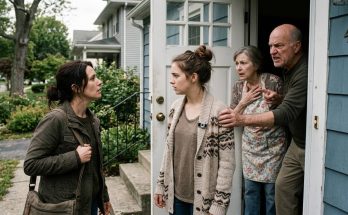
I spent twenty years believing there was nothing left for me in my parents' house.
I was wrong.
For most of those years, I thought I understood exactly what had happened to me at seventeen.
I had gotten pregnant.
My parents had discovered it.
They had thrown me out, and I had somehow managed to keep going.
Then my baby died, according to the only people who had told me what happened.
That was the version I carried into adulthood.
It was simple enough to repeat, even when I couldn't bear to think about it.
What I never considered was how much of that story I had accepted without seeing for myself.
I had been seventeen when my mother found the pregnancy test.
I was barely nine weeks along.
I hadn't known how to tell my parents, and I hadn't known what they would do when they found out.
I only knew I wasn't ready for that conversation.
So I hid the test beneath the rubbish in my bathroom bin.
It seemed like a way to buy myself a little time.
A few more hours, perhaps a few more days, before I had to look my mother in the face and explain something I could barely explain to myself.
I was young enough to think that if something stayed hidden, I could postpone the moment when it became real to everyone else.
I understand now how foolish that was.
But I also understand the fear behind it.
I wasn't trying to hurt anyone.
I was scared.
And I had no idea how quickly my life was about to change.
My mother found the test.
I don't remember every movement that followed, but I remember what she did with my clothes.
She took my high school backpack and shoved some of my things inside.
There was no careful folding.
No conversation about what I needed.
She packed enough for me to leave, and then she carried the bag toward the front door.
My father was standing there.
He didn't step between us.
He didn't ask my mother to slow down.
He didn't ask me whether I was frightened or whether I understood what was happening.
He stood behind her while she put my belongings outside.
I remember the doorway because it became the dividing line between the life I had known and the one I was suddenly expected to manage alone.
My father spoke as if he had already made his decision.
He told me that I had brought this situation on myself and that, from that night forward, I could no longer depend on them.
Then the door closed.
That was it.
No discussion.
No chance to explain.
No suggestion that we might speak again when everyone had calmed down.
I was outside, and they were inside.
The rain was coming down hard.
My clothes began to cling to my skin, and the straps of my backpack felt heavier as the fabric absorbed water.
I stood on the lawn looking at the house.
I kept waiting for the door to open again.
Part of me expected my mother to come out and tell me to get inside before I caught a cold.
I expected my father to appear behind her, still angry but willing to let me stand in the hallway while we figured out what came next.
I had lived in that house long enough to know its ordinary sounds.
I knew what it meant when someone walked across the floor inside.
I knew the difference between a door opening because somebody was leaving and one opening because somebody had remembered something.
That night, I listened for any sign that they had changed their minds.
Nothing happened.
The porch light went dark.
I stared at the place where the light had been shining a moment earlier.
It was a small thing, that light.
It should not have mattered as much as it did.
But I had been standing there, soaked through, still hoping my parents would remember that I was their daughter.
Then even the light was gone.
I looked down at my backpack.
My belongings were inside it, but I had no idea where I was supposed to take them.
I had no idea what I would do about being pregnant.
I didn't know how I would manage the coming months, or what would happen when the baby arrived.
I only knew that I couldn't make the door open by standing in front of it.
So I left.
I wish I could say I walked away with my head held high.
I didn't.
I was seventeen, frightened, and hurt in a way I couldn't have described properly at the time.
I was also ashamed.
Looking back, that shame makes me angry with myself.
I had done nothing that justified being treated as if I had ceased to belong to my own family.
Yet I spent a long time wondering whether my father was right.
Perhaps I had made a choice.
Perhaps I was supposed to accept every consequence without expecting help.
Perhaps needing my parents meant I hadn't grown up enough to deserve their respect.
Those thoughts stayed with me far longer than the rain did.
The night itself eventually ended.
My clothes dried.
The water stopped running off the ends of my hair.
The memory of the porch light, however, never really went away.
I never returned to that house.
Not the following morning.
Not when I needed something I had left behind.
Not for a birthday or a holiday.
I didn't go back for Thanksgiving.
I didn't go back for Christmas.
I didn't show up at the door expecting my parents to forgive me, and I didn't ask relatives to arrange a meeting.
There were times when I heard that my mother had asked about me.
Those reports reached me through extended family.
Each time, I wondered what she had wanted to know.
Was she asking whether I was safe?
Was she asking whether I had given birth?
Did she wonder where I was living, or whether I had anyone to help me?
I couldn't answer those questions.
I only knew that asking other people about me was not the same as opening the front door.
My father never gave me a reason to believe that returning would be welcome.
So I built a life somewhere else.
Seattle became the place where I learned to live without waiting for my parents to change.
I had no childhood room to return to.
No familiar kitchen where I could sit and admit I was struggling.
No mother I could call when I didn't know what to do.
I had to learn how to keep moving even when the questions in my head had no answers.
Some days, that meant concentrating on whatever was directly in front of me.
Other days, it meant refusing to think too far into the future.
I learned that a person could continue living while carrying something she had never properly dealt with.
I also learned that time did not automatically make painful things understandable.
Twenty years passed.
I became an adult, and the girl standing in the rain became someone I could remember without feeling as if I were still standing on that lawn.
Or so I thought.
The pregnancy was not the only thing that had happened to me at seventeen.
There had also been the birth.
My baby had arrived prematurely.
I remembered the hospital, the uncertainty, and the terrible helplessness of being so young while adults spoke about things I didn't know how to understand.
My daughter had been transferred to another medical center across town.
That was what the paperwork said.
My parents had told me that she died not long after the transfer.
At the time, I believed them.
I had been grieving, and I had been heavily medicated.
I didn't have the strength to investigate every detail or demand a complete account of what had happened.
I relied on what I was told because I had little else to rely on.
There had been no reason, then, for me to think that the explanation was anything other than the truth.
For years, I treated the loss as something that could never be undone.
My daughter had been born, and she had died.
That was the end of the story as I understood it.
I did not know where she had been buried.
I did not know the name of a funeral home.
I did not have a death certificate in my possession.
I had the memory of what I had been told, and the pain that came with it.
For a long time, I didn't ask myself why those other things were missing.
I thought there was no point.
What could a piece of paper change about something that had already happened?
I had spent enough years learning to live with the loss that I was afraid to examine it too closely.
Still, some questions never disappeared completely.
They waited.
And twenty years after my parents had put my backpack on the lawn, I found something that made me look at the past differently.
It was an ordinary week in Seattle.
My first daughter would have turned twenty that week.
I had never stopped knowing the date.
Even when I didn't speak about her, the date remained part of my life.
I couldn't have explained why I had chosen that particular time to clean out my hall closet.
I only knew that I was sorting through old things when I came across an envelope from the hospital.
The envelope was old enough that I recognized it immediately.
I stopped what I was doing.
For a moment, I simply held it.
Then I opened it.
Inside were my discharge papers.
My old plastic hospital wristband was there, too.
And beneath them was a document I had not examined carefully since I was seventeen.
I took it out and began to read.
At first, I thought I knew what I was looking at.
Then I reached the part about the transfer.
My baby had been sent to a different medical center across town.
I read that information again.
I had known about the transfer, of course.
My parents had told me my daughter died after it.
But I had never stopped to consider what the document actually established, and what it didn't.
The paper recorded the transfer.
It did not establish that my daughter had died.
I sat with the envelope in my hands.
For the first time in twenty years, I began to wonder whether I had ever received the full truth.
Click here to continue reading: PART 2: The Hospital Envelope Was Ordinary, but the Missing Records Forced Me to Reconsider the Only Explanation I Had Ever Been Given
I Thought Losing My Parents Was the Worst Thing That Could Happen to Me, Until I Questioned What They Told Me About My Baby
Part 1 of 12