Once I decided to go back, I couldn't convince myself that the idea would disappear if I waited long enough.
I tried to approach it carefully.
I reminded myself that the paperwork did not prove my parents had lied.
It only showed that I didn't have the information I thought I had.
There could be an explanation.
I wanted to leave room for that possibility.
But I also wanted to stop making excuses for the questions I had never asked.
For twenty years, I had treated my parents' version of events as the final word.
They had told me my daughter died after the transfer.
I had believed them.
Now I needed to understand why I had no record of her death.
I couldn't get that answer by staring at the envelope in Seattle.
And I couldn't get it by continuing to avoid the people who had told me what happened.
I had not returned to my parents' house since the night they threw me out.
That fact seemed almost impossible when I considered it.
Twenty years.
Two decades of birthdays and holidays passing without me sitting at their table.
Two decades in which I had built a life elsewhere while the house in Illinois remained part of a past I did not want to revisit.
I had not gone back when relatives mentioned my mother asking about me.
I had not gone back because I wondered whether my father might have changed.
I had not gone back to see whether the porch light still worked or whether the front lawn looked the way I remembered it.
I had stayed away because I knew what it felt like to stand outside that door and be told I no longer belonged.
I wasn't willing to put myself through that again without a reason.
Now I had one.
The hospital envelope had given me something I had never allowed myself before.
A reason to doubt the story.
Not a reason to believe a different story.
There was a difference.
I didn't know whether my daughter had died.
I didn't know whether my parents had deliberately withheld information.
I didn't know whether the missing records meant anything beyond the fact that I had never received them.
I knew only that I had questions, and that those questions mattered enough for me to stop hiding from them.
I wanted to be prepared for the possibility that my parents would refuse to answer.
My father had never been a man who made me feel comfortable challenging him.
I could still remember the certainty in his voice when he told me I was on my own.
He had not sounded confused.
He had not sounded as if he needed time to think.
He had spoken as though the matter was already settled.
That memory had stayed with me because I had once believed that parents were the people who stood between their children and the worst things that could happen to them.
My father had done the opposite.
He had made it clear that his care had conditions, and that my pregnancy had placed me outside them.
My mother had packed my clothes.
She had carried my backpack out of the house.
She had been the person who turned my fear into something I could no longer keep private.
Neither of them had stopped to consider what it meant to send a seventeen-year-old girl away while she was pregnant.
For years, I had struggled with the fact that they could do that.
I had wondered whether they regretted it.
I had wondered whether my mother ever remembered the rain.
But those questions had never been enough to bring me back.
I had learned to live without their answers.
The question about my daughter was different.
I could not simply tell myself that my parents had made a terrible decision and that I had survived it.
My daughter was part of that decision's aftermath.
Her birth and the story of her death had shaped the darkest period of my life.
If I had been given incomplete information about her, then I had spent twenty years grieving without knowing the whole truth.
I couldn't accept that possibility without trying to find out more.
I made the decision to return to Illinois.
I didn't expect an apology.
I didn't expect my parents to embrace me or admit that throwing me out had been wrong.
I had spent too long waiting for things that might never happen.
I didn't expect a miracle, either.
I knew how that word sounded.
I knew that questioning a death did not mean the person had survived.
I was not going to convince myself that my daughter was alive just because the paperwork had left me uncertain.
Hope could be cruel when it had nothing solid beneath it.
I wasn't looking for a comforting answer.
I was looking for the truth, whatever it turned out to be.
I kept the envelope close as I prepared to leave.
It was the only physical evidence I had that might help me explain why I was returning after so many years.
The papers were old.
The wristband was still plastic.
None of it looked important enough to change a person's understanding of her entire life.
But it had changed mine.
I thought about the girl who had hidden a pregnancy test under the rubbish because she didn't know how to face her parents.
I wished I could tell her that she would eventually grow older.
I wished I could tell her that the rain would end, that she would survive being turned away, and that she would build a life that did not depend on the approval of the people who had raised her.
I could tell her those things because I had lived them.
What I could not tell her was whether the explanation about her baby was true.
That was the question I had carried into adulthood without realizing how little I knew.
The journey back to Illinois gave me too much time to think.
I went over the sequence of events again and again.
My mother found the test.
My parents made me leave.
I gave birth prematurely.
My daughter was transferred to another medical center.
My parents told me she died shortly afterward.
I had accepted the last statement as the end of everything.
Now I was returning to the beginning of that story's unanswered part.
I wondered what I would say when I saw them.
I had rehearsed conversations in my head before, though I had never acted on them.
In some versions, I told my father exactly what I thought of him.
In others, I asked my mother why she had allowed me to be sent away.
Those imagined conversations always became tangled in the same old hurt.
This time, I tried to keep my questions simple.
What happened to my daughter?
Where was the record of her death?
Why had I never been given it?
I did not need to explain twenty years of pain before asking those questions.
I did not need my parents to agree with my choices.
I did not need them to approve of the life I had made.
I needed them to tell me what they knew.
As I got closer to the house, the memories became harder to keep at a distance.
I had spent years imagining what it would feel like to return.
I had wondered whether I would be angry, frightened, or relieved.
I thought perhaps I would feel nothing at all.
But I had no way to know until I was there.
The house had been the center of my childhood.
It had also been the place where my parents had decided I no longer belonged.
I had not returned for a single family occasion in twenty years.
That absence had become a fact I could carry without explaining it to anyone.
Now I was going back because of a piece of paper I had nearly put away and forgotten about again.
I kept thinking about the missing death certificate.
It was such a specific absence.
I had been told something final about my baby, yet I could not produce the basic documentation that would confirm what I had been told.
I had never seen a burial record.
I had never been given the name of a funeral home.
I had not known where to go to mourn her, beyond the memories I carried.
I had been left with grief, but without the ordinary details that might have helped me understand what had happened.
At seventeen, I hadn't known to ask for them.
At thirty-seven, I could no longer pretend I didn't notice they were missing.
I did not know what my parents would say when I confronted them.
Perhaps they would repeat the same account.
Perhaps they would tell me that I had misunderstood something.
Perhaps they would refuse to discuss it.
I prepared myself for each possibility as best I could.
The one thing I knew was that I could not leave without asking.
I had driven back to face the people who had sent me away.
I had spent twenty years building a life without them.
That life mattered to me, and I wasn't going to surrender it simply because my parents might be angry.
But I had reached a point where protecting myself from their rejection could not be the only thing I considered.
I had to protect my right to know what had happened to my daughter, too.
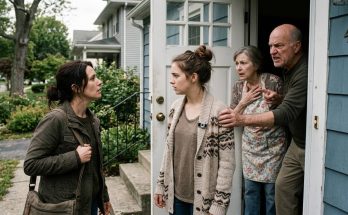
When I finally approached the house, I recognized it.
It was the same place I had left in the rain.
The memory of the front lawn came back before I had time to prepare myself.
I remembered my backpack lying in the wet grass.
I remembered the porch light going dark.
I remembered standing there, waiting for the door to open again.
I had not forgotten any of it.
I had simply stopped going back.
Now I was standing there as an adult, with twenty years between me and the girl who had been sent away.
I had come for answers.
I had no idea how much had changed inside that house.
I had no idea whether my parents would even let me finish a sentence.
But I was no longer willing to let the memory of that night make the decision for me.
I went to the front door.
Then I knocked.
Click here to continue reading: PART 4: I Had Prepared Myself for My Father’s Anger, but the Young Woman at the Door Made the Past Feel Suddenly Unfamiliar
I Thought Losing My Parents Was the Worst Thing That Could Happen to Me, Until I Questioned What They Told Me About My Baby
Part 3 of 12