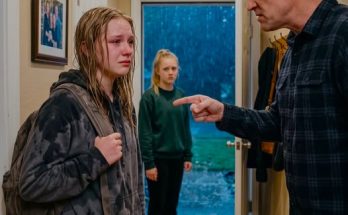
My father received the call about three hours after he had sent me away.
I wasn't there to hear his side of the conversation.
I didn't see where he was standing when the telephone rang or whether Lydia was beside him.
I learned what had happened through the people who spoke to me later.
At the time, I was still struggling to stay awake for more than a few moments.
I didn't know what my father had been told.
I didn't know whether he had understood how serious the situation was.
I only knew that I had been found unconscious beside the road, and the people caring for me needed to speak with my family.
Officer Marcus Reed was the one who contacted him.
He began by confirming that he had reached Daniel Collins.
Then he asked when my father had last seen me.
My father answered that he had seen me earlier that evening.
According to what I later learned, he described the situation as an argument at home.
He made it sound like a disagreement that had gotten out of hand.
He didn't initially explain that he had ordered me to leave.
He didn't explain that I had gone without my phone or a coat.
He didn't mention that I was fifteen and had no money with me.
Officer Reed asked another question.
Had I left the house wearing a jacket?
My father paused.
Then he said I hadn't.
That was when the conversation began to change.
The officer wanted to know why.
My father reportedly explained that I had been involved in a family dispute and that he had expected me to go somewhere else.
He said I had chosen to leave.
Those words mattered.
I wish I could say I was surprised that he used them.
I wasn't.
Even before I knew about the call, I had worried that he would describe the evening as something I had done to myself.
I had imagined him telling someone that I was being difficult.
That I was refusing to listen.
That I had walked away because I didn't want to face the consequences of my behavior.
I had been trying to defend myself against that version of the story since the moment he closed the door.
Now, someone outside our family was hearing it.
And Officer Reed wasn't satisfied.
He asked whether my father knew I had left without a phone.
My father said he hadn't thought about it.
The officer asked whether I had taken any money.
My father admitted that I hadn't.
There was a silence after that, at least according to the account I eventually heard.
Three ordinary questions.
A coat.
A phone.
Money.
My father had answers for all of them.
None of those answers explained why he had let me walk into a storm with nothing.
Officer Reed then told him what the driver had reported.
I had been found unconscious beside the road, several miles from home.
My clothes were soaked.
I had been exposed to the cold for a long time.
The person who found me had called for assistance because I was not responding.
My father didn't seem to understand at first.
He asked how far away I had been.
When the officer answered, my father became quiet.
Nearly four miles.
That was the distance between the house he had locked behind me and the place where I had finally collapsed.
I had covered that distance because I believed there was no other choice.
My father had never asked where I intended to go.
He had never checked whether I had somewhere safe to stay.
He had never considered how a fifteen-year-old girl could manage without a phone, money, or warm clothing in the middle of an October storm.
He had simply expected me to disappear from his sight.
Now the officer was telling him where I had ended up.
My father asked whether I had been taken somewhere for treatment.
Officer Reed told him I was at the hospital.
Then he explained that I was still in poor condition after being found unconscious.
I can imagine my father's face when he heard that.
I can imagine him standing very still, with the phone pressed against his ear.
But I cannot tell you exactly what he felt.
I wasn't in the room.
And I had learned that evening how dangerous it could be to assume I knew what another person was thinking.
All I know is what happened next.
My father asked whether I was alive.
Officer Reed told him I was.
Then he instructed my father to come to the hospital.
The call ended.
For a few seconds, my father had to sit with the information he had received.
His daughter had left the house in the rain.
She had walked nearly four miles.
She had collapsed beside a road.
She had been found unconscious.
And none of it had happened because I had been caught with drugs.
It had happened after he believed an accusation without checking whether it was true.
Lydia was there when the call came.
She had been part of the argument that led to my expulsion, and she had remained inside the house while I walked through the rain.
My father had accepted her account of me.
Now a police officer had contacted him with facts that could not be dismissed as another argument between family members.
The driver had found me.
The road was real.
The distance was real.
The absence of a coat, phone, and money was real.
My father couldn't make those things disappear by insisting I had chosen to leave.
He had to confront the result of his own decision.
I later learned that he asked Lydia what had happened.
I don't know the exact words he used.
I don't know whether he raised his voice or whether he spoke quietly.
I only know that the confidence he had shown while ordering me out was no longer enough to carry him through the conversation.
He had believed he knew what I was.
He had acted as if the accusation settled everything.
Now he was being asked to explain his actions to someone who had no reason to accept his version simply because he was my father.
For once, he couldn't end the discussion by telling me to stop talking.
He couldn't send Officer Reed to another room.
He couldn't close a door and decide that the matter was finished.
The officer had given him a place to go and a reason to get there.
My father needed to come to the hospital.
That was the first thing he had been told that evening that left no room for an argument.
I wasn't aware of any of this as it happened.
I was still in the hospital, exhausted and frightened, trying to understand where I was and what would happen next.
At times, I managed to open my eyes.
At other times, I couldn't stay awake.
The people caring for me spoke in calm voices and asked questions I struggled to answer.
I knew my name.
I knew I was fifteen.
I knew I had left home without a coat.
Everything beyond those facts came back slowly.
Whenever I remembered the front door closing, my chest tightened.
Whenever I remembered the road, I felt the same helplessness that had settled over me when my legs stopped working.
I tried not to think about my father.
That was almost impossible.
I had spent the entire walk wondering whether he would come after me.
Now I knew someone had contacted him, but I didn't know whether he would actually come.
He might still be angry.
He might believe Lydia.
He might arrive and accuse me of embarrassing him.
He might look at me lying there and decide I was responsible for everything that had happened.
I couldn't rule out any of those possibilities.
I had learned that his certainty could change the course of my life without him asking me a single question.
I didn't know what would happen when he saw me again.
I only knew I was too tired to argue.
A nurse spoke to me when I opened my eyes.
She asked whether I knew who had been contacted.
I nodded faintly.
“My dad?”
She told me that he had been reached.
I waited for her to say more.
She didn't promise he would arrive soon.
She didn't tell me what he had said.
She simply let me know that the hospital had contacted my family.
I turned my face toward the pillow.
I felt relief, but it was mixed with something I didn't want to name.
I wanted my father to come.
I was frightened of him coming.
Both feelings were true.
I had spent the evening hoping he would unlock the door.
Now I was hoping he would walk through a different one.
The difference was that this time, I couldn't get up and leave if the conversation became unbearable.
I had nowhere else to go.
My backpack had been brought along with me.
I couldn't remember exactly when someone had taken it from the roadside, but I was told that my belongings had been kept together.
The bag contained the clothes I had packed, the school items I had taken upstairs, and the algebra worksheet.
Nothing else.
No drugs.
No secret stash.
No evidence of the person Lydia had described.
Just the belongings of a girl who had been trying to finish her homework before her father sent her out of the house.
I wanted him to see that bag.
I wanted him to understand what it meant.
Not because a worksheet could prove everything about me, but because it was a piece of the ordinary life he had interrupted.
I had been a student that afternoon.
I had been his daughter.
I had been someone who expected to sleep in her own bed.
Then one accusation had been enough to make him forget all of that.
I closed my eyes again.
Somewhere beyond the room, my father was deciding what to do with the truth he had been given.
I couldn't know whether he was beginning to doubt Lydia.
I couldn't know whether he was questioning himself.
I couldn't know whether he understood that the most important thing he had failed to do was not search my backpack.
It was ask me one question before he opened the door and sent me into the storm.
I waited.
For once, there was nothing I could do to make the next moment arrive sooner.
Click here to continue reading: PART 5: I Was Waiting for My Father to Arrive, Still Hoping He Would Ask Me What Really Happened Before Judging Me Again
My Father Had Already Decided I Was Guilty Before I Could Explain What Was Inside My Backpack
Part 4 of 20