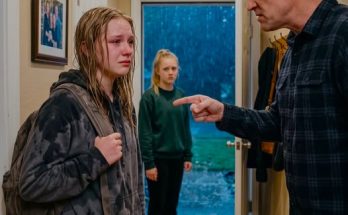
My father came back later.
I heard him at the door before I saw him.
He knocked softly.
"Emma? Can I come in?"
I turned toward him.
"Yes."
He opened the door and stepped inside.
He looked tired, and his hair was still damp from the weather outside.
He carried the coat he had brought earlier.
"I thought you might want this nearby," he said. "But I can put it somewhere else."
I looked at it.
"Leave it on the chair."
He did.
Then he sat down.
"How are you feeling?"
"Tired."
"Anything else?"
I thought about the question.
"Still scared."
He nodded.
"Okay."
He didn't tell me there was nothing to be afraid of.
He didn't say I was safe now and should stop thinking about what happened.
He let my answer stand.
I shifted the blanket and looked at the phone on the table.
"Did you go home?"
"Yes."
"Was Lydia there?"
He paused.
"Yes."
I waited.
"Did you talk to her?"
"A little."
"What did she say?"
"She repeated what she told me before."
I watched him.
"Did you believe her?"
He looked down.
"I don't know what I believe about everything yet."
The answer bothered me.
I wanted him to tell me that he had finally understood how little he had known when he sent me away.
I wanted him to admit that he had treated an accusation as if it were proof.
But I didn't want him to say something simply because he thought it would make me feel better.
"Did you ask her any questions?" I asked.
"Some."
"Did you ask why she thought I had drugs?"
He nodded.
"And?"
"She didn't give me an answer that cleared things up."
I looked toward the window.
There it was again.
An accusation without an explanation.
I still didn't know why Lydia had said what she said.
The only thing I knew was that my father had believed her enough to send me out.
"Did you tell her what happened to me?" I asked.
"Yes."
"What did she say?"
He rubbed his hands together.
"She knew the officer had called."
"That's not what I asked."
He looked at me.
"She didn't say much when I told her you were in the hospital."
I waited for him to continue.
He didn't.
I didn't know what to make of that.
I didn't know what Lydia thought about the rain, the road, or the fact that I had been found unconscious.
I didn't know whether she felt sorry.
I didn't know whether she regretted what she had said.
I wasn't going to invent answers just because the silence was uncomfortable.
"Did you ask her whether she had any proof?" I said.
"Yes."
"And?"
He looked down.
"I still don't have anything that explains why she was so certain."
I drew the blanket over my knees.
"Then you shouldn't have been certain either."
He nodded.
"You're right."
I was tired of hearing him agree.
I was also tired of having to explain things that should have been obvious.
"Why did you need to be certain so quickly?" I asked.
He thought for a while.
"I think I wanted the situation to be simple."
I looked at him.
"Simple?"
"I wanted to believe I understood what was happening. I didn't stop to consider that I might not."
I looked away.
His answer made sense in a way I didn't like.
He had chosen the version of the story that allowed him to act without asking questions.
He had not needed to know what happened.
He had only needed to feel sure.
And I had paid for that certainty.
"You made it simple for yourself," I said.
He lowered his head.
"Yes."
"And you made everything harder for me."
"I know."
I looked at the coat on the chair.
The sleeves hung over the edge.
I thought about how easy it would have been for him to let me take it.
He could have asked me to sit down.
He could have asked me to show him the backpack.
He could have given himself a few minutes to calm down.
Instead, he had opened the door and sent me away.
I didn't understand how a person could make such a serious decision without stopping to consider the most ordinary things.
The weather.
The distance.
The fact that I was fifteen.
The fact that I had nowhere to go.
"Dad?"
"Yes?"
"If you get angry again, what are you going to do?"
He took a slow breath.
"I'm going to stop before I make a decision."
"What does that mean?"
"It means I need to calm down. I need to ask questions instead of acting on what I think I know."
"And if you're still angry?"
"I still need to listen."
I studied his face.
"What if you think I'm lying?"
He looked directly at me.
"Then I need to find out what happened before I decide what to do."
I held his gaze for a moment.
That was what I had wanted from him all along.
Not because I expected him to believe every word I said without question.
Because I needed him to treat me like someone who deserved to answer for herself.
"I can't promise I'll trust you right away," I said.
"You don't have to."
"I might remember this even when you're trying to be nice."
"I understand."
"I might get upset about things that seem small to you."
He nodded.
"I'll try to listen."
I looked down at my hands.
"I don't want to have to keep reminding you that I'm your daughter."
He went very still.
Then he said, "You shouldn't have to."
I didn't answer.
The words hurt because they were true.
For a while, we sat without talking.
My father asked whether I wanted something to eat.
I wasn't hungry.
He asked whether I wanted him to stay.
I said yes.
He stayed.
He didn't try to turn the conversation into a promise that everything would be different from now on.
He didn't tell me that we needed to move forward.
He didn't ask how long I intended to remain angry.
That mattered.
It didn't prove that he would never make the same mistake again.
It only showed that, for the moment, he was allowing me to have my feelings without treating them as another problem he needed to solve.
I picked up the algebra worksheet and unfolded it.
The paper made a faint crackling sound.
I looked at the unfinished problems.
"Do you remember what I was doing that evening?" I asked.
"Your homework?"
I nodded.
"You were doing algebra."
"I was sitting at the table."
He looked at me.
"I remember."
"I wasn't planning to go anywhere."
"I know."
"I thought I'd finish the worksheet and go to bed."
My voice caught slightly.
I stopped and looked at the paper.
My father didn't interrupt.
That ordinary plan had been all I expected from the evening.
I had not expected to defend myself against an accusation.
I had not expected to be told to leave.
I had not expected to walk nearly four miles in the rain.
And I had not expected to wake up in a hospital room wondering whether my father would come.
I folded the worksheet and put it away.
"I don't want to talk anymore right now."
"Okay."
He settled back into his chair.
I lay down and turned toward the window.
My father remained in the room.
I didn't feel safe enough to forget what had happened.
But I didn't feel forced to explain it again, either.
For that afternoon, I let the conversation end.
Click here to continue reading: PART 19: I Still Couldn’t Promise My Father That I Trusted Him, So I Stopped Trying to Give Him an Answer Before I Was Ready
My Father Had Already Decided I Was Guilty Before I Could Explain What Was Inside My Backpack
Part 18 of 20