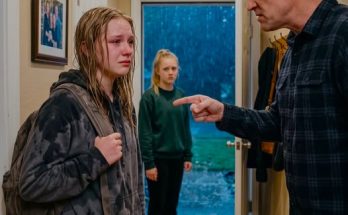
I heard the footsteps before I saw him.
They stopped outside my room.
Someone spoke quietly.
Then the door opened.
My father stood in the entrance.
For a moment, neither of us said anything.
He looked as though he had come in a hurry.
His clothes were the same ones he had worn earlier, or close enough that I couldn't tell the difference.
His hair was untidy.
His face looked pale.
He glanced at the bed, then at the equipment nearby, then back at me.
I watched him do it.
I wanted to know what he was thinking.
I wanted to know whether he saw his daughter or the consequence of his own decision.
He took one step into the room.
“Emma.”
I didn't answer.
He moved closer.
“Are you awake?”
I looked at him.
“Yes.”
My voice was quiet.
He stopped beside the bed.
For several seconds, he seemed unable to decide what to say.
I had imagined this moment on the road.
I had imagined him arriving at the house, realizing I was gone, and driving around until he found me.
I had imagined him apologizing before I had to explain anything.
I had imagined him wrapping me in a coat and telling me to get into the car.
None of those things had happened.
Instead, I had been found by a stranger.
A police officer had called my father.
And now he was standing beside my hospital bed, looking at me as if he had walked into a room where he didn't know the rules.
He reached toward me, then stopped.
I noticed the movement.
He seemed to notice that I had noticed.
His hand dropped to his side.
“Are you hurt?”
I looked down at the blanket.
“My face hurts.”
He nodded.
“Anything else?”
“I don't know.”
That was the truth.
I was tired.
I felt weak.
My thoughts were still scattered, and I couldn't always remember how much time had passed between one thing and the next.
I didn't know how to describe the feeling of having walked until I couldn't walk anymore.
I didn't know how to explain the fear that had stayed with me even after someone found me.
I didn't know how to tell him that the worst part wasn't the cold.
It was realizing that he had heard me ask for help and had chosen to shut the door.
He pulled a chair closer to the bed.
The legs scraped against the floor.
The sound made me flinch.
He noticed.
“Sorry.”
I didn't know what to do with that word.
It was the first apology-like thing I had heard from him, but he hadn't apologized for anything yet.
He sat down.
For a while, he stared at his hands.
I stared at the backpack beside me.
Neither of us seemed ready to speak.
Finally, he asked what had happened after I left the house.
I looked at him.
I couldn't believe he was asking me that question now.
I had been trying to answer it before he sent me outside.
I had asked him to check my bag.
I had told him Lydia was wrong.
I had begged him to listen.
He had refused every chance I had given him.
Now he wanted me to explain what had happened after the door closed.
I swallowed.
“I walked.”
He looked up.
“Where?”
“I don't know. Away from the house.”
“Why didn't you go somewhere?”
I stared at him.
The question hurt more than I expected.
“I didn't know where to go.”
He opened his mouth, then closed it.
I waited.
I wanted him to understand how the question sounded from where I was lying.
I had been fifteen years old, alone in the rain, without a phone or money.
I had been trying to find somewhere safe.
He had made me leave without knowing whether I had any place to go.
I couldn't understand how he could ask me why I hadn't found one.
“I thought you might come after me,” I said.
His face changed.
Only slightly.
But I saw it.
He looked down at the floor.
I had expected him to defend himself.
I had expected him to tell me I should have known better.
Instead, he remained silent.
I didn't know whether that silence meant he was ashamed or whether he was searching for another way to explain what he had done.
I was too tired to guess.
He asked how far I had walked.
I told him I didn't know.
I had no way of measuring the distance.
The officer had told him I had been found nearly four miles from home.
He repeated the number quietly.
“Almost four miles.”
I didn't respond.
He looked at the backpack.
“Is that everything you took?”
I nodded.
“Some clothes and my schoolwork.”
He reached toward the bag but stopped before touching it.
I saw his eyes settle on the front pocket.
The folded algebra worksheet was inside.
He knew what I usually carried in that bag.
He had seen me leave for school with it every morning.
Now it sat beside a hospital bed, damp and marked from the road.
He looked back at me.
“Why didn't you take your coat?”
I stared at him for a long moment.
Then I answered.
“You told me to leave it.”
He closed his eyes.
I hadn't said it angrily.
I hadn't raised my voice.
I had simply repeated what had happened.
That seemed to make it harder for him to answer.
He rubbed his palms together.
“I was angry.”
I looked at him.
“So was I.”
He nodded, but I didn't think he understood what I meant.
He had been angry because he believed Lydia.
I had been angry because he wouldn't listen.
But his anger had put me outside in the storm.
Mine had only made me ask questions.
I didn't say that.
I didn't have the strength.
He leaned forward in the chair.
“I didn't think you would go that far.”
I looked at the blanket again.
That sentence stayed between us.
He hadn't thought I would walk nearly four miles.
He hadn't thought I would collapse.
He hadn't thought a driver would find me unconscious beside the road.
But none of those things had been required for his decision to be wrong.
I could have been found much closer to home.
I could have reached a stranger's door.
I could have spent the night outside somewhere else.
He still would have sent his fifteen-year-old daughter away without a coat, phone, or money.
I wanted him to understand that.
Instead, I asked the question that had been waiting inside me since the argument began.
“Why didn't you check my backpack?”
He looked at me.
I held his gaze.
“You could have looked inside. I asked you to.”
He didn't answer immediately.
His fingers tightened around one another.
“Lydia said—”
“I know what Lydia said.”
My voice cracked.
I stopped and took a breath.
“I know what she said. But you didn't ask me anything.”
He looked away.
I could feel tears gathering again, and I hated how quickly they came.
“I told you she was wrong.”
He said my name softly.
I shook my head.
“No. You didn't listen.”
That was the first time I had spoken to him without trying to make my words gentle enough for him to accept.
I wasn't trying to win an argument.
I was telling him what had happened.
He sat very still.
For a moment, I thought he might tell me I was being disrespectful.
He had used that kind of answer before when he didn't like the way I spoke.
But he didn't.
He looked at the backpack again.
Then he looked at the hospital bed.
His eyes stopped on the scrape along my cheek.
He swallowed.
“I didn't know it would end like this.”
I stared at him.
I wanted to ask whether he thought that made it better.
I wanted to ask whether he had expected me to vanish into the night and never require anything from him again.
But the questions stayed inside my head.
I was exhausted.
I couldn't keep explaining the same truth in different ways until he found one he could hear.
I turned my face away.
He remained in the chair.
For a while, the only sounds were the quiet movements outside the room and the faint rustle of the blanket when I shifted.
I knew he wanted me to say something.
I knew he wanted some sign that he could still reach me.
But I didn't know how to give him one.
I had spent the evening asking him to believe me.
Now he was sitting beside my bed, and I wasn't sure I could believe him when he said he hadn't meant for this to happen.
I didn't doubt that he had been angry.
I didn't doubt that he regretted the hospital call.
What I couldn't understand was how he had managed to forget that I was his daughter before he opened the front door.
He stood after a few minutes.
He looked as though he wanted to touch my shoulder.
He didn't.
“I'll be here,” he said.
I didn't answer.
He walked toward the door, then paused.
He glanced back at me.
I kept my eyes on the backpack.
When the door closed behind him, I felt both relieved and disappointed.
I wanted him near me.
I wanted him to leave.
I hated that I could feel both things at once.
I pulled the blanket closer and tried to rest.
The algebra worksheet was still in the front pocket of my bag.
I knew exactly where it was.
And I knew that, even after my father had finally come to see me, the question that mattered most remained unanswered.
Click here to continue reading: PART 7: My Father Had Come to See Me, but the One Person Whose Story He Believed Was Still Waiting Outside the Truth
My Father Had Already Decided I Was Guilty Before I Could Explain What Was Inside My Backpack
Part 6 of 20