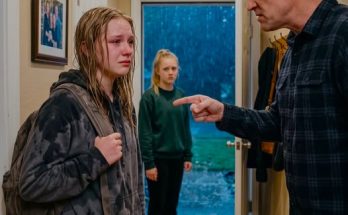
I didn't know how long my father stayed away from the room.
Time still moved strangely.
I slept for short stretches, woke when someone spoke, and tried to understand what was happening around me.
When I opened my eyes again, my father was back in the chair.
He wasn't looking at me.
He was staring at the floor, his hands resting between his knees.
I watched him for a while.
He looked older than he had that morning.
I knew that was probably impossible.
Nothing about his face had changed enough to explain the difference.
But something had happened to the way I saw him.
Before that evening, I had thought of my father as the person who would protect me when things went wrong.
Now I was trying to understand how to think about someone who had put me in danger because he believed another person.
He looked up when he noticed I was awake.
“Do you need anything?”
I shook my head.
He nodded.
Neither of us spoke for a while.
I could have asked him whether Lydia was still at home.
I could have asked what she had said after the officer called.
I could have asked whether he had finally considered that she might be wrong.
But I didn't.
I didn't want to spend the little energy I had left trying to convince him of something he should have checked before I left the house.
Instead, I asked for water.
He reached for the cup and brought it closer.
My hands were still unsteady, so he held it while I took a small drink.
The water tasted ordinary.
I was grateful for that.
Everything else felt complicated.
When I finished, he put the cup back.
“Thank you,” I whispered.
He nodded again.
I wondered whether he heard how formal I sounded.
I had thanked him for water because I couldn't find anything else to say.
He had been my father that morning.
By evening, I was treating him like someone whose reactions I needed to manage carefully.
He shifted in the chair.
“Emma, I need to ask you something.”
I looked at him.
He paused.
“Did you have anything in your bag?”
I stared at him.
For a moment, I thought I had misunderstood.
Then I realized he was asking about the accusation.
He still needed to know whether I had possessed drugs.
I felt a familiar tightness in my chest.
“No.”
He nodded slowly.
“Nothing at all?”
“Nothing.”
I looked toward the backpack.
“You can check.”
He followed my gaze.
I waited for him to reach for it.
He didn't.
Instead, he rubbed his forehead.
“I should have looked earlier.”
I didn't answer.
It was the closest he had come to admitting that he had made a mistake.
But it didn't erase what had happened.
I had asked him to search the bag before he sent me out.
He had refused.
Now he was asking me the question he could have answered for himself by opening the zipper.
“Yes,” I said. “You should have.”
He flinched.
I hadn't meant to hurt him.
Or maybe I had.
I wasn't sure anymore.
I was tired of protecting his feelings while mine were still sitting in the room, unanswered.
He leaned back.
“I believed Lydia.”
I looked at him.
He said it quietly, as if speaking the words aloud made them more difficult to carry.
I wanted to know why.
I wanted to know what made her accusation more convincing than my denial.
I wanted to know what he had seen that made him so certain.
But he didn't explain.
And I didn't ask.
I was afraid that whatever answer he gave would reveal something I wasn't ready to hear.
Perhaps he thought Lydia was more reliable.
Perhaps he had already decided I was capable of the thing she described.
Perhaps it was easier to believe her because doing so gave him a reason to be angry.
I didn't know.
I couldn't invent an explanation and then blame him for it.
I could only judge what he had done.
He had believed her without checking.
He had refused to hear me.
He had sent me away.
That was enough.
He looked at the backpack again.
“Is your homework in there?”
I nodded.
“The algebra worksheet.”
He seemed surprised.
“You were doing homework?”
“Before dinner.”
He lowered his head.
I watched him look at his hands.
I wondered whether he remembered seeing me at the table earlier that day.
I had been complaining about the last few problems.
I had asked him whether he remembered how to solve equations like those.
He had told me to ask my teacher.
It had been an ordinary conversation.
Nothing about it had suggested I would be lying unconscious beside a road a few hours later.
I didn't know whether he remembered.
I didn't ask.
After a while, he said he was sorry.
The words were quiet.
They didn't come with an explanation.
He didn't say Lydia had misled him.
He didn't say I should have behaved differently.
He didn't tell me that he had only been trying to teach me a lesson.
He simply said he was sorry.
I stared at him.
Part of me wanted to accept the apology immediately.
I wanted to believe that those two words meant he understood everything.
I wanted to put the evening behind us and return to the life I had known before.
But I couldn't.
Not yet.
“Sorry for what?” I asked.
He looked at me.
I had never asked him that before.
Usually, when an adult apologized, I was expected to accept it and move on.
I had learned to treat apologies as the end of an uncomfortable conversation.
This time, I needed to know what he was apologizing for.
He looked down again.
“For sending you out.”
I waited.
“And for not listening.”
I felt my throat tighten.
Those were the things I had wanted him to say.
Yet hearing them didn't make the pain disappear.
I had needed him to listen before I was hurt.
I had needed him to look inside the backpack before deciding I was guilty.
I had needed him to remember my age before telling me to leave.
His apology came after a driver had found me unconscious.
I didn't know how to make peace with that.
“I asked you to check,” I said.
“I know.”
“You wouldn't even look.”
He nodded.
“I know.”
I turned toward the window.
I was afraid that if I kept looking at him, I would start crying again.
He didn't ask me to forgive him.
For that, I was grateful.
I couldn't have answered.
After a few minutes, he asked whether I wanted him to stay.
I thought about it.
I wanted to say yes because I was still frightened and I didn't want to be alone.
I wanted to say no because his presence reminded me of the locked door.
Neither answer felt right.
“You can sit there,” I said finally.
He nodded and remained in the chair.
We didn't talk much after that.
He stayed quiet when I closed my eyes.
When I opened them again, he was still there.
I didn't know whether he was watching me or simply waiting.
I didn't ask.
I was beginning to understand that I couldn't make him understand everything in one evening.
I couldn't force him to see the road through my eyes.
I couldn't make him feel the cold that had soaked through my clothes or the panic that had settled in when I realized I had nowhere to go.
I could tell him what had happened.
I could tell him what I had needed.
But he would have to decide whether he was willing to face the truth.
I was too tired to carry that decision for him.
I turned onto my side.
The backpack sat beside the bed.
I could see the edge of the front pocket.
The worksheet was inside.
I thought about the unfinished problems.
I had left them blank because I couldn't solve them.
Now I wondered whether I would ever look at that paper without remembering the rain.
My father spoke softly.
“Try to rest.”
I closed my eyes.
For once, I didn't answer him.
I wasn't trying to punish him.
I simply had nothing left to give.
Click here to continue reading: PART 8: The Unfinished Worksheet Stayed Beside My Bed While I Tried to Understand Whether an Apology Could Make Home Feel Safe Again
My Father Had Already Decided I Was Guilty Before I Could Explain What Was Inside My Backpack
Part 7 of 20