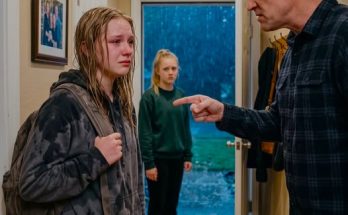
I woke up enough to recognize the room.
The light was still above me, and the air felt different from the damp cold that had followed me down the road.
I could hear people moving nearby.
For a few seconds, I didn't remember where I was.
Then I tried to move my legs, and the memory returned.
The road.
The rain.
My backpack.
I closed my eyes.
I didn't want to go through it again.
A voice beside me asked whether I could hear her.
I opened my eyes and nodded.
She asked me to tell her my name.
“Emma Collins.”
My voice sounded weak.
She spoke to me calmly, and I tried to concentrate on what she was saying.
I understood that I was in the hospital.
I understood that people were looking after me.
The rest came slowly.
I asked how long I had been there.
She gave me an answer, but I couldn't hold on to it.
Time had become difficult to measure.
I remembered walking away from home, but I couldn't remember every street I had passed.
I remembered falling, but not how long I had been lying beside the road.
The gaps frightened me.
I had always thought that if something important happened, I would remember it clearly.
Instead, some of the worst moments had become a collection of disconnected sounds and pictures.
The lock turning.
Headlights crossing the pavement.
My hand slipping off the backpack strap.
I turned my head toward the side of the bed.
“Where's my bag?”
The woman looked at me.
“Your belongings are here. They're being kept together.”
I tried to sit up.
She told me to take it slowly.
I stopped.
My body felt heavy, and I was tired enough that even lifting my head required effort.
I hated that.
I wanted to get up and prove I could manage on my own.
I wanted to leave before my father arrived.
I wanted him to see me sitting upright, able to speak, with enough strength to tell him exactly what he had done.
But I couldn't even make myself sit comfortably.
I lay back against the pillow.
The woman asked whether I needed anything.
I shook my head.
That wasn't true.
I needed a dozen things.
I needed to know what would happen when my father walked into the room.
I needed to know whether Lydia had told him anything else.
I needed to know whether he still believed I had drugs.
Most of all, I needed to know why he hadn't trusted me enough to look inside my backpack.
I didn't ask those questions.
I was afraid of hearing the answers.
A little later, someone checked on me again.
I asked whether my father had been contacted.
The answer was yes.
I looked toward the doorway.
“Is he coming?”
The person told me that my family had been informed.
She didn't promise anything beyond that.
I understood why.
She couldn't make my father come to the hospital.
She couldn't decide whether he would apologize.
She couldn't tell me what he believed.
I nodded as if the answer was enough.
It wasn't.
I waited anyway.
I had spent most of my life waiting for my father in ordinary ways.
Waiting for him to finish work.
Waiting for him to come home.
Waiting for him to look at a school assignment I wanted to show him.
That evening, I was waiting for something much smaller.
I wanted him to walk through the door and look at me as his daughter.
Not as the girl Lydia had described.
Not as a problem he needed to remove from his house.
Just me.
I wanted him to see that I was frightened.
I wanted him to understand that I hadn't left because I wanted to punish him.
I had left because he had made it clear I wasn't allowed to stay.
Those were different things.
I wasn't sure he understood the difference.
I turned toward the window.
The glass reflected part of the room, but I couldn't see outside clearly.
I wondered how much rain had fallen after I collapsed.
I wondered whether the driver had seen me immediately or had passed me once before realizing there was someone on the ground.
Then I stopped myself.
Thinking about the driver made me feel something I couldn't quite manage.
Gratitude, mostly.
But there was embarrassment too.
A stranger had noticed that I needed help.
My own father hadn't noticed what I needed before he sent me away.
I knew that wasn't a fair comparison in every possible way.
The driver had found me after I had collapsed.
My father had been angry and had believed an accusation.
But I couldn't stop thinking about the choice each of them had made.
One person had stopped.
The other had closed a door.
I was still thinking about that when I heard footsteps in the hallway.
I looked toward the entrance.
They passed.
I let my head sink into the pillow.
A few minutes later, I asked about my backpack again.
This time, someone brought it close enough for me to see.
It looked ordinary.
The fabric was damp, and the bottom had marks from the roadside.
One strap was twisted.
I stared at it longer than I needed to.
That bag had been on my shoulder when I left home.
It had carried everything I thought I might need.
A few clothes.
My school things.
The worksheet I hadn't finished.
I had packed it because my father told me to.
I had carried it because I didn't know where else to go.
And I had held on to it when I couldn't stand anymore.
I wanted to open it.
My hands were still unsteady, so someone helped me bring it closer.
I touched the zipper.
For a moment, I couldn't remember why I wanted to look inside.
Then I remembered Lydia's accusation.
I wanted to see the contents with my own eyes.
Not because I thought something had appeared inside the bag.
Because I needed to remind myself that I hadn't imagined the truth.
I opened the main compartment.
The clothes were still there.
My notebook was bent at one corner.
The algebra worksheet was folded near the front.
I pulled it out carefully.
The paper had been dampened at the edges.
Some of the pencil marks were smudged, but I could still see the problems I had attempted.
Three answers were missing.
I stared at them.
It was such a stupid thing to cry over.
I had been found unconscious beside a road.
My clothes were wet, my face was scraped, and I was still trying to recover enough strength to sit up.
Yet the unfinished worksheet was what finally made the tears come.
It belonged to the afternoon before everything happened.
I had been sitting at my desk, annoyed with myself because I couldn't work out the last few questions.
I had thought the evening would be ordinary.
I would finish the assignment.
I would go to bed.
I would wake up the next morning and complain about school like every other teenager.
Instead, I was lying in a hospital bed with the paper in my hands, wondering whether I would ever feel safe in my own home again.
I wiped my face with the back of my hand.
The movement hurt where the gravel had scraped my cheek.
I stopped touching it.
I folded the worksheet along its old crease.
Then I placed it back in the front pocket of the backpack.
I didn't want anyone to throw it away.
I didn't know why I needed to keep it.
I only knew that I did.
A little later, I heard a conversation outside the room.
I couldn't make out the words.
I looked toward the door and tried to listen.
Footsteps approached, paused, and moved away again.
My heart beat faster.
I was becoming afraid of every sound.
I hated that too.
Before that evening, I had never thought of my father's arrival as something I needed to prepare myself for.
I had worried about disappointing him.
I had worried about being punished for breaking a rule.
But I had never worried that seeing him would make me feel less safe.
I turned onto my side as far as I could.
The movement pulled at my tired muscles, and I stopped.
I looked at the backpack again.
I wished I could go back to the moment before the accusation.
I wished I could have taken my phone.
I wished I had grabbed my coat.
I wished I had known that my father wasn't going to open the door.
But those wishes couldn't change what had happened.
I had been sent away without anything I needed.
I had walked until my body could no longer carry me.
And now I was waiting for the man who had made that possible.
I didn't know what I would say when he arrived.
I had imagined explaining myself so many times that the words no longer felt useful.
Maybe I would ask him why.
Maybe I would ask him to search the backpack.
Maybe I would simply look at him and wait for him to speak first.
For the first time, I didn't want to do all the work of making things right.
I wanted him to take responsibility for what he had done.
I wanted him to ask me a question.
Just one.
Click here to continue reading: PART 6: When My Father Finally Came to the Hospital, I Couldn’t Tell Whether He Was Afraid for Me or Afraid of What He Had Done
My Father Had Already Decided I Was Guilty Before I Could Explain What Was Inside My Backpack
Part 5 of 20