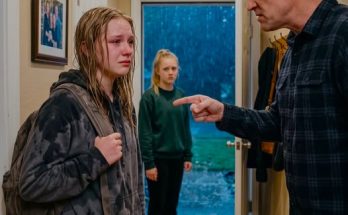
When I woke again, my father was standing near the door.
He turned as soon as he heard me move.
"Sorry. I didn't mean to wake you."
"You didn't."
He came back to the chair.
For a moment, I thought he was going to ask whether I was ready to leave.
He didn't.
Instead, he asked whether I wanted some water.
I nodded.
He brought me the cup and waited while I drank.
The water was no longer cold, but I finished it anyway.
"Thanks."
He took the cup and set it down.
Neither of us spoke for a while.
I had started to recognize the difference between silence that came from anger and silence that came from not knowing what to say.
My father had used the first kind before.
Now he seemed afraid of saying the wrong thing.
I didn't want him to be afraid to speak.
I wanted him to understand that speaking meant he had to listen, too.
"Have you been home?" I asked.
He looked at me.
"No."
"Since you came here?"
"No. I've stayed here."
I glanced at the chair.
"You must be tired."
"I am."
"Why don't you go home for a while?"
He shook his head.
"Because I told you I'd stay."
I looked at him carefully.
He hadn't said it to make me feel guilty.
At least, I didn't think he had.
"You could still go get some sleep," I said.
"Would you be comfortable if I did?"
I hadn't expected him to ask.
I thought about it before answering.
"I think so."
"Then I'll make sure you have what you need before I leave."
I nodded.
He didn't get up immediately.
He waited as though he wanted to make certain I meant what I'd said.
I appreciated that he didn't turn my answer into permission to do whatever he wanted.
"Can you leave my backpack here?" I asked.
"Of course."
"And my phone?"
He glanced toward the table.
"I'll leave it right there."
I watched him for a moment.
"Don't take my things home without asking me."
His expression changed.
"I won't."
I looked down at the blanket.
It was a simple request, but I had needed to say it.
My backpack had been with me when I left the house.
It had been with me on the road.
It had been beside me when I woke up in the hospital.
I wanted to know where it was.
I wanted to know that I could reach for it without having to ask someone to return it.
My father seemed to understand that the bag meant more to me than the clothes inside.
He didn't question it.
After a while, I asked, "Did you think I'd come back that night?"
He looked at his hands.
"I thought you might."
"But you didn't know."
"No."
"You didn't know where I was."
"No."
"You didn't know if I could get somewhere safe."
He swallowed.
"No."
I stared at the folded blanket.
"Did you look outside after I left?"
He took a breath.
"I didn't go after you."
"That's not what I asked."
He looked at me.
"I looked toward the door, but I didn't follow you."
I waited for him to explain.
He didn't try to.
I could tell he wanted to say that he had been angry or that he had thought I would return.
I had heard those things already.
They hadn't changed what happened.
"I kept looking behind me," I said.
His eyes lifted.
"I thought you might be coming."
He pressed his hands together.
"I should have."
I shook my head.
"You can't keep saying what you should have done."
He stopped.
"I need you to understand what you did."
"I do."
"Then don't make it about what you wish you'd done instead."
He sat quietly.
I wasn't certain whether my words had reached him.
I was certain I couldn't make them any clearer.
After a while, he said, "I sent you out without knowing whether you'd be safe."
I looked at him.
"Yes."
"I didn't ask where you would go."
"No."
"I didn't ask you to explain what Lydia had said."
"No."
"And I didn't come after you."
I nodded.
He looked down again.
"I understand why you're angry."
I didn't answer.
Understanding why I was angry was not the same as knowing how to keep it from happening again.
Still, it was the first time he had described his actions without making the argument sound like something we had both done to each other.
I let the quiet settle.
Later, my father asked whether I wanted him to contact anyone for me.
I said no.
He accepted the answer.
He asked whether I wanted my phone closer.
I said yes.
He moved it to the table within reach.
Then he asked whether I wanted the coat brought back.
I shook my head.
"Not yet."
"All right."
I could see that he wanted to help.
I was beginning to understand that he could want to help and still need to wait for me to tell him how.
That had not been true in our hallway.
There, he had decided what I was allowed to take and where I was allowed to go.
Now he was asking.
I didn't mistake the difference for a solution.
But I noticed it.
My father stood after a while and looked at the door.
"I should go home for a little while," he said. "You said you thought you'd be okay."
I nodded.
"I'll be okay."
"If that changes, you can tell someone here."
"I know."
"And I'll come back."
I looked at him.
"Are you asking me to trust that?"
He stopped.
"No. I'm telling you what I'm going to do."
That answer made more sense to me.
I didn't have to decide whether I trusted him.
I could wait and see whether he returned.
"Okay," I said.
He picked up his phone and put it in his pocket.
Then he looked at the backpack.
"Do you need anything before I go?"
"No."
He hesitated.
"I'll see you later, Emma."
"Okay."
He didn't ask me to say I loved him.
He didn't ask me to forgive him.
He left the backpack where it was and walked out.
I listened to his footsteps fade.
The room felt different without him.
I was alone, but I wasn't outside.
I had a bed, a blanket, water, and people nearby if I needed help.
I didn't have to walk anywhere.
I didn't have to keep searching the road for a familiar car.
I sat quietly and looked at my backpack.
Then I pulled out the algebra worksheet.
The three unfinished problems were still there.
I turned the paper over and looked at the blank side.
For a moment, I thought about writing down everything I wanted my father to understand.
I didn't.
I folded the worksheet and returned it to the pocket.
I didn't need to turn it into a list.
I had already told him what mattered.
Now I needed time to see what he would do with it.
Click here to continue reading: PART 18: When My Father Returned, He Didn’t Ask Me to Pretend the Night Was Over, and That Small Difference Stayed With Me
My Father Had Already Decided I Was Guilty Before I Could Explain What Was Inside My Backpack
Part 17 of 20