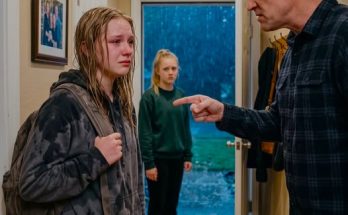
The first time I thought about sitting down, I was still angry enough to believe I could get through the night.
My feet hurt.
Water had worked its way into my shoes, and every step made the wet fabric rub against my toes.
I shifted my backpack from one shoulder to the other.
Neither side felt better.
The rain kept coming.
I tried to walk faster, but the pavement was slick, and I couldn't see far ahead through the water.
Cars passed without slowing.
Their tires hissed against the road.
I watched their taillights disappear, then looked behind me for another set of headlights.
I knew my father wasn't likely to be there.
I looked anyway.
I had spent my whole life believing he would come looking for me if I was in trouble.
When I was little, he used to wait in the driveway when I walked home from a neighbor's house after dark.
He would stand beside his car with his arms folded, pretending he was annoyed that I had taken so long.
Then he would ask whether I had enjoyed myself.
I remembered those evenings because I was trying to understand how the same man could leave me outside in the rain.
I didn't have an answer.
I only had the road.
After another stretch of walking, my hands began to shake.
At first, I pressed them against my sides.
Then I curled my fingers into my palms and tried to keep them still.
It didn't help.
The cold had moved beyond my clothes.
It felt as if it had settled somewhere inside my body, where I couldn't reach it or push it away.
I kept telling myself I needed to find a phone.
That was a practical problem.
Practical problems could be solved.
I could knock on a door.
I could find a business that was still open.
I could ask someone to call my father and tell him I needed to come home.
I repeated those possibilities in my head because thinking about the other possibility was worse.
What if he refused?
What if I reached someone who called him, and he told them to leave me alone?
I couldn't make myself consider what I would do then.
I was fifteen.
I had never spent a night away from home without an adult knowing where I was.
I had never needed to decide where I would sleep.
I had never thought about how a person found help when the person who was supposed to protect her was the one who had sent her away.
The road curved.
I followed it.
A passing truck sent water across the edge of the pavement, splashing my shoes and the bottom of my jeans.
I flinched and stepped farther from the road.
My backpack bumped against my hip.
I caught it with one hand.
For a moment, I thought about opening it and checking that my things were still there.
The idea seemed ridiculous.
Of course they were there.
I'd packed them myself.
Still, I wanted something I could verify.
Something that hadn't changed because another person had decided I was guilty.
I kept walking.
By the second mile, the shaking had become harder to control.
My fingers felt thick and clumsy.
When I tried to tighten the backpack strap, I couldn't get a good grip on it.
I used both hands.
The movement took longer than it should have.
I told myself I was tired.
That was all.
I had walked farther than I usually did after school, and the weather was miserable.
Anyone would be tired.
I could keep going.
I had to keep going.
I began looking at the ground because watching the traffic made my head feel strange.
The white lines along the road blurred whenever I lifted my eyes.
I blinked several times.
The picture cleared, then softened again.
I stopped beside a patch of grass and tried to take a deeper breath.
My lungs felt tight.
Rain ran down my face and collected beneath my chin.
I wiped it away with the sleeve of my sweatshirt.
My sleeve was completely wet.
I stared at it for a moment, as though that discovery required an explanation.
Then I started walking again.
I don't remember exactly when the fear became stronger than the anger.
It happened somewhere along that road, without a clear moment I could point to afterward.
I realized I had no idea how far I was from home.
I didn't know the nearest street name.
I couldn't check a map.
I couldn't call anyone.
My phone was still in the house, probably lying where I had left it earlier that evening.
I pictured its screen lighting up with a message from a friend.
I pictured nobody knowing I was gone.
I pictured my father sitting inside, convinced that he had solved a problem by sending me away.
The thoughts made me walk faster.
Then my legs began to feel heavy.
I slowed down.
I told myself I could stop for a minute once I found a place with shelter.
I searched the roadside for an overhang, a bus shelter, or even a building entrance where I might get out of the rain.
I didn't see anything close enough to reach easily.
The traffic continued.
The sky had darkened, and the road seemed longer than it had earlier.
I was no longer sure how much time had passed.
My watch was inside my backpack, but my fingers were too stiff to manage the zipper properly.
I tried once.
The zipper caught.
I tried again and gave up.
I didn't need to know the time.
I needed to get somewhere warm.
That was all that mattered.
I began thinking about my bedroom.
The blanket on my bed.
The small lamp on my desk.
The worksheet I'd left unfinished.
I could picture the exact place where I had stopped working.
I had been sitting with one knee tucked under me, tapping my pencil against the paper because I couldn't solve the last few problems.
I'd planned to finish them after dinner.
Instead, I'd been sent outside to prove I could survive without the things I'd always taken for granted.
The thought made my throat tighten.
I wanted to cry, but my face already felt wet, and I couldn't tell whether the rain was hiding the tears.
I wasn't ashamed of crying.
I was ashamed that I still wanted my father to come for me.
Even after everything he had said, I kept hoping he would change his mind.
Looking back, that hope was difficult to admit.
I had spent the evening asking him to trust me, and when he refused, I had continued to measure every passing car against the possibility that he might appear.
I wasn't ready to accept what his decision meant.
Not yet.
I kept walking.
At some point, I stumbled.
My foot caught on an uneven section of pavement, and I pitched forward far enough to throw out my hands.
My palms struck the ground.
Pain shot through them.
I stayed bent over for a few seconds, trying to catch my breath.
Then I straightened up.
The road tilted slightly when I looked at it.
I blinked hard.
It was probably because I was exhausted.
I had to be exhausted.
I took another step.
Then another.
I remember thinking that if I could just find a place to sit, I would feel better.
The thought seemed reasonable.
My legs were trembling, and my knees felt unreliable.
I could rest for a few minutes and then continue.
I could stand up again.
I had been walking for miles, and surely that meant I was close to somewhere.
I didn't know that my judgment was becoming less dependable.
I didn't know how much trouble my body was having keeping up with what I demanded of it.
I only knew I was tired.
The rain struck the top of my head and ran down the back of my neck.
I pulled the backpack closer.
The weight of it had become uncomfortable, but I couldn't bring myself to set it down.
Everything I had with me was inside that bag.
Not much.
A few clothes.
Schoolwork.
The algebra worksheet with the blank answers.
It was strange that I cared about it so much.
I wasn't thinking about grades anymore.
I wasn't thinking about my teacher or whether I would have to explain missing class.
I was thinking about the fact that I had been working on it in my own room only hours earlier.
That paper belonged to a life in which I had a home to return to.
I held it close without taking it out.
Another set of headlights approached.
I turned toward the road.
For a second, I thought the car was slowing.
It wasn't.
The tires sent a low rush of water along the pavement, and the vehicle disappeared into the darkness.
I stood watching the empty road.
Then I realized I had been holding my breath.
I let it out slowly.
My hands shook harder.
I rubbed them together, but I could barely feel the friction.
I tried to make a fist.
My fingers moved only partway.
That frightened me.
I had thought being cold meant shivering and wanting a blanket.
I hadn't understood that there could be a point when the cold made ordinary things difficult, when your own hands stopped responding the way you expected.
I looked around for somewhere to go.
The road seemed empty.
The nearest lights were far ahead.
I could not tell whether they belonged to a house or a business.
I started toward them.
Every step required more effort than the one before.
My backpack dragged against my shoulder.
I pulled the strap higher, but my fingers slipped.
The bag slid down again.
I let it stay there.
I was too tired to fix it.
I kept telling myself I only needed to reach the lights.
Once I got there, I could ask for help.
Someone would understand.
Someone would see that I was a child standing in the rain without a coat and ask what had happened.
I would tell them the truth.
I would tell them my name.
I would tell them where I lived.
And maybe, finally, someone would believe me.
I took another step.
Then my knee buckled.
I caught myself before I fell, but the effort left me breathless.
I stood still, leaning forward with my hands on my thighs.
The rain struck the back of my neck.
I tried to straighten.
My legs trembled beneath me.
I told myself to move.
I could not seem to make them obey.
For the first time that night, I wasn't thinking about how to get home.
I was thinking about whether I could remain standing.
That frightened me more than anything Lydia had said.
Click here to continue reading: PART 3: The Roadside Was Empty Except for Passing Cars, and I Was Beginning to Lose the Strength to Ask Anyone for Help
My Father Had Already Decided I Was Guilty Before I Could Explain What Was Inside My Backpack
Part 2 of 20