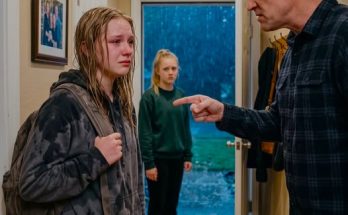
I don't remember the exact moment I fell.
I remember trying to take another step.
I remember the road shining beneath the headlights of an approaching car.
I remember thinking I needed to move farther from the pavement.
Then my legs gave way.
My backpack slipped from my shoulder as I went down.
I tried to catch myself, but my hands landed awkwardly, and one side of my face struck the gravel.
There was a sharp scrape against my cheek.
For a moment, I could still hear the traffic.
I tried to push myself up.
My arms shook.
I couldn't get my knees beneath me.
I tried again.
Nothing happened the way I wanted it to.
The backpack lay beside me, its front pocket pressed against the wet ground.
I reached for it.
I don't know why.
Maybe I was afraid someone would take it.
Maybe I wanted to hold something familiar.
Maybe I simply needed to believe there was still something I could control.
My fingers caught the strap.
I pulled the bag toward my chest.
Then I lay still, trying to understand why getting up had become impossible.
I had been cold before.
I had been tired before.
This was different.
The sounds around me seemed distant, as if the traffic had moved to the other side of a thick wall.
I could see headlights passing, but I couldn't make myself focus on them.
I wanted to shout.
I wanted to ask someone to stop.
When I opened my mouth, I couldn't get the words out properly.
I remember thinking about my father.
Not what he had said.
Not Lydia.
I thought about the front door and the lock turning after I stepped onto the porch.
I wondered whether he had gone back to the living room.
I wondered whether he had told Lydia that I was finally out of his way.
Then I wondered whether he would notice if I never came home.
That was the last clear thought I remember having beside the road.
After that, the night broke into fragments.
A bright light.
A voice calling from somewhere above me.
Someone telling me not to move.
Hands near my shoulder.
I couldn't tell who was speaking.
I couldn't answer the questions I heard.
I knew someone was there, but I couldn't make my body respond.
Then even those fragments disappeared.
I learned later that a driver had noticed me lying near the road.
The driver stopped and called for help.
I don't remember the person who found me, and I can't describe the vehicle.
I only know that someone saw a girl on the ground and understood she needed help.
By then, I had been away from home for hours.
I had walked nearly four miles without a coat, a phone, or any money.
My clothes were soaked.
My cheek had been scraped by the gravel.
My backpack was beside me, and I was still holding part of its strap when the people who came to help tried to move me.
I don't know whether I had been clutching it deliberately or whether my hand had simply closed around it.
I don't remember letting go.
The next thing I knew, I was aware of a different kind of light.
It wasn't the glare of passing headlights.
It was pale and steady, shining above me.
I tried to open my eyes.
They felt heavy.
I managed to lift my eyelids for a moment, then closed them again.
Voices moved around me.
I could hear them, but the words seemed to run together.
Someone asked me a question.
I tried to answer.
My throat felt dry, and the sound that came out was barely recognizable as my own voice.
I wanted to ask where I was.
I wanted to ask whether I could go home.
I wanted to explain that I hadn't done what my father believed I had done.
But I couldn't arrange the words.
The effort made me tired.
I slipped away again.
When I became aware of the room a second time, I heard a man speaking in a calm, deliberate voice.
He asked whether I could tell him my name.
I tried.
“Emma.”
It came out quietly.
He leaned closer.
“Emma Collins?”
I moved my head a little.
That was all I could manage.
I heard him repeat my name to someone else.
The sound of it was strange.
I was used to hearing my name called from the kitchen or across the house.
Here, it was being used to identify me to people who didn't know me.
I opened my eyes again.
I couldn't take in much.
The light above me blurred at the edges.
I tried to look around, but my head felt heavy, and I stopped.
Someone told me I was safe.
I wanted to believe that.
I didn't know what safe meant anymore.
I remembered the locked door.
I remembered the road.
I remembered trying to make my legs move.
My chest tightened.
I began to cry, although I wasn't sure I had enough strength left to do it properly.
A voice told me I didn't have to explain anything right away.
I closed my eyes.
For the first time since leaving home, I wasn't required to make a decision.
I didn't have to find a phone.
I didn't have to choose which direction to walk.
I didn't have to convince anyone that I was telling the truth.
I could lie still.
I could let other people take care of the things I couldn't manage.
That should have been a relief.
It was, a little.
But I was also frightened because I didn't know what would happen when someone contacted my father.
I knew he would eventually be told where I was.
I couldn't imagine what he would say.
Would he still be angry?
Would he tell them I had caused trouble?
Would he explain that I had left home by choice?
I had no way to know.
I only knew that I didn't want to hear his voice while I was lying there unable to sit up.
I turned my face slightly away from the light.
The scrape on my cheek stung.
I thought about the backpack again.
I wanted to make sure it was nearby.
I couldn't see it.
I tried to lift one hand, but it felt too heavy.
I let it fall back.
A person beside me noticed the movement and asked whether something was hurting.
I couldn't explain.
The truth was that everything felt wrong.
My body hurt in ways I couldn't name.
My thoughts came and went.
I was ashamed of needing help, though I had done nothing to deserve that shame.
I was afraid of what my father would think when he learned how far I had walked.
I was afraid he would see my condition as proof that I had made a foolish choice rather than proof that I had needed somewhere safe to go.
Even then, I was still trying to predict his judgment.
I had been raised to care about it.
That habit didn't disappear just because he had put me outside.
Time passed without making much sense to me.
I heard footsteps.
A door opened and closed.
Someone asked for information about me.
I heard my name again.
Then there was a pause, followed by the sound of a telephone.
I didn't know who was making the call.
I couldn't follow the conversation.
I only remember that the person speaking became more serious when he said my age.
Fifteen.
The word seemed to change the room.
I wasn't simply someone who had been found beside a road.
I was a child.
Someone's daughter.
Someone who should have had an adult looking after her.
I didn't hear every word that followed.
But I heard enough to understand that they were trying to reach my father.
My stomach tightened.
I wanted to tell them not to call him yet.
I wanted to ask for another hour, or ten minutes, or however long it would take me to become strong enough to explain everything myself.
I didn't know how to ask.
And even if I had managed it, I wasn't sure anyone would have agreed.
My father was the person they needed to contact.
He was my parent.
That fact remained true even after he had sent me away.
I turned my head back toward the light.
I tried to keep my eyes open.
I told myself I could explain once he arrived.
I could tell him what had happened on the porch.
I could tell him there had been nothing in my bag except clothes and schoolwork.
I could show him the algebra worksheet.
The idea seemed important.
If he saw it, perhaps he would remember that I had been doing homework before the argument started.
Perhaps he would understand how ordinary my evening had been.
Perhaps he would finally ask me what really happened.
I held on to that possibility because I had nothing else.
Then exhaustion pulled me under again.
I didn't know what my father was doing at that moment.
I didn't know whether he had started to worry.
I didn't know whether Lydia had told him anything more.
I didn't know that the call would force him to consider questions he hadn't asked before sending me out into the storm.
I only knew that I had been found.
I was no longer alone beside the road.
Someone had stopped.
Someone had called for help.
And somewhere beyond the room where I lay, an adult was being asked to explain why a fifteen-year-old girl had been outside in the rain without the most basic things she needed.
Click here to continue reading: PART 4: The Officer Asked My Father About My Coat and My Phone, and the Answers He Gave Became Harder to Defend
My Father Had Already Decided I Was Guilty Before I Could Explain What Was Inside My Backpack
Part 3 of 20