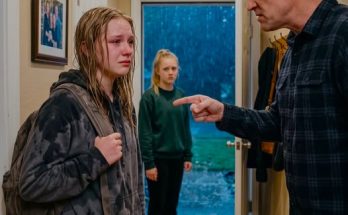
“Dad, please let me explain.”
I said it twice.
The first time, he kept staring at me.
The second time, he pointed at the front door.
“I said get out, Emma.”
I was fifteen years old, standing in our living room with my backpack hanging from one shoulder, trying to understand how an ordinary evening had turned into something I couldn't take back.
Rain tapped against the windows.
The television was still on in the next room, low enough that I could hear the weather report but not make out the words.
My father, Daniel Collins, stood between me and the hallway.
His face looked unfamiliar.
Not because he was shouting.
Because he had stopped looking at me as if I were his daughter.
Lydia was behind him.
She wasn't crying anymore.
That should have made me suspicious of how quickly everything had happened, but I was too busy trying to save myself.
She had accused me of having drugs.
I had no idea why she had chosen that accusation, and I had no idea what she expected to happen after she made it.
I knew one thing.
There were no drugs in my backpack.
There were no drugs in my bedroom.
There was nothing in my possession that could explain why my father was looking at me with disgust.
“Check my bag,” I said.
He shook his head.
“Don't stand there and insult me.”
“I'm not insulting you. Just look.”
“Lydia told me what she saw.”
I looked past him at her.
She lowered her eyes.
That small movement bothered me even then, although I couldn't have explained why.
“Dad, she's wrong.”
“Enough.”
One word.
He delivered it so sharply that I stopped talking.
Looking back, I still remember the silence that followed more clearly than his shouting.
I had grown up believing that if something went wrong, I could tell my father the truth and he would at least listen.
He might be angry.
He might punish me.
But he would ask questions.
That evening, he didn't ask a single one.
He didn't ask where the drugs supposedly came from.
He didn't ask why I would have them.
He didn't even ask me to empty my pockets.
He had already decided what kind of person I was.
And once he made that decision, everything I said sounded like another lie.
“Go upstairs and get your things,” he ordered.
I stared at him.
“My things?”
“You heard me.”
“But it's raining.”
“Then you should have thought about that before you did whatever you did.”
I wanted to tell him I hadn't done anything.
I wanted to scream that he was making a terrible mistake.
Instead, I stood there holding the strap of my backpack so tightly that my fingers began to hurt.
I was afraid.
That was the first feeling I recognized.
The second was embarrassment.
I couldn't believe my father was doing this while Lydia watched.
Some part of me still expected him to notice my face, hear the tremor in my voice, and realize I was telling the truth.
He didn't.
I went upstairs because he told me to.
My bedroom looked exactly as it had that morning.
The bed was unmade.
My schoolbooks sat in a crooked stack beside the desk.
A pair of socks lay near the laundry basket, where I had missed my shot the night before.
Nothing about the room looked like the place of someone who had committed the terrible thing Lydia described.
I pulled a few clothes from a drawer and pushed them into my backpack.
I didn't know where I was going.
I didn't know whether I would be allowed back inside.
I didn't know how long my father intended to keep me away.
I only knew that if I argued with him again, he might become angrier.
So I packed.
A sweatshirt.
Two shirts.
A pair of jeans.
Some underwear.
My school notebook.
The algebra worksheet I'd been working on before dinner.
It was unfinished.
I had left several problems blank because I couldn't work out the last steps, and my teacher had written a small note in the corner reminding me to show my calculations.
I almost left it on the desk.
Then I folded it and slipped it into the front pocket of my backpack.
It was such a normal thing to do.
I was still a student.
I still had homework.
I still had a class to attend the next morning.
I didn't understand how quickly those ordinary parts of my life were about to become distant.
When I came downstairs, my father was waiting near the door.
Lydia stood by the sofa.
Neither of them offered to help me.
I glanced toward the coat rack.
My jacket hung from its usual hook.
I reached for it.
“Leave it,” Dad said.
I turned around.
“It's cold outside.”
“Maybe being uncomfortable will teach you something.”
I stared at him, waiting for the sentence to change into something less cruel.
It didn't.
“Please, Dad.”
He opened the front door.
Cold air rushed into the house, carrying the smell of wet pavement and fallen leaves.
Rain blew across the porch.
“I am not having this discussion again.”
I could have refused to move.
I could have planted my feet and demanded that he check the backpack before making me leave.
But I was fifteen, and he was my father.
I still believed that if I obeyed him, there might be a way to fix what had happened.
I stepped outside.
My sneakers touched the wet concrete.
I turned back almost immediately.
He was already pulling the door shut.
“Dad?”
He looked at me through the narrowing gap.
For one brief second, I thought he might reconsider.
Then the door closed.
The lock turned.
I stood there listening to the sound of it.
A deadbolt wasn't supposed to mean anything beyond keeping strangers outside.
That night, it meant my own home had become a place I wasn't permitted to enter.
I waited.
I told myself he needed a few minutes to calm down.
Maybe he would open the door and ask me to come inside.
Maybe he would tell Lydia to leave us alone so we could talk.
Maybe he would finally ask me to show him the contents of my backpack.
I counted the minutes without meaning to.
One.
Two.
Five.
The porch light cast a pale circle across the steps.
Rain collected along the edge of the roof and fell in steady streams.
I could hear movement inside the house, but I couldn't tell who was moving or where they were going.
I knocked once.
“Dad, I'm outside.”
No answer.
I knocked again, harder.
“Please open the door.”
Nothing.
I pressed my forehead against the wood.
The door felt cold.
I had never thought about how a locked door could make a person feel so completely alone.
Eventually, I stepped away from it.
I looked down at my clothes.
My sweatshirt was already damp.
My jeans were getting wet around the knees, and the canvas on my sneakers had darkened where the rain struck them.
I had no coat.
My phone was still inside.
I had no money in my pockets.
I hadn't thought to take any because I hadn't been preparing to leave home.
I'd been preparing to finish my homework.
That was the part I couldn't get past.
A few hours earlier, my biggest problem had been algebra.
Now I was standing outside in October weather, with nowhere to go and no way to contact anyone.
I looked at the front window one last time.
The curtains were drawn.
I couldn't see Lydia.
I couldn't see my father.
I couldn't even tell whether they were watching me.
I turned toward the sidewalk.
At first, I walked slowly.
I thought about going to the nearest house and asking to use a phone, but I didn't know the people who lived there.
I imagined having to explain why a fifteen-year-old girl was knocking on a stranger's door after dark, soaked through and carrying a school backpack.
I imagined them calling my father.
I imagined him telling them the same thing he had told me.
That I was a liar.
That I had brought this on myself.
I kept walking.
The rain grew heavier.
I pulled my backpack closer to my chest and tucked my chin into my sweatshirt.
The strap rubbed against my neck.
My hands were already cold enough that I had trouble adjusting it.
I tried to think of somewhere I could go.
There was nowhere obvious.
I had friends at school, but I didn't know their home addresses by heart.
Even if I did, I couldn't be sure anyone would answer the door.
I could go back to the house.
The thought came and went.
I could knock again.
I could apologize for something I hadn't done.
I could promise my father anything if it meant he would let me sleep in my own bed.
But I had already knocked.
He had heard me.
He had chosen not to open the door.
I kept moving because standing still made the cold worse.
After a while, the neighborhood began to look unfamiliar.
The houses stood farther apart.
The sidewalks narrowed, and the road carried more traffic.
Headlights passed through the rain in long, blurry streaks.
Every time a car approached, I looked toward it.
I didn't know what I expected.
Perhaps I thought my father would suddenly appear, pull over, and tell me to get in.
Perhaps I thought he would recognize how far I had gone and realize he had made a mistake.
I watched every vehicle anyway.
None of them stopped.
By the time I had walked for about a mile, my anger was beginning to fade.
There was nothing satisfying about being right when I was cold, wet, and alone.
I didn't want my father to suffer.
I didn't want Lydia to be punished.
I wanted someone to ask me what had actually happened.
I wanted to sit somewhere warm and explain myself without being interrupted.
Most of all, I wanted to go home.
But the road stretched ahead of me, and the house behind me remained locked.
I adjusted the backpack against my chest.
The unfinished algebra worksheet shifted inside it.
I could feel the edge of the paper through the thin material.
I held on to that small, ordinary object as I continued walking.
I didn't know it yet, but it would be one of the few things I had left when someone finally found me.
Click here to continue reading: PART 2: I Kept Looking for My Father’s Car Until the Cold Made It Hard to Remember Why I Was Still Walking
My Father Had Already Decided I Was Guilty Before I Could Explain What Was Inside My Backpack
Part 1 of 20