Later that morning, someone came into the room to check on me.
I answered the questions I could.
When she left, my father asked whether I needed anything.
"My coat."
He looked at the chair.
"It's right there."
"I know."
I wanted to touch it.
I also wanted to leave it exactly where it was.
The coat had been ordinary before that night.
I wore it when the weather turned cold.
I tossed it over the back of a chair when I came inside.
I had never thought about what it meant to own a coat until my father told me I couldn't take it.
Now the sleeves lay folded together, and I couldn't look at them without remembering the rain.
My father followed my gaze.
"Would you like it closer?"
I nodded.
He picked it up and placed it on the bed near my feet.
Then he sat down again.
I touched the cuff.
It felt dry and familiar.
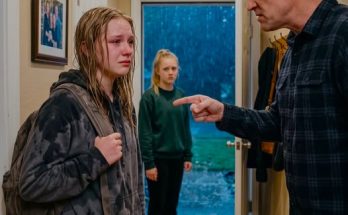
For a moment, I was back in the hallway, trying to explain myself while he stood between me and the door.
I pulled my hand away.
My father noticed.
"Do you want me to move it?"
"No."
He didn't touch it again.
I stared at the coat until the feeling passed enough for me to breathe normally.
"I used to wear this to school," I said.
"I know."
"I never thought I'd be scared of it."
He looked at the folded sleeves.
"I'm sorry."
I didn't answer.
I had heard those words so many times that they seemed to have become part of the room.
I wasn't saying they meant nothing.
I just couldn't make them mean enough.
My phone rested on the table.
I picked it up and turned it over.
The screen lit when I pressed the button.
There were messages waiting, but I didn't open them.
I didn't want to explain where I was.
I didn't want to answer questions about what had happened.
I didn't want to read something ordinary from someone who had no idea that my life had changed in a few minutes.
I set the phone down.
My father watched me.
"Do you need to tell anyone you're here?"
"Not right now."
"All right."
He didn't reach for the phone or ask who had messaged me.
I was grateful for that.
The silence between us had become less uncomfortable, but it wasn't comfortable yet.
I could tell he wanted to make things right.
I could also tell that he didn't know how.
I didn't know either.
"Dad?"
"Yes?"
"If we go home, what happens?"
He leaned forward.
"What do you mean?"
"What happens when we walk through the front door?"
He looked toward the window as if the answer might be there.
"We'll talk about it."
"When?"
"When you're ready."
I shook my head.
"You keep saying that."
He waited.
"I need to know whether you're going to do it again," I said. "Not whether you want me to feel better."
He looked at me for a long moment.
"No. I won't send you out like that again."
"How do you know?"
He seemed to struggle with the question.
"Because I know what happened."
"That's what you know now."
He lowered his eyes.
I continued.
"You knew I was your daughter before. You knew it was raining before. You knew I didn't have a phone before."
He nodded slowly.
"You're right."
I wanted to hear something stronger than that.
I wanted him to tell me that he had finally understood every part of it.
But I knew that asking for a perfect answer wouldn't make me safer.
What I needed was for him to stop pretending that a promise could do the work of changed behavior.
"I need you to ask me what happened," I said. "Even when you're angry."
"I will."
"And I need you to let me answer."
"I will."
"If Lydia tells you something about me, you can't just decide it's true."
He looked uncomfortable when I said her name.
"I understand."
"You have to check."
"Yes."
"And if you don't know what happened, you have to admit that you don't know."
He nodded.
"I can do that."
I looked at him.
"Can you?"
He didn't rush to answer.
"I should have done it that night," he said. "I didn't, and I can't ask you to trust me just because I'm saying it now."
That was closer to what I needed to hear.
I looked down at my hands.
They still seemed thinner than I remembered.
My fingers felt tired when I curled them around the blanket.
"I don't want to be afraid to come home," I said.
My father covered his mouth with one hand.
He didn't cry loudly or ask me to comfort him.
He just sat there, struggling to respond.
"I don't want you to be afraid of me," he said at last.
"Then I need you to understand why I am."
He nodded.
"I do."
I wasn't ready to tell him that I believed that.
Instead, I picked up the algebra worksheet from the backpack.
The paper had begun to dry, but one edge was still wrinkled.
I opened it on the blanket.
The same three problems waited for me.
I could see the line I had written the night before.
It was only the beginning of a solution.
I picked up the pencil and tried to work through the next step.
For a few seconds, the numbers made sense.
Then I lost track of what I was doing.
I erased a mark that didn't need erasing.
The paper tore slightly beneath the eraser.
I stopped.
My father leaned forward but didn't reach for the worksheet.
"Do you want help?"
I considered the question.
"Not with the math."
He sat back.
"Okay."
"I just wanted to see if I could do it."
"And?"
"I can't right now."
He nodded.
"That's all right."
I folded the paper along its old creases.
I wasn't sure why I kept carrying it around.
Maybe because it was the one thing in my backpack that proved I had been doing something ordinary before the accusation.
I had been sitting at home, working on algebra.
I had not been planning to leave.
I had not packed for a journey.
I had not expected to be walking along a road in the rain.
I had expected to finish my homework and go to bed.
That ordinary expectation had been taken away from me so quickly that I still couldn't fit the two versions of the evening together.
My father watched me put the worksheet back in the pocket.
"I should have asked to see your bag," he said.
"Yes."
"I should have listened."
"Yes."
"I should have let you explain."
I looked at him.
"You should have."
He nodded and said nothing else.
That was enough for the moment.
I placed my phone beside the water and pulled the coat a little closer, not because I was ready to wear it but because I wanted it within reach.
My father stayed in his chair.
We didn't settle what would happen at home.
We didn't decide what I would say to Lydia.
We didn't agree that everything could return to normal.
For the first time, we left those questions unanswered without pretending they had disappeared.
Click here to continue reading: PART 16: My Father Asked Whether I Was Ready to Leave, and I Told Him the Truth Instead of Giving Him the Answer He Wanted
My Father Had Already Decided I Was Guilty Before I Could Explain What Was Inside My Backpack
Part 15 of 20