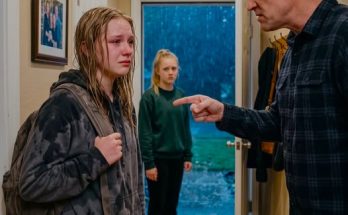
The next time I woke, my father was still in the room.
He had moved the chair closer to the wall.
His arms were folded, and his head had tilted forward.
He looked tired.
I watched him for a few seconds before he noticed I was awake.
“Hey,” he said quietly.
I nodded.
He straightened in the chair.
“How are you feeling?”
I considered the question.
I didn't know how to answer it in a way he would understand.
My cheek hurt.
My body felt weak.
My thoughts were clearer than they had been earlier, but I still had trouble following them when too many things came back at once.
I was relieved to be out of the rain.
I was frightened of going home.
I was angry with my father.
I wanted him to stay.
I wanted him to leave.
“I don't know,” I said.
He accepted the answer without pushing.
That was different.
Earlier, he had treated my refusal to agree with him as proof that I was hiding something.
Now he seemed willing to let a question remain unanswered.
I didn't know whether that meant anything yet.
He asked whether I wanted some water.
I said yes.
He brought the cup closer, and I drank slowly.
When he returned it, he looked at the backpack.
“Do you want me to put that somewhere?”
I shook my head.
“No. It's fine there.”
He left it beside the bed.
I was glad he hadn't tried to move it.
The bag had become more than something I carried to school.
It was the only thing I had taken from home that night.
It had been with me when I walked away.
It had been with me when I fell.
It had held the clothes I thought I might need and the worksheet I hadn't finished.
I didn't want it out of sight.
My father followed my gaze.
“I didn't know you had packed so little.”
I looked at him.
“I didn't know where I was going.”
He nodded.
He didn't try to argue.
I could tell he wanted to say something else, but he seemed to be choosing his words carefully.
That was new too.
I had spent years learning how to tell when he was angry.
The change in his voice.
The way he held his jaw.
The short answers that meant I should stop talking.
I hadn't spent much time learning how to recognize him when he was ashamed.
I wasn't even sure that was what I was seeing.
He might have been frightened.
He might have been upset by the hospital.
He might have been worried about what would happen next.
I couldn't know.
I had to stop pretending I could read his mind.
He looked at me for a long moment.
“I thought you would go to a friend's house.”
I frowned.
“You didn't ask me if I had somewhere to go.”
He lowered his eyes.
“No. I didn't.”
I waited for him to explain.
He didn't.
For the first time, I understood that there might not be an explanation that made his choice reasonable.
He had been angry.
He had believed Lydia.
He had wanted me out of the house.
He had acted on those feelings without considering what would happen to me afterward.
There wasn't a complicated mystery hiding behind that.
It was a series of decisions.
And he had made them.
I turned my head toward the backpack.
“Did you look inside it?”
He shook his head.
“Not yet.”
I stared at him.
“You still haven't?”
He seemed embarrassed.
“I wanted to talk to you first.”
I didn't know what to say.
He had finally come to the hospital.
He had apologized.
He had admitted that he should have listened.
Yet he still hadn't done the simple thing I had asked him to do before I left.
I couldn't decide whether that mattered more than his apology or less.
Maybe it mattered because the backpack was concrete.
It wasn't a feeling he could deny.
It wasn't an argument he could reinterpret.
He could open it.
He could look at the clothes.
He could see the notebook and the worksheet.
He could find out that the accusation had no support in anything I had carried with me.
I pulled the bag a little closer.
“Look now.”
He hesitated.
Then he leaned forward.
I watched him unzip the main compartment.
He moved the folded clothes aside.
He saw the notebook.
He saw the school papers.
He looked through the front pocket and found the algebra worksheet.
He held it up carefully.
“This is what you were working on?”
I nodded.
“Before dinner.”
He studied the page.
The pencil marks were uneven where the rain had touched them.
Three questions remained unfinished.
He looked at the blanks.
Then he looked at me.
I didn't need to say anything else.
There was no hidden object.
No evidence of what Lydia had accused me of doing.
There were only my clothes, my schoolwork, and the things I had packed because my father had ordered me to leave.
He put the worksheet back.
He didn't fold it the way I had.
He simply slipped it into the front pocket and closed the zipper.
For a moment, he kept his hand on the bag.
Then he pulled it away.
“I should have checked.”
“Yes,” I said.
He nodded.
I could see that he wanted me to say more.
Maybe he wanted me to tell him that the mistake was understandable.
Maybe he wanted me to tell him I knew he hadn't meant for me to end up in the hospital.
Maybe he wanted me to make it easier for him to forgive himself.
I couldn't do that.
Not because I wanted him to suffer.
Because I wasn't ready to pretend that what happened was smaller than it was.
He had sent me outside in a storm without knowing where I would go.
He had not checked my belongings.
He had not asked me to explain.
He had not come looking for me before someone else found me.
The police officer had been the one to tell him where I was.
I couldn't erase those facts just because my father now looked sorry.
He sat back in the chair.
“I don't know what to say.”
I looked at him.
“Neither do I.”
That answer seemed to surprise him.
Perhaps he had expected me to tell him what he needed to do next.
Perhaps he had thought that if he apologized, I would know how to make things normal again.
I didn't.
I was fifteen.
I had no idea how to repair the trust between a parent and a child when the parent had made it clear that an accusation could outweigh everything the child said.
I didn't know how to return to a house where I might be judged again without being heard.
I didn't know how to ask for help from someone who had already shown me what he could do when he was angry.
I only knew I couldn't solve those problems by myself.
My father looked toward the door.
“Do you want me to call anyone?”
I thought about the question.
I didn't know who I wanted to speak to.
I wanted my life to become ordinary again.
I wanted to finish my homework and go to school.
I wanted to stop thinking about the road.
I wanted to trust my father without having to examine every word he said.
But wanting those things didn't tell me how to get them.
“No,” I said.
He nodded.
He didn't insist.
The room grew quiet again.
I picked at a loose thread on the blanket.
My father watched me for a moment, then looked down at the floor.
I wondered whether he was thinking about the door.
I wondered whether he could still hear the lock turning in his memory.
I wondered whether he had begun to understand that the moment he closed it, he had taken away the one place I had always believed I could return to.
I couldn't ask him.
I wasn't sure I wanted to hear his answer.
Instead, I reached for the backpack and checked the front pocket myself.
The worksheet was still there.
I smoothed the folded edge with my thumb.
The paper was wrinkled, but the questions were still readable.
I didn't try to solve them.
I wasn't ready to think about algebra.
I just wanted to know that the page had survived.
My father watched me.
“Keep it,” he said.
I looked at him.
“I was going to.”
He nodded.
Then he sat quietly while I put the worksheet back in its pocket.
I didn't forgive him that morning.
I didn't tell him I hated him either.
I wasn't ready to choose a word that would decide what our relationship meant from then on.
I was still his daughter.
He was still my father.
But the way I understood those words had changed.
For the first time, I knew that being someone's child didn't guarantee they would make the right choice.
And for the first time, I knew that an apology could be real without making the hurt disappear.
I lay back against the pillow.
My father remained beside the wall, close enough that I could see him if I turned my head.
I didn't ask him to leave.
I didn't ask him to stay.
I let the quiet remain between us.
The unfinished worksheet rested inside the backpack.
The rain was no longer falling on me.
But I still didn't know whether I could go home and feel safe again.
Click here to continue reading: PART 9: My Father Wanted Us to Move Forward, but I Was Still Trying to Understand Why He Had Let Me Walk Away
My Father Had Already Decided I Was Guilty Before I Could Explain What Was Inside My Backpack
Part 8 of 20