My father stayed beside the wall until I fell asleep again.
When I woke, the chair was empty.
For a moment, I felt relieved.
Then I looked toward the door and wondered whether he had gone home.
I didn't know why that bothered me.
I had spent years wanting space whenever he was upset with me.
Now that I had a reason to be upset with him, I found myself watching for his return.
I was tired of feeling two things at once.
A nurse came in to check on me.
She spoke quietly and asked how I was feeling.
I told her I was tired.
She nodded as if that answer made sense.
I asked whether my father had left.
She told me he had stepped out for a little while.
I didn't ask where he had gone.
I looked toward my backpack instead.
The zipper was closed, and the folded algebra worksheet remained in the front pocket.
I touched the fabric near the zipper.
It was dry now.
That small detail made me feel better than it should have.
The bag had survived the walk.
So had the paper.
I was still trying to decide whether I had survived the rest of it.
When my father returned, he carried a cup of water.
He placed it where I could reach it and sat down.
Neither of us spoke at first.
Then he asked whether I remembered everything that had happened before I left the house.
I looked at him.
“Yes.”
He rubbed his hands together.
“Can you tell me again what Lydia said?”
I felt my stomach tighten.
I had expected him to ask about the road.
I had expected him to ask how long I had been outside or whether I remembered falling.
Instead, he was asking me to return to the argument that had started everything.
“She said I had drugs.”
“Did she say where?”
I shook my head.
“She didn't show you anything?”
“No.”
He looked down.
I waited for him to explain why he had believed her.
He didn't.
I could feel the old anger returning.
I had already answered these questions once.
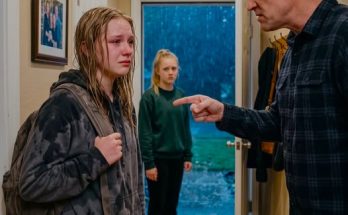
I had answered them while standing in the living room with my backpack on my shoulder.
I had answered them while my father pointed toward the door.
Now I was answering them from a hospital bed.
“I told you to check my bag,” I said.
“I know.”
“You didn't even try.”
He nodded.
“I know, Emma.”
I looked away.
I didn't want to hear my name spoken gently if nothing else was going to change.
He seemed to understand that I had reached the end of what I could say.
For a while, he remained quiet.
Then he asked whether I remembered anything after I fell.
I told him about the headlights.
I told him that I had tried to get up but couldn't.
I told him that I remembered holding on to my backpack.
I didn't describe every sensation.
Some of it was still difficult to put into words.
He listened without interrupting.
That should have been reassuring.
Instead, it made me angry that he had been capable of listening all along.
He had simply chosen not to when it mattered most.
I didn't say that aloud.
He asked whether I had been afraid.
I stared at him.
“Yes.”
He lowered his head.
I wanted him to understand that the fear hadn't begun when I collapsed.
It had started when he closed the door.
The cold came afterward.
The confusion came afterward.
The moment when I could no longer trust my legs came afterward.
But the fear had been there from the beginning, when I was still standing on the porch waiting for the lock to turn again.
I didn't know how to make him understand that without making him feel worse.
Then I realized that his feelings were not my responsibility to manage.
I had spent the entire evening trying to say things in a way he might accept.
I had softened my words.
I had repeated myself.
I had begged.
None of it had changed his decision.
I couldn't keep doing that now.
“I thought you would come back outside,” I said.
He looked up.
“I thought you would realize you were wrong.”
He opened his mouth, but I continued.
“I kept looking for your car.”
His face tightened.
“I didn't know where you were.”
“You didn't look.”
The words came out before I could stop them.
He sat very still.
I watched him absorb them.
I wasn't trying to hurt him.
But I wasn't going to take them back.
He had not looked for me before the police called.
He had not known where I was because he had made no effort to find out.
I had been the one walking through the rain, looking over my shoulder for a car that never came.
My father leaned forward.
“I should have come after you.”
I didn't answer.
It was the first time he had said something that acknowledged what I had wanted from him that night.
But I didn't know what to do with it.
If he had come after me, I might never have collapsed.
If he had opened the door, I might never have left the porch.
If he had searched the backpack, the argument might have ended before it began.
There were so many points where one different choice could have changed the evening.
I couldn't go back and choose for him.
He looked toward the bag.
“Did you really think I wouldn't believe you?”
I stared at him.
I wanted to say no.
I wanted to tell him that I had always believed he would hear me out, even when he was angry.
But the truth was more complicated.
I had known he could be stubborn.
I had known he sometimes made up his mind before hearing the whole story.
I had never believed he would send me into a storm without even checking what I was carrying.
“I didn't think you'd do that,” I said.
He nodded slowly.
“I didn't think I would either.”
I looked at him.
For the first time, he seemed to understand that the problem wasn't simply what he had believed about the accusation.
It was what he had been willing to do because he believed it.
I rested my head against the pillow.
My cheek still hurt.
I was tired of talking.
My father stood and adjusted the chair.
“I'll give you some rest.”
I didn't ask him to stay.
He moved toward the door, then paused.
“Emma, I am sorry.”
I looked at him.
He waited as if he expected me to respond.
I didn't know what he wanted me to say.
I couldn't tell him everything was fine.
I couldn't tell him I understood.
I couldn't promise that I would forgive him.
So I said nothing.
He left the room quietly.
I watched the doorway until it was empty.
Then I turned toward my backpack.
The algebra worksheet was still inside.
I wondered whether my teacher would accept it late.
The thought was so ordinary that I almost smiled.
I had been frightened I would never get home, and now I was thinking about homework again.
That was what I wanted.
Not because school was important enough to erase what had happened.
Because I wanted my life to belong to me again.
I wanted to think about things that had nothing to do with my father's anger.
I wanted to solve equations.
I wanted to complain about assignments.
I wanted to be fifteen without having to wonder whether I could survive the night if someone accused me of something I hadn't done.
I closed my eyes.
For the first time since the storm began, I stopped waiting for the sound of my father's footsteps.
Click here to continue reading: PART 10: The Questions I Had Been Too Frightened to Ask Became Harder to Avoid Once My Father Finally Sat Still and Listened
My Father Had Already Decided I Was Guilty Before I Could Explain What Was Inside My Backpack
Part 9 of 20