When I woke again, the room was brighter.
I could hear movement outside the door and the occasional sound of someone speaking in the hallway.
My father was sitting in the chair.
He looked up as soon as I moved.
“Morning,” he said.
I nodded.
I wasn't sure whether it was morning or simply a time when the lights were brighter.
I asked him what time it was.
He answered.
I tried to remember when I had last slept.
The hours wouldn't line up in my head.
I gave up.
My father asked whether I wanted breakfast.
I said I wasn't hungry.
He didn't insist.
That was another small difference between us.
Usually, when he believed something was good for me, he expected me to accept it.
Now he seemed afraid of making another decision on my behalf.
I didn't know whether that was guilt or caution.
I only knew that I appreciated being allowed to answer for myself.
After a while, he asked if I wanted to talk.
I looked at him.
“About what?”
“About what happened.”
I stared at the blanket.
“We already talked.”
“I know.”
He paused.
“But I don't think I understood everything you were trying to tell me.”
I didn't respond immediately.
Part of me wanted to believe him.
Another part remembered how many times I had tried to explain myself before he sent me away.
I couldn't pretend that one quiet conversation had repaired that.
Still, I was tired of carrying questions I had never asked.
“Why did you believe her?”
He looked down.
“I thought she was telling me the truth.”
“Why?”
He rubbed his forehead.
“I don't have a good answer.”
I waited.
He seemed uncomfortable with the silence.
“I was convinced,” he said. “I didn't stop to think about what I was doing.”
I looked at him.
“You didn't stop to think about me.”
He closed his eyes briefly.
“No. I didn't.”
I had expected him to defend himself.
Instead, he admitted it.
That didn't make the answer easier to hear.
It made it harder to avoid.
I had wanted a reason that would help me understand what had happened.
But sometimes the reason was simply that someone had made a terrible choice and hadn't thought far enough ahead to understand the consequences.
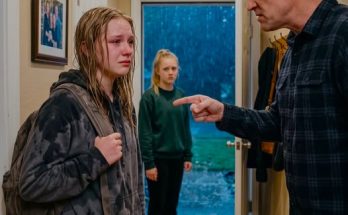
My father had believed Lydia.
He had not checked the backpack.
He had not asked me to explain.
He had not considered where I would go.
He had acted first and thought later.
I couldn't make that into something harmless.
“Did you think I was lying when I asked you to look?” I asked.
He looked at me.
“I didn't give you the chance to prove anything.”
“That isn't what I asked.”
He sat quietly.
Then he said, “Yes. I think I had already decided you were lying.”
I turned away.
I hadn't wanted him to say that.
But I had needed him to stop pretending that the argument had been a misunderstanding between two people who were equally responsible.
I had told him the truth.
He had refused to hear it.
Those were not the same actions.
My father leaned forward.
“I should have listened to you.”
I stared at the edge of the blanket.
“Yes.”
He didn't ask me to make him feel better.
He didn't tell me that all parents made mistakes.
He didn't say that I would understand when I was older.
For that moment, he let the answer stand.
I thought about the porch.
I thought about how I had stood there expecting the door to open.
I had been so certain that he would change his mind that I had wasted precious minutes waiting.
I had believed the problem was his anger.
I thought that once he calmed down, he would remember who I was.
Now I understood that anger had not been the only thing involved.
He had made a judgment about me.
And he had been willing to act on it without checking whether it was true.
“Were you going to let me stay outside all night?” I asked.
His face changed.
“I don't know.”
The answer made me feel cold again, although the room was warm.
He looked as if he wanted to explain.
“I thought you'd go to someone you knew. I thought you'd find somewhere to stay until we could talk.”
“You didn't ask if I knew anyone nearby.”
“No.”
“You didn't ask if I had money.”
“No.”
“You didn't even let me take my coat.”
He looked down.
“No.”
I had not raised my voice.
I was simply listing the things that had happened.
I wanted him to hear them without turning them into an argument.
He rubbed his palms together.
“I wasn't thinking clearly.”
I looked at him.
“I was fifteen.”
He nodded.
“I know.”
“I didn't know where to go.”
His eyes became wet, though he looked away quickly.
I had never seen him react that way to something I said.
I didn't know what it meant.
I didn't reach for him.
I didn't apologize for making him upset.
I let him sit with the truth.
He took a slow breath.
“I can't change what I did.”
“No.”
“But I can admit it was wrong.”
I watched him.
“That doesn't mean I can forget it.”
“I know.”
I wondered whether he really did.
For him, the worst part of the evening might have been the telephone call.
The moment when a police officer told him that his daughter had been found unconscious.
For me, the worst part had started long before that.
It had started when I realized that no matter how clearly I told the truth, my father might not care enough to check it.
That realization would not disappear just because he felt sorry.
I needed time.
I needed him to understand that.
“I don't know if I can trust you right now,” I said.
He nodded.
The answer seemed to hurt him.
But he didn't tell me I was being unfair.
He didn't remind me that he was my father.
He didn't demand that I forgive him because he had apologized.
He simply sat there.
I looked at the backpack.
The damp marks on the bottom were fading as the fabric dried.
I reached over and touched the front pocket.
“Everything I had was in there.”
My father followed my gaze.
“I know.”
“No. I mean everything I took because you told me to leave.”
He looked at the bag for a long time.
Then he lowered his head.
I didn't know what he was thinking.
I didn't ask.
The room grew quiet.
I realized I had been holding my breath and let it out slowly.
My father remained in the chair.
He didn't try to turn the conversation toward what I might have done differently.
He didn't ask whether I would promise to behave better.
He didn't ask me to stop being upset.
For once, the responsibility for what had happened stayed where it belonged.
With him.
I wasn't happy about that.
I didn't want to be the person who had to teach her father how to listen.
I wanted him to have known already.
But I couldn't change the past any more than he could.
I could only decide what I needed from him now.
“I need you to believe me when I tell you something,” I said.
He looked at me.
“And if you don't know whether I'm telling the truth, you ask me. You don't just decide.”
He nodded.
“I understand.”
I held his gaze.
“I need you to mean that.”
“I do.”
I wanted to believe him.
I wasn't ready to.
Those were different things too.
I leaned back against the pillow.
My body was tired, and the conversation had taken more out of me than I expected.
My father stood and moved the cup closer.
“Get some rest,” he said.
I nodded.
He sat down again.
I closed my eyes.
I didn't feel safe with him in the same way I had before.
But I no longer felt that I had to pretend everything was fine just because he was sorry.
That was a beginning.
Not forgiveness.
Not trust.
Just the truth, spoken plainly enough that neither of us could pretend it had not been said.
Click here to continue reading: PART 11: I Had Always Thought Home Was a Place I Could Return to, Until My Father Made Me Question What the Word Meant
My Father Had Already Decided I Was Guilty Before I Could Explain What Was Inside My Backpack
Part 10 of 20